Monday, May 31, 2010

About "The Ice"


Ah, The Ice. Which goes up on Book View Cafe today.

I don't have a lot of "favorite" stories. Each story pretty much is my favorite at the time of writing. Later, it has to take a back seat to the next favorite.

At the time I had discovered both ice hockey and Gordie Howe. My friend, David Smith, had taken me to a hockey game. At the time I was impressed by its speed and power but mostly because it was so beautiful. So, at age 41 I started to try to learn hockey. I never was very good but I enjoyed it.

Anybody who learns ice hockey eventually learns about Gordie Howe. Check the link. It says more than I could.

The Ice was published in 2003 and written in 2001. Dolly the Sheep was cloned in 1996. Human cloning was in the news all the time.

This was all churning in my mind so I ended up writing a Gordie Howe-Ice Hockey-Cloning story.

I sent the story to Gardner Dozois who was then editing Asimov's. He liked it and wanted to buy it but it was too long. I wrote a shorter version. Then, he wrote back he liked the earlier version and bought it-- bought it twice, for that matter, since he also picked it up for best of the year.

Go enjoy.

Sunday, May 30, 2010

Intelligence Outside Primates


(Picture from here.)

In the Will Farrel move, Land of the Lost, there's a set of scenes where the team is menaced by a T. Rex. Farrel keeps saying they don't have to worry about it because it's so stupid; it's got a brain the size of a walnut.

Later, there's a huge crash outside of the cave where they're hiding. The team comes out and sees this boulder sized object. "What is it?" says one. Says Farrel: "It's a walnut."

This describes the demise of the anthrocentric view of intelligence.

No one disputes the intelligence of us hairless monkeys. But we like to consider ourselves more than just smart apes. Wallace, Darwin's co-presenter at the initial offering of their papers on evolution, thought we were so special that we were outside of natural selection.

Well, over the years Jane Goodall and others have shown that we can find the roots of everything we do in our primate ancestors: tool using, proto-language communication, etc.

But we would expect that, wouldn't we? After all, we share more than 98% of the genetic material with chimpanzees. We only diverged a few million years ago. Jane Goodall thinks we should keep chimps in the same genus as human beings. Wouldn't our "specialness" just be redefined to be within our own little clade?

Well, it turns out: no.

Traits that are observed in animals are viewed as original or derived. Original traits are those that have arisen from the group under examination. Derived traits are those that come from the ancestral stem collection of which the examined group is a member. Hair, in mammals, is an original trait in that only mammals have it. The quality of having four limbs, however, is a derived trait that mammals inherited from their stem ancestors.

Birds derived from dinosaurs about 150 million years ago. Dinosaurs derived from reptiles about 230 million years ago. They synapsids (from which mammals originated) split from the sauropsids (from which the reptiles came) about 324 million years ago. I'd say it's a pretty safe bet that any intelligence showing up in birds came from a different ancestral origin than intelligence in, say, mammals.

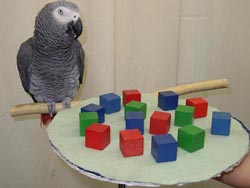
Which brings us to Irene Pepperberger's work.

Doctor Pepperberg worked with the African gray parrot Alex for many years, teaching him a vocabulary and studying how he used it. Alex was able to understand and respond to a considerable range of questions, behavior, make demands and ask questions. These were not human responses. I was able to talk with Doctor Pepperberger some years ago at Boskone. The films she showed of Alex were truly remarkable. Not because of the symbolic reasoning and abstract perception that Alex was showing, but because how far from human they were. Alex was a wonderful bird. But his reasoning, from my quick observation of the films, was not a human reasoning. If you watch chimps and gorillas execute similar tasks the way they respond is eerily human.

Pepperberg's work is made even more interesting with the work done on crows. Crows have been shown to use tools to gather food in the file. Raves have been shown to use logic in solving problems. In this experiment, the ravens were given a complex task to complete. This is not the interesting part. Many animals can be trained to execute complex tasks. These ravens were given the task to figure out for the first time. They observed the situation and figured it out.

So: we see intelligence in birds. The next question is what are they using to execute intelligence?

Remember, mammals use the cerebral cortex for intellectual pursuits. But the cortex evolved in mammals after they split from reptiles. Therefore, intelligence in birds cannot use the same mechanism. Evolution of the brain is (roughly) in three parts: reptilian, paleomammalian and neomammalian structures. (See here.) The cortex is a neomammalian structure.

Therefore, birds cannot be using the same mechanism as humans. Which shouldn't surprise anyone. We have to use a big sweaty cortex to get things done. Birds do the same thing with something the size of your thumb.

Makes you think differently about dinosaur behavior, doesn't it?

I asked Doctor Pepperberg about this and she thought the structures of intelligence might be originating from the tectum. In non-mammalians it serves as the main visual area of the brain. The development of the mammalian cortex arises out of the embryonic tectum. Doctor Pepperberger also pointed out that the experiments required to demonstrate this sort of thing would be fatal to the subjects and so she wasn't interested in it.

The other component of human beings that people point to as "special" is empathy and altruism. Well, turns out birds might well be displaying these traits as well. (See here.) Research with ravens has shown that behavior remarkably like consolation between victims of aggression and the rest of the flock show up regularly.

There's a common discussion among scientists and science fiction writers about the likelihood of intelligence arising out in the universe. The word, "intelligence", here is a code word for "beings like us". Animals that build cities, engage in cooperative behavior, show up on television and litter the sky with satellites.

But "intelligence" is far broader than we first realized. Ravens, gorillas, chimpanzees, elephants, wolves, dolphins and even cephalopods have all shown themselves to solve problems, use tools and communicate in a sophisticated fashion. It seems to me that once you have a brain in place there's a selective advantage to use it that's limited only by the ability to keep it fed and full of oxygen.

That said, where humans are unique is the joining of intelligence with hands and a mysterious natural selection for more intelligence. Chimps have been chimps for a million years. Humans have advanced enormously just in the last few hundred thousand years.

Now that might be rare.
=======================================

Lies about illegal immigrants
Anti-vaccine people
Dale Peterson

Russian local globes
Modern forms of life had single origin
29 cases of evidence for macroevolution
Economics meets reality: Krugman discovers human irrationality
Effects of CO2 in oceans: 55 million years ago
Amphiumas
Honey badger
Group selection in evolution
Giant oarfish
Hacking quantum cryptography
Organ legging
Eco-friendly aircraft
Jupiter loses stripe

World's smallest houseboat
Kathi's Tiny House
Homemade globes
Soda bottles -> Polyhedra
Easel
Roast your own coffee
Altoid BBQ grill
Banana cake
Mobile veggie garden
Lifting fingerprints
Making biodiesel

Friday, May 28, 2010

True Cost of Oil


(Picture from here.)

There's an article over at Clean Technica that talks about the cost of oil vs. the cost of renewables. The article is good but it got me thinking-- never a good sign.

Anyway, I started looking for sites that analyzed the total cost of oil. Here was on that was interesting. Go look at the post. It is that author's contention that if all of the effort of protecting the oil, negotiating with the member states, etc., are factored in the yearly cost of depending on oil is 10 trillion dollars.

The US GDP is only 14 trillion and some change.

You can argue with many of the numbers. But it does seem clear that while you can't lay the Afghanistan war on the door of oil, you can and must lay the war in Iraq. We would never have gone in there had it not been for Iraq's oil, regardless of the tyranny of Hussein.

The true cost of oil is far and away much higher than the comparative cost of renewable power. And we don't end up hostage to bizarre thinking in the mid-east.

This is when it comes down to political posturing and hidden agendas. United States security is a conservative issue. They should be leading the charge.

Yet, somehow, the conservative agenda has been hijacked by strange economic forces. You would think that a technological path that points us away from being dependent on other countries would be central to a conservative ideology.

I've said it before. We need a true conservative movement with a positive ideology.
========================
Wall of Idiots
GOP crowdsourcing experiment

Thursday, May 27, 2010

What is the "Top Kill" Method?


(Picture from here.)

BP is trying to use a "Top Kill" method of stopping the leak. It may have been successful. But what is it?

Well, here's a quick guide to what it is. Enjoy.
Also, here's the link to the live video feed at the well head.


========================
Wall of Idiots
SWAT teams
Mitt Romney

Vito Fossellia
Vaccine haters foiled again
20 worst drinks in america
Peak water: 1970

Wednesday, May 26, 2010

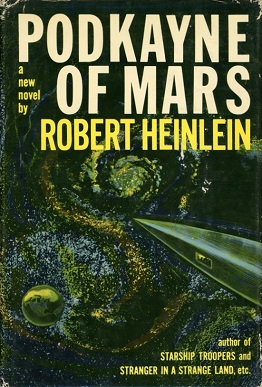
Consideration of Works Past: Podkayne of Mars


(Picture from here.)

First, let's get a few things straight. Heinlein is not God. Heinlein was a good, if pedantic writer. Like Mark Twain, he liked to pontificate in his work. Like Mark Twain, the quality of his work suffered when he indulged that predilection. Unfortunately, Twain was nine times the writer Heinlein was. Heinlein's later work degenerated into long sermons punctuated by meaningless action and pointless sex.

Podkayne is the story about a young girl about fifteen who has been raised on Mars along with her brother, Clark. Podkayne is fairly intelligent and sophisticated by Mars standards but, Mars being a frontier society, her sophistication pretty much fails outside of Mars. Her twelve year old brother Clark is considerably brighter and much less trusting. They travel towards earth in the company of her Uncle Tom ostensibly for pleasure but later it's known that Tom is on an important political trip for Mars. Things get sticky on Venus. Clark gets kidnapped. Tom gets kidnapped. Podkayne gets kidnapped. Tom is released to do their bidding. Clark develops a plan to escape. Podkayne gets trapped inside the blast perimeter of Clark's bomb.

Podkayne was written in 1962 and published, also unfortunately, in March of 1963-- eight months before the Kennedy assassination. Podkayne, as a teenager, is a late fifties early sixties girl. She wants to be a space ship captain. The pill came out in 1960. Betty Friedan's book, The Feminine Mystique, came out in 1963-- the same year Second Wave Feminism started. Consequently, any radical notions of women working in a man's world (a subtext in the book) were outdated the moment it was published and possibly before.

For example, Podkayne starts out in the beginning of the book all fired up to be a space ship's captain. Later, she admits that it's not so clear she has what it takes since her educational opportunities are limited. She considers marrying a space ship captain as a legitimate alternative to doing it herself. After all, babies are important and fun, too. She doesn't consider bettering the alternatives-- getting help from her Uncle Tom, who is an important senator, or from her possible boyfriend, who is rich beyond belief. In short, there are only two alternatives: slugging it out with a man or sleeping with him. In this, she's a fifties teenager, not the incarnation of a teen at the moment the book is written.

The ending, as published, has Podkayne in the hospital and Clark waiting for her. Clark has some hope of redemption of his sneaky and selfish ways.

Heinlein wanted the book to serve as a cautionary tale for parents that pursue their own goals at the expense of raising their children-- this is the reason for Uncle Tom's diatribe at the end of the book in the original, published ending. In his original, submitted, manuscript Podkayne died. Heinlein thought that having her die validated the rest of the book. The editors thought that killing Podkayne was a downer and had RAH change the ending. Hence, Tom's diatribe so that RAH can be sure we get the right message. RAH said that letting Podkayne live was like "revising Romeo and Juliet to let the young lovers live happily ever after." Which captures both what he thought of the required change and who he liked to compare himself at the same time.

From the tone above you can tell this isn't one of my favorite books.

First, the anti-parenting diatribe comes as a shock. There is no support for it in the book and since it's an add-on I need not respect it.

There are some interesting things going on, however. There's a racial subtext that apparently isn't obvious to a lot of people. I don't mean the obvious statements in the book. Tom is of Maori blood and is dark. Podkayne takes after the Norwegian side of the family and is blond. But there's a subtler, more interesting element. The very fact that Tom Fries is referred to as "Uncle Tom" cannot have been by accident. The scenes describing Pinhead the Venerian are reminiscent of southern white literature depicting black men as rampaging brutes. (See here.) There's also a scene where Podkayne reaches her limit and decides that she's going to plead with her Uncle Tom to do whatever it takes to save her. She's not proud but anything beats being tossed in the cage with Pinhead. RAH wasn't stupid. He knew what he was doing. It's not clear to me what he meant by this but it is clear he meant to something.

Finally, I'll weigh in on the ending controversy.

I read the 1995 version of Podkayne published in 1995. Apparently, there was an essay contest as to which ending was the best. The finalists were listed in the back of the book. Three versions of the ending were included in the book: the original, the first published version and an emended version combining the two.

Largely, the essays fell into "leave the original ending" camp. The biggest reasons seemed to be 1) because RAH wanted it that way and 2) reasons that RAH had given for wanting it that way. The pro essays were largely emotional of the "she's too nice to die" sort. The best essay was that Podkayne had to die because she was too stupid to live. RAH said

Which is close to what I would have said to RAH had he dropped Podkayne into our workshop.

Essentially, all of the essays, the editor and RAH himself were wrong though the "too stupid to live" essay was closest.

Consider the ending:
  1. Podkayne was out in the jungle with no hope of finding her way back.
  2. Clark gives her a tracker (essentially GPS) to help her find her way out. She loses it.
  3. Clark gives her a gun to take care of herself. She loses that, too.
  4. She doubles back to find a pet she'd left at the compound.
  5. She then gets lost and circles around in the blast area when Clark's bomb goes off. She dies/not dies depending on the version.
Yup. Too stupid to live.

But, like most problems in writing, the obvious solution (leave the original ending) is not the correct one.

It's not whether or not she dies that's the problem. It's the way the situation was set up. RAH set up a condition where her living or dying didn't matter. He had substituted sentimentality for pathos and by doing so made Podkayne pathetic regardless of what happened to her. It's a silly problem and both solutions are by their nature silly. The real solution is to change the problem.

Podkayne doesn't lose the tracker and doesn't lose the gun. She does turn around and goes after the pet. After all, how many pet owners have lost their lives returning to a burning building to save a cat or a dog? She gets the pet and runs outside but there wasn't time. She gets caught in the blast anyway. Perhaps she didn't figure the time well. Perhaps Clark's bomb went off early. Perhaps she bet poorly. Regardless, she was doing something she wanted to do and was caught by the blast doing it, not wandering in the wilderness like some lost and bawling calf.

Now, given that scenario her death (or life) has meaning. So, should she die?

I don't think so.

Forget all the issues of whether she's a role model or is too nice to die. That's all hogwash. What matters is artistic integrity.

For Podkayne to die is artistically sentimental. It's too easy. Podkayne doesn't get a chance to examine her life. (I submit that slogging through bog trying desperately to get away from a nuclear detonation isn't a good time for inner reflection.) She doesn't get a chance to open up her choices and decide her life. Nor does Clark. In either current version, neither gets an opportunity to look at themselves. RAH is giving us easy answers.

The last scene in the book would, of course, when Clark is there with Podkayne, her body burned and broken but with the possibility of recovery, and Podkayne wakes up.

I never liked Romeo and Juliet much, either.

Idiocy Level at Eleven


(Picture from here.)

Jesus. The idiocy level is exceptionally this week. Must be impending summer and mid-term elections.

I mean my Wall of Idiots list is huge.

I like a healthy debate. I like good arguments. I am not conservative myself by nature-- I've had too many opportunities in my life that came directly from the institutions derided by many conservatives to feel that way. But a good conservative opposition is absolutely essential to this country's well being. Any way forward out of this mess has got to be a blend of social responsibility and individual rights, intelligent investment and fiscal responsibility.

What we get is Sarah Palin: the intellectual rigor of overcooked spaghetti.

This week's crop must be led by the most egregious offenders: The Texas School Board, who voted to revise and dumb down history books.

More on it here, here, and here. Colbert was a hoot. But, of course, our greatest living journalist Jon Stewart was spot on.
====================================
Wall of Idiots
Lies about healthcare
Heartland Institute
Ocean heat increasing
Online education
American constituents
Newt Gingrich and here and here
Hawaiian Democrats
Rand Paul
John Boehner House, R-OH
Sarah Palin. As always. And here.

Monday, May 24, 2010

News from BVC


(Picture from here.)

Book View CafĂ© will be attending two major SF Cons this weekend. Lori Devoti, Nancy Jane Moore, Madeleine Robins, and Jennifer Stevenson will be present at Wiscon, held in Madison Wisconsin Friday, May 28 through Monday, May 31. Panels include: “My Big Fat Paranormal Wedding,” “Internet Publishing: The Graduate Seminar,” “A Path to Ending Women’s Fear of Men,” “The Colonialization of (Middle Class) Children,” “Research: ur doin it rong,” “Let’s Create an Online Business Model That Works,” and “Does Media SF Get a Free Pass for Scientific Illiteracy.” In addition to the panels, BVC members will be reading from their work at the all-BVC reading as well as signing books on Monday’s big Sign Out. Details and schedule here.

Also this weekend, Maya Bohnhoff will be at Baycon, Friday, May 28 through Monday, May 31 at the Hyatt Regency in Santa Clara, CA. She will be holding a writers workshop on Saturday. On Sunday she’ll be reading and signing her books as well as performing music. On Monday she will be on the Media Tie-in Fiction panel. Information on Baycon here.
==========================================
Wall of Idiots
Environmental toxins linked to ADHD
More to worry about than global warming
Breaking climate science
BP oil enters Loop Current
House GOP stops science bill

Links of Interest
Good news: Malaria may not get worse from global warming
Resveratrol and SIRT1
Musk turtle breathes through its tongue

DIY
Bamboo bike frame
Flower bike spoking