Tuesday, June 29, 2010

Book View Cafe News


Book view Café (BVC) has recently launched the ebook version of Chaz Brenchley’s urban fantasy, DEAD OF LIGHT. Published in 1995, the book was nominated by the British Fantasy Society for best novel. BVC is proud to bring the novel back into the hands of the reader. “One of the great joys of Book View Cafe is the opportunity to bring old favourites back into print. I don't think there's a book in my list that I enjoyed writing as much as "Dead of Light" and its sequel, "Light Errant…" Brenchley says.

Kudos from Val McDermid: "Brenchley is a writer who worms his way into the heads and hearts of his characters and tells their terrible, tragic truths. Dead of Light grips like superglue. Powerful, poetic and passionate, it reveals an assured and accomplished story-teller at the peak of his powers."

DEAD OF LIGHT can be purchased from the BVC bookstore here. at

Samples are on line here.

Monday, June 28, 2010

About "The Secret Lives of Fairy Tales"


The Secret Lives of Fairy Tales goes up today at the Book View Cafe.

This story grew out of a conversation I had with someone at a convention. The individual in question liked stories that gave him the proverbial "sense of wonder."

I don't read SF or fantasy for that reason. I like the real world and I like the fiction to have that same sense of verisimilitude of the real world. Or, as I like to say it to myself, some writers make the mundane fantastic; I make the fantastic mundane.

It's a gift.

I had just read some fairy tale retellings and I was struck by how they had retained the traditional disconnect between reality and fantasy even while they had placed them in urban settings, political intrigue and the bedroom. Elves were still elven. Fairies were still fairy. From what I could tell, the fairy tales were changed in setting only. It was a retelling without reimagination.

So I thought I'd give it a try.


Sunday, June 27, 2010

Diet, Jaws and Human Evolution


It's been thought for some time that human diet might have something to do with evolution. That big brain is expensive and it needs to be paid for. One idea was proposed a few years ago. It turns out that the gene for salivary amylase, an enzyme that turns starch into sugar, has a variation in humans. We have multiple copies of that gene. This means we have significantly more amylase in our saliva which means significantly more starch is predigested. Hence, more calories for less effort.

One would expect it, then, to show up in older hominids by its absence; that is, by more robust jaws and teeth.

This was an interesting sidelight to the discovery of a new human species: Homo gautengensis. This hominid emerged about 2 MYears ago and died out about 600k years go. It is a robust species with large teeth and a small brain. It produced and used stone tools and could have made fire. Likely it was a close answer but not a direct descendant.

So, we think. Big teeth. Strong jaw. Maybe it had the amylase variations. Or did it have to digest with brute force.

Not so fast, I say.

It turns out those weak humans have a mighty bite-- better than chimps or orangutans. How? You may ask.

It turns out the big jaws and tough teeth of our ancestors aren't necessarily the best way to get a good bite. A new study suggests that though we are not so heavily muscled in our jaws are efficiency in biting is considerably greater than we might have otherwise considered.

A team in Australia found that the human skull does not have to be robust because it transmitted more of the muscle force to the teeth than our relatives. The teeth are highly adapted to a strong bite with a thick enamel-- which has been a bit of anomaly since we were considered wimpy biters.

One of the interesting features of great ape anatomy is the saggital crest. This ridge of bone across the center of the top of the skull is the place were big jaw muscles attach, the other end being the jaw. Big muscles mean more force to the teeth.

However, they may also restrict increase of cranial size since that increase would have to be at the cost of those muscles.

The new study suggests that humans found another way to apply that force, reducing the need for the big jaw muscles that covered the skull-- possibly another enabling change to allow increase in brain size.

You are what your ancestors ate.

Friday, June 25, 2010

Consideration of Works Past: Bester's Demolished Man


Alfred Bester's The Demolished Man was first published as a novel in 1953. It won the first Hugo for SF's best novel.

I've discussed Bester before regarding his novel The Stars My Destination-- you can read that post here. While my enjoyment of Stars has survived into my dotage, any enjoyment of TDM has since passed.

Bester was an extremely inventive writer and what enjoyment I still get from TDM comes from that.

The story must have been interesting back in 1953. In Bester's future telepaths (called espers) are present but rare. They are useful in most areas of society and have managed to create a world where murder is rare. If a telepath can tell you're going to murder someone he can stop you. (There is some similarity to Phillip K Dick's Minority Report. MR was published in 1956 and I can't help wondering if he was inspired by TDM. But I digress.)

There is, of course, a murder. The rest of the book is attempting to play pin the murder on the suspect.

Bester wrote this book in this overheated Mickey Spillane sort of style. Put the pedal to the metal and damn the footnotes. He does something a little similar in the style of Stars but in that case the characters are much more believably larger than life. Pushing a businessman in that vein is a bit harder to take. Which, by the way, is one of the problems I have with Ayn Rand's The Fountainhead. Much as I like architects, they never seemed all that hot.

The detective, Lincoln Powell, figures out very early on that Ben Reich has committed the murder. The rest of the book is Powell trying to figure out how to prove it within the rules of prosecution. These are pretty contrived: telepathic evidence, even by a policeman, is not permissible except under circumstances, all three components of the act, method, motive and opportunity, must be proven, the judge is a machine, etc.

There are a few interesting things in the novel. Bester was ahead of his time in realizing that in the future the proof of the crime would be the most difficult part while apprehension of the criminal would become easier. There is the aspect of how a telepathic "peep" might compromise the fifth amendment-- though in his future there's not much presence of a country. Places are mentioned but without any real government or legal presence. There's the idea of "demolition", the 24th alternative to capital punishment, where the memories and personality of the individual are destroyed and only the naked brain is preserved. How this is in any way more humane than actual death is not explored.

In fact, not much that he presents of things that are in fact interesting are at all explored.

What Bester was interested in was the esper community and how they interacted. And I think here is where Bester failed. He did present the idea that telepaths would require a community of their own and that ostracism to normal humans would be catastrophic. Fine and good-- however, a much better treatment of the role of telepathy and what it would mean to the individual is in John Brunner's The Whole Man. (I spoke about TWM here.) What Bester says in his book, once you strip out the pretty type facing, is not much more than I said. Ostracism is bad. Ostracism by telepathists is worse. There is also a long and execrable subplot involving a Freudian regression of a young girl back to a baby where Powell becomes the father figure and is, of course, her love interest by the end of the book-- but the less said about that the better.

The rest of the book isn't worth much to modern eyes except where it bears on Stars.

You can see in TDM a lot of techniques that Bester tried, failed and got right in The Stars My Destination. Bester was thirty when he wrote TDM. He had written some truly brilliant short fiction. TDM was his first try at a novel. It was serialized in 1952 prior to its actual publication in 1953.

After TDM he wrote a novel called The Rat Race, of which I know nothing except the cover. Tag line: "A savage, merciless satire of the TV business."

Which makes Stars his third novel. The work shows.

So: The Demolished Man: Not a great book. Interesting for its time. Hasn't weathered well.

But it does make me want to read The Rat Race.

Thursday, June 24, 2010

Evolution and Randomness


I've talked a lot of about evolution in this blog. Now I'm going to point to someone else.

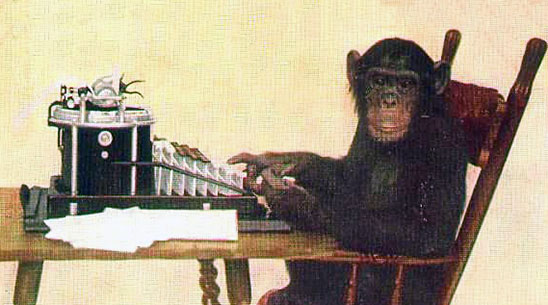
William Standsfield has written a true tour de force on how evolution works using the the old monkey chestnut: How long would it take a team of monkeys and typewriters to come up with Shakespeare?

This fallacious reasoning behind this chestnut is a common mistake in understanding evolution deniers often trot out. It's phrased: "It would take [X years/Y % probability] for this [evolutionary item of the moment] to occur randomly. Therefore, evolution can't be true."

The fallacy is, of course, evolution is anything but random.

Go read the article here. It's very good.

Wednesday, June 23, 2010

Book View Cafe News


Last Chance in Book View Café’s Extraordinary Steampunk Photo Contest

Book View Café is winding up their SHADOW CONSPIRACY Extraordinary Photo Contest next week. Selected photos will be used as illustrations in the upcoming SHADOW CONSPIRACY Vol. II. Winning entries will receive copies of THE SHADOW CONSPIRACY, Vols. I and II, as well as other ebooks from member authors.

A readers’ choice award will be announced at the blog. (Prize TBA).

Rules for the contest can be found here.

Contest ends midnight July 1st, 2010.

Friday, June 18, 2010

DIY Friday


(Picture from here.)

It's another DIY day. With additional Very Cool Things.

These projects all look fun.

Go make things.


Very Cool Things
Skeletal anatomy of cartoon characters
Catapulting flaming bowling balls
Origami masks
Virtual pottery wheel
V: Great Lego Microbiologists
1:1 plywood space vehicles
Large Hadron Collider Popup Book
V: Thomas Kuntz
Matchstick Luthier
V: Origami Hang Gliders
One Creative Thing a Day
Coat hanger gorilla
Applied Kinetic Arts

Resources
Made by Hand
Bildr
V:Adam Savage on problem solving
V: How do mecanum wheels work?
How a truss works
Useful mechanical animations
Fix It Channel

Machines
Laundry machine
Stirling engines: here, here
Tesla turbine and here
Steam engine
Bamboo bike
Lenz Turbine
Restoring a drill press
PC Fans->Wind Generators
12 V Air Conditioner
Rebuild a rear bicycle hub
Gas powered vacuum for gold prospecting
Mini charcoal furnace
Liquid nitrogen generator
Milling Machine for < $100
Solar trackers
Sewing machine -> scroll saw

Jewelry/Ornamentation
Silver Cross
Key fob
Earbud sleeve
Spark plug biplanes
Macrame bracelet
Silver ring
Jerusalem Cross

Food
Puff Pastry
Pancakes
Plum smoothies
Bread pudding
Shortbread cookies
Mexican salsa
Campfire twists
Molten chocolate baby cakes
Chewing gum
Rice krispies burger
BBQ sauce

Kitchen Equipment
Cookie cutter
Dehydrator
Glass water bottle

House
Installing a hardwood floor
Vertical wine rack
Elephant piggy bank
Hungarian shelves
Baby mobile
Ironing board
Under bed storage unit
Aquarium water change device
Shoe shelf
Chitosan bandages

Electronics
Small LED Projector
Edge lit displays
Computer control of AC devices
USB grass charging station
Home made projector
Electromagnetic assist pendulum
Solar pendulum
Twisting wire bundles
Tin can microphones
Algae powered lamp
Router -> Repeater
Synthetic aperture RADAR
Plumbing pipe lamps
Driftwood light

Garden
Drip Irrigation
Slug beer
Automated sprinkler system
Plantable greeting cards
General garden stuff
Gazebo
Coffin
Bees in a bell jar
Hero's Fountain and here

Arts and Crafts
Dog fur for spinning
Yoshimoto Cube and here
Working paper gears
Zine making
Modular kirigami
Knife