Sunday, August 22, 2010

Arms and the Animal


(Picture from here.)

I'm on vacation so I haven't been doing my part in cluttering up the blogosphere.

But: every two weeks I do an entry over at BVC. For reasons that escape me they've been all about evolution and biology.

So it goes.

Evolution is hard to understand not because the principles are difficult-- they aren't-- but because the opportunities for selection pressure and the mechanisms of adaptive response depend on past evolutionary events we may not know.

The short form: You can't understand the present organism without understanding the parent organism. You can't understand the parent organism without understanding its parent organism. The mind boggles.

But there are patterns that show up regularly.

One of these is the "evolutionary arms race". The EAR describes a situation where two sets of genes (housed in different organisms either in the same species or different species) that exert selection directly on one another.

An example came across my desk today so we'll use it.

Consider the echolocation of the bat.

Bats used different styles of echolocation to find their prey. They use a general form to find the objects they're flying around, the geography and the availability of food on the wing. When they zero in on a particular prey object the nature of their clicks change, coming faster and faster-- getting more and more accurate position updates.

Moths, one of the selected prey species, have adapted to the shift in echolocation technique. Some take evasive action or merely fall out of the air whenever they hear the clicks. Some emit their own clicks like ultrasonic chaff attempting to fool the hunter. Some moths can tell the difference between normal and targeting echolocation and only take action on hearing the shift.

Bats have adapted to their prey's adaptation. Some bats have pitch shifted, moving their frequencies above or below what their prey can detect.

A species of the European Barbastella changes the amplitude of the clicks as it homes in, making them quieter and quieter as it gets closer.

Another example of the arms race is between the common garter snake and the newt. Tetrodotoxin is the same poison in fugu-- death by respiratory paralysis. Some western newts also produce TTX-- a lot of TTX. Enough to poison all of the humans in a small room. All because garter snakes particularly like this kind of newt. The garter snake has evolved an immunity to TTX-- not a complete immunity. Just enough that a certain amount of TTX will kill it. Which means a selection opportunity for those newts making more than that certain amount. As the newt population shifts to the higher dosage it has a selection effect on the garter snake-- those that have an immunity to a higher dosage of TTX survive and those with a lesser immunity don't. Which puts the same selection pressure back on the newt.

There's a good discussion of the whole garter snake/newt process here.

There's some good fossil evidence that some sort of arms race occurred with trilobites.

The golf ball sized blue ringed octopus (Hapalochlaena maculosa) also uses TTX both for predation and protection. (I should do a blog on TTX.) It is also hypervenomous in that a bit from it can kill a human being. Pretty strong stuff for something that lives on crabs. A cursory google search didn't turn up any resistant prey or predators but I'm guessing they're out there.

Or were.

Thursday, August 19, 2010

What I Really Wanted from Writing Science Fiction

... and didn't know it until now. Rachel Bloom has it here. NSFW video.

Wednesday, August 11, 2010

Read My Lips: No New Jobs

(Picture from here.)

I read a lot of right wing propaganda.

By "propaganda" I mean what comes out of the mouths of right wing pundits, tea partiers and Goebbelian messages from the RNC. You know, things that don't manage to fully wrap around reality.

This is opposed to actual conservative dogma which has significant merits and is worthy of discussion. But that's not what I'm talking about today.

Besides the ceremonial casting out of those that don't fit the white, protestant, southern esthetic there is the drumming mantra that the right wing knows how to create jobs. Jobs is what it's all about. Remember? It's all about jobs, stupid.

Hm.

Well, the Republicans have been in charge most of the last thirty years. Let's look at their record.

The best graphic I found is the one shown above from a Washing Post article here. Condensed it is here:
  • 1940s: Democrat, 72%
  • 1950s: Mostly Republican, 51.3%
  • 1960s: Mostly Democrat, 53.1%
  • 1970s: Mixed, 38.1%
  • 1980s: Republican, 34.9%
  • 1990s: Mostly Democrat, 38.6%
  • 2000s:Mostly Republican, 17.8% (0% according to some)
I'm pretty sure we can discount the 40s since there's this little thing called Word War II and coming out of the Great Depression.

The graphic at left (found here) points out that we had two, not one but two, recessions in the last decade. The first one could be discounted as caused by 9/11 although I think it's pretty clear it was solidly in the works prior to the attack. Certainly, one could think that the attack inhibited the recovery.

The point is, though, that the economy chugged right along independent of administration. The slope of the 60s, 70s, 80s and 90s were all pretty much the same.

However, one thing happened prior to the last decade that I would argue flattened the jobs prospect.

The first was the shipping of jobs out of country. This happened for a lot of reasons which I will not debate the merits of here but regardless of why we must agree it happened. The net effect of shipping a bunch of jobs overseas is that they're not here. Consequently, they cannot be counted upon as a job growth mechanism.

If one of the basic tenets of a government is to ensure the prosperity of its populace, we have to say our government fell down on the job as evidenced in the last decade.

Given a substantial portion of the last thirty years, and certainly most of the last decade, was in the hands of the Republicans it seems they inherit a significant portion of the blame.

Will they admit it?

Never.

Will we hold their feet to the fire?

Not in my life time.

Source articles:
Huffington Post
World Net Daily
Bloomberg Business Week
The Mortgage Reports
Washington Post

Trans Siberian Railroad


(Picture from here.)

My mother died about six years ago.

Opal was a particularly interesting woman who was unfazed at being out of step with the rest of the world. In her early seventies she organized for herself a trip to Hong Kong. Once there, she decided she didn't want to deal with jet lag-- it would interfere with her plans-- so she kept to Missouri time. Hong Kong is 13 hours ahead of Missouri. So she would get up at 3 AM HK time and go to be about 3 in the afternoon-- not perfectly on Missouri time but not all that far off, either.

What she found was that many HK residents and businesses that were not tourist oriented got up about that time so she saw a side of Hong Kong life denied to those of us trying to adhere to our view of local time. She made many friends. Since no one expected an elderly American woman to keep to their time, she was made welcome.

One of her desires was to cross Russia by train on the Trans-Siberian Railway.

She didn't get there.

Had she lived, she might have been able to at least transit Russia vicariously on this site.

Maybe there's internet in the after life.

Monday, August 9, 2010

Missed Deadline

No new stories up over at Book View Cafe this week. I missed my deadline for putting stuff up.

That said, I'm going to be doing something a little different over the next few weeks.

I have some stories that will be going up that have not seen print for some time. This will include my first published stories.

I'm going to be putting up my novel, Slow Lightning, and some material that has never been published at all and only seen by a small and select few.

It will be up to the readers whether or not they deserve they light of day.

Stay tuned.

Sunday, August 8, 2010

Tooth vs. Tooth


As I've said before, I don't know why I ended up continually discussing evolution in this venue. But it's fun so I'll continue.

One of the interesting problems in evolution is capturing the change from one species to another. We are in the position of viewing a living organism as a complete picture. In actuality, what we see is the sum of all of the selection brought to bear on the ancestors of that living organism. To use the photograph metaphor, we think we're seeing a picture. What we're actually seeing is a series of transparent overlays, some of which add components, some of which change form, some of which remove components, but that the sum result is the organism before us.

A living organism is the reflection of its heritage.

It's also important to remember that each of those overlay images was itself the sum of successful ancestral selections. This means that when we look at an ancestor of an organism, we have to presume it was just as fitted to its environment as the descendant is now.

Which brings us to whales.

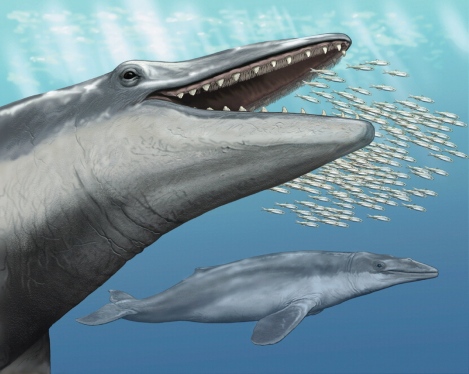
Whales (order Cetacea) are taxonomically divided into two groups: Mysticeti, the baleen whales, and Odontoceti, the toothed whales. I talked about a toothed whale monster a few weeks ago. (See here.) This time I'm going to talk baleen whales.


A good cladogram of the Cetaceans is shown here. (Article link here.) This particular cladogram shows the relationships between the different groups based on vestibular evidence. Both groups ultimately derived from Artiodactyla-- sheep, goats and the like.


A cladogram of the members of Cetaceans themselves shows the division between the Odontoceti and Mysticeti is shown here.

All of the toothed whales are presumed to have evolved after the split from Mysticeti since, after all, they have teeth, as did their ancestral Artiodactylans. Baleen whales have embryonic tooth buds but they degrade early in development.

A transitional form would have some sort of recognizable tooth as well as some sort of recognizable baleen.

Thomas Deméré and his colleagues found such a transitional form about two years ago: Aetiocetus. (Wikipedia entry here. Original article here.) Aetiocetus definitely has teeth. It also has a fringe of baleen on the upper jaw. Consequently, it is a lovely transitional form.

The nature of the transitional form informs us of a number of things.

First, the transitional form is, itself, recognizably a whale. This shows definitively that the derivation of the baleen whale happened after whales moved from land to sea and were fully adapted as toothed whales. We could likely presume that from other evidence but this fossil drives the nail in the coffin.

Second, Deméré also examined the DNA sequences of fetal Mysticete tooth buds and found that the teeth had dentin but lacked enamel. Presuming that baleen whales derived from toothed whales that had both dentin and enamel, they went looking for inactivated genes for enamel. They found such inactivated genes.

It's as nice a piece of evolutionary science as I've ever seen.

Deméré's article was brought to me by this reference.

Friday, August 6, 2010

Examining the Templeton Foundation


(Picture from here.)

It should be no surprise that someone with my views on religion would find the Templeton Foundation troubling.

Oh. Forgot for a moment. I haven't yet stated my views on religion.

From a societal position, watching the power belief demonstrates in my culture, I find it fascinating and endlessly interesting. It's a wonderful way that people have used to answer questions they find important.

From a personal point of view I couldn't be more bored. Most of the questions are those created by the religion that can only be answered by religion. A good example is one that the evangelists liked to use when I was in college: "How will you spend eternity?"

My answer was usually "Mostly dead. Some life in the near future."

The Templeton Foundation was created to fund "discoveries relating to the Big Questions of human purpose and ultimate reality."

You can probably figure out my answers right off the bat: 1) None and 2) go ask the cosmologists and physicists. 3) Give me a million dollars.

I'm still waiting for my million dollars.

TF has certainly given out its share of money on things like the "science of godly love" and "faith, rationality and the passions".

Since I don't care about the questions you might think this a no-brainer for someone like me: ignore them.

But money talks and TF has a lot of money. Billions of dollars. NIH is reducing its funding of research over time and every where university research is having troubles. That Templeton money is very tempting.

We knowresearch money tends to frame the debate just by what they choose to fund. We've seen that in drug company and governmental research already. It doesn't help that the TF is scheduled to be one of the 25 biggest foundations in a few years when the estate is fully settled.

That's the troubling part.

A very good analysis of the Templeton Foundation is here.