(Picture from
here.)
The news last week, among other things, is
Kepler-22b, a planet about 2.4 times the radius of Earth orbiting a G-type star,
Kepler-22.
Kepler-22 is about 600 light years from her. Kepler-22b appears to be orbiting in the habitable zone: the orbit around the start that gets enough sunshine to neither turn water to steam nor to freeze it utterly. It is/may/possibly be/we wish it were liquid water.
Why? Because liquid water is one of the prerequisites for our kind of life. Not that life that isn't ours isn't possible on some of the other planets found by Kepler. Just that with only a sample number of 1 we don't have much to compare it to.
We don't know the mass of the planet simply because of the way Kepler finds things. It looks for a blink in the star it's looking at to determine that something passed in front of it. Hence, we have an idea of Kepler-22b's size but not what fills it.
There's a good article over at
Life Unbounded that discusses what it
might be. It might be pure rock, pure ice, pure iron or a mix-- like our lovely home. If it
is like our planet, things are going to be much heaver. Volume, and hence mass, is a cube function not a linear one. An increase of radius of 2.4 doesn't make the mass 2.4 times earth. If Kepler-22b were only made of rock and ice, it's gravitational pull would be about 5 times earth. A mix of ice and rock gets you 10 times earth. If it were like earth the pull would be better than 40G! But for arithmetic convenience, let's postulate it is of the composition that there are only 10Gs on the surface. Your average couch potato American Super Bowl watching male will weigh 2000 pounds, not 200-- more than a Holstein or a small rhinoceros.
Let's wax speculative for a moment. Let's say mammalian life evolved on Kepler-22b. That would mean a relatively modest size animal, such as a human, would have to have skeletal and musculature systems beefed up to be comparable to cattle. It's certainly possible-- cattle do quite well. But what would that mean?
Think about land vertebrates. They would have to either evolve these load bearing structures early or they'd never get on land. Let's start with salamanders, an early land vertebrate. If you look at a salamander the arms come into the body structure at nearly right angles. Earth's really huge salamanders would have required significant musculature around the shoulders to lift themselves off the ground. Or they could have just dragged themselves around.
Now, take that ancient 200 pound salamander and make it 2000 pounds. It's not moving, dragging or otherwise. I have a strong suspicion that land based animals would have significant difficulty. Flight might well be evolutionary impossible. I suspect verticality would be problematic-- humans would be on all fours and not have much chance to develop hands.
But that line of speculation only suggests that the evolution de novo of such structures on land would be difficult. Not impossible-- living systems manage many things. Just our kind of mammalian life being so suited to the conditions that birthed would have difficulty evolving the same sort of adaptations under such heavier gravity.
But let's go to the ocean.
Two things immediately leap to mind for ocean based life on Kepler-22b. For one thing, the gravity problem drops away. Archimedes pointed out that buoyancy is a function of how much water something displaces. If you displace 1 gallon of earth water you get a buoyancy of 8 pounds. If you displace 1 gallon of Kepler-22b water you get a buoyancy of 40 pounds. Of course, there's 5 times more pressure on that empty gallon jug so it would need to be stronger. But water is incompressible. That's why fish can go up and down the water column easily.
We can presume that we have aquatic life if there is any life at all.
Pressure changes would be much more rapid. On earth, we get about 33 feet/atmosphere. That means if you go down 99 feet you are under 4 atmospheres of pressure: 1 from the surface + 3 for the depth. On Kepler-22b that would be much more rapid: 1 atmosphere every 3.3 feet. However, that's an earth atmosphere. About 14.7 psi/atmosphere. I would expect surface atmospheric pressure on Kepler-22b would be significantly greater. I don't know how much.
Regardless, the pressure gradient in the ocean would be significant. This would completely change the ecology and physiology of marine life. We know there are some pretty strange animals living down about 5000 feet. On earth, that's about 152 atmospheres. Light does not penetrate down that far so animals have two big issues to face: no photosynthesis and pressure issues.
On Kepler-22b we get the same pressure at 500 feet. Much, much closer to the surface. Many animals on earth manage quite nicely migrating from the surface down to that depth and return, though whether they'd be able to withstand the pressure gradient on Kepler-22b is open to question.
Kelp can grow as deep as 200 m-- around 180 feet. This relationship between depth and growth is purely defined by how much light is received by the organism and is independent of pressure. We can imagine that our Kepler-22b kelp beds are surviving under 56 earth atmospheres of pressure rather than a little over 5.5.
So, Kepler-22b's attempt at vertebrate life would give us some surprises. Ocean life, maybe not so much.
We can forget marine mammals, icthyosaurs, plesiosaurs, seals and sea otters. All of those animals started on land and made the return. If a land animal actually evolved and returned to the sea, it would carry with it the characteristics that made it successful on the land. Kepler-22b's dolphins aren't going to look like ours if they happened at all. There would be too much differing heritage.
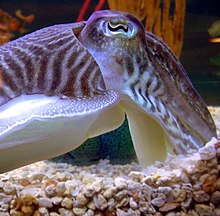
But advanced organisms can evolve in the sea. We have cuttlefish, tuna and octopuses, all of which are very bright. If/when we get to Kepler-22b we might find cultures based around them.
My money's on the cuttlefish.





 Posts
Posts

