It's odd to me John Steinbeck doesn't come up in conversation too much anymore.
When books do come up there's usually a breakdown something like this: mostly contemporary with the genre interest of the speaker showing up broadly, some books to reference the contemporary books, a few 19th century canon references such as Twain, Dickens or Kipling., the foreign book of the moment and that's about it. Sometimes there's reference to Hemingway or Lawrence or some such-- usually if a movie has been recently released. For that matter, the movies almost always dominate the conversation.
If Steinbeck does come up, one of three books are mentioned: The Grapes of Wrath, Of Mice and Men and Cannery Row. Of Mice and Men and The Grapes of Wrath fight for first place depending on the movie release schedule. The Grapes of Wrath has been read by most people who went to high school before 1990. Cannery Row comes in a distant third.
(If you liked Cannery Row, run, do not walk, to read the delightful sequel, Sweet Thursday. Don't bother with the Nick Nolte movie. It will only make you sad.)
People seem easy with Hemingway or Lawrence or Dickens or even Twain. But when Steinbeck is mentioned people look away or mumble something to show they heard but to make sure they're not understood.
And yes, I'm trying to write like Steinbeck.
Hemingway, Faulkner and the other American writers of the first half of the 20th century were kept alive in part because they were taught in high school. I don't think that's going on so much now. Shakespeare is being taught, of course. My son has not and apparently will not be taught these authors. Leave that for college, perhaps. Contemporary writers are being used in their place. I think this is a loss.
Back in the late sixties and seventies I went on a Steinbeck jag. For me this is not unusual. I get fired up by a writer and want to read everything they've ever written. (There's a post coming on the use, care and feeding of obsessions. But that day is not this day.) I read East of Eden (1952) during this period and was blown away by it. I heard music described to me once as equal parts surprise and inevitability. East of Eden shows the same can be true for a good novel.
Steinbeck used the Cain and Abel story as a model for the novel. He does this from the very first and has his characters follow the rough pattern throughout their lives. Given that the story is ubiquitous you'd think that the novel would be boring. After all, you know the end. Cain will slay Abel in some way. There is going to be a fight over the father.
Somehow this doesn't seem to matter when you're reading it. It is like the novel fulfills the original story. Rounds it out. Gives it depth and meaning.
Okay, okay. A synopsis.
Adam and Charles Trask are born half-brothers to the same father. They work out their conflict through the first half of the novel and I won't talk about that too much. If you want the full synopsis go to the wikipedia entry I listed earlier. While the goal is never in doubt the road there is twisty and I don't want to spoil it.
Regardless, it climaxes with the introduction of Cathy, a psychopath of the first order. She is found broken and bleeding on their front door. Adam doesn't see her pathology in her but to Charles it is perfectly clear. Adam falls in love with her and takes her to California to start a new life with him. She'd leave him in a moment but she's pregnant and still recovering and can't get clear just yet. After the birth and after she's strong enough, she leaves Adam with two twin boys and disappears. The boys are ultimately named Aron and Caleb. And then they play out the Cain and Abel story.
But there's a lot more to this book. Steinbeck was born in the Salinas area, descended from the Hamilton family through his mother. The story involves the Trasks and Hamiltons together-- so much so I'm not terribly sure where truth ends and fiction starts. Olive Hamilton is a character in the book. Olive Hamilton Steinbeck was John Steinbeck's mother.
East of Eden has every Steinbeck virtue and every Steinbeck flaw. The narrative is crisp and evokes the very soil and grass of all of the locations, from the Indian Wars to the Connecticut hills and finally the Salinas Valley. You can feel the clods underfoot and feel the sun on your face. The characters are lively and quick. Steinbeck had the gift of non-judgmental writing. He can write of prostitutes, criminals, violence, indolence, evil and good without making the reader terribly clear if the author thinks any of this is actually bad or good. I like that about him. He lays things out. If the reader comes to the conclusion that, say, prostitution is evil (or good) thing it's an uncomfortable discovery as there's not much in the novel to support it. Steinbeck serenely slips past judgment in the spinning of the story.
On the other hand there are times the characters think out loud to one another and at such points they all sound alike and they all sound like the same sort of discussion that happens in the narrative. This can be tedious. I like that characters work out ethical and moral dilemmas in conversation. But they don't all have to work it out in exactly the same way.
One of the things that you can love or hate about Steinbeck is that he truly loves his characters. Steinbeck is the God we wish we had. He likes us with all our foibles. We make him laugh when we dance and sing. And when he drops tribulation down on us like the Looney Tunes Ton'O'Bricks, he at least feels apologetic about it.
This sort of character affection shows up a lot in the American writing of the thirties and forties. You find it in A Tree Grows in Brooklyn by Betty Smith (1943.) The Human Comedy by William Saroyan (also 1943.) The Good Earth, Pearl S. Buck (1932.) Our Town, Thornton Wilder (1938.) Their Eyes were Watching God, Zora Neale Hurston (1937.) And, of course, anything written by John Steinbeck.
I found myself a little depressed reading the book at this stage of my life. I would have liked to have read it for the first time now instead of re-reading for the nth time. I know the story so well my mind tends to run over the good parts quickly and snag on the flaws. It's still a wonderful book but, I think, a little less wonderful now than when I first read it forty years ago.
Even so, it's still a very, very good book and a repository of craft worthy of discovery.
Sunday, December 30, 2012
Sunday, December 23, 2012
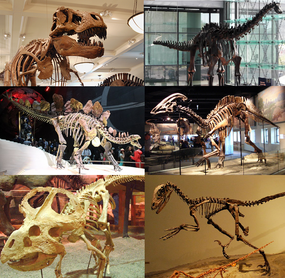
Dinosaurs: Stranger Than You Think
(Picture from here.)
I was going to put up a post on the biological necessity of government and how it was a compromise between the twin human drives of competition and cooperation. How boring is that? Instead, something better came across my desk. What could be more exciting than dinosaurs?
A few necessary ideas that lay the groundwork.
First: all existing vertebrate classes are supposed to follow a size rule: a lot of little guys, less middle guys and not very many big ones. This is true for birds, amphibians, reptiles, etc.
Second: In terms of biomass, mammals rule the roost regarding large animals. "Large" being defined as greater than a few hundred grams. There are a few big bugs but starting about the size of a shrew and going on to whales mammals are the dominant terrestrial animals. Not to say that birds, amphibians and reptiles aren't important. But we live in something called the Age of Mammals for a reason. In the water it's a different story.
Third: There's a tendency for animals to reside in a given trophic class and ecological niche. Like the pirate code, it's more of a suggestion, really, and it's far more true for terrestrial life than aquatic life. But rats tend to compete against things that are rat like. Cod compete with things that are cod like. It's not often that rats compete with cod.
Fourth: For mammals (remember we're in the Age of Mammals) and birds competition is usually between adults. Both rear their young and toss them out of the nest when they are approaching adulthood. Competition is between adults or adult equivalent, not between young. This isn't as hard and fast outside of mammals and birds. The young of cod and frogs occupy a different ecological niche than adult cod and frogs. Competition is between different species.
As you might have guessed, new data suggests that for dinosaurs It Ain't Necessarily So.
David Hone and associates at Queen Mary University have just published a paper that details aggregate sizes of adult vertebrates. (Here is the paper. Here and here are good discussions of it.) It turns out that the size distribution I described above does not hold with dinosaurs. All other classes of vertebrates skew towards few large species and many small species. Dinosaurs skew in the opposite direction: many large species, few small ones.
The article is very good and readable and I suggest you go read it in its entirety. It's not a simple statistical correlation. Theropods have a somewhat different skew than the other two groups of dinosaurs. Reptiles have a bump in the middle occupied by the crocodilians. The figure at the left is from the article. It's pretty unmistakable. Upper left is the Dinosauria. Look at all of the others. All skewed to the left except dinosaurs which are skewed to the right.
There are a lot of implications here and possible explanations of odd bits of dinosaur data. Let's explore some of these and then see how this new data fits.
One issue is how many dinosaurs there actually were. Peter Dodson and Steve Wang have a nice paper about this problem. There are, of course, all sorts of problems with any sort of diversity estimation such as bias in the fossil record, estimating the diversity at any one time versus the whole 150 million years, etc. The maximum number of genera looks to range from less than fifty to close to 250 over the duration of the dinosaurs. (From figure 2 in the article.) Compare that to the 1,229 genera of modern mammals. In addition, it's estimated that the number of species/genus in dinosaurs is about 1.2 with the vast majority of genera represented by a single species. Modern mammals have about 4 species/genus. It's clear that dinosaurs were less diverse than mammals.
Another problem is predator/prey ratios. This has been discussed in the context of whether or not dinosaurs are warm blooded or not for a long time. (See here.) Cold blooded predators have a predator/prey ratio of about 1:4. Because they're not keeping a warm body temperature they don't need to eat so much and so there can be more of them. Think crocodiles. Mammals historically have a p/p ratio of about 1:30 and modern mammals a ratio of 1/100 or even less. Dinosaurs have a ratio of 1/14. Better than crocodiles but not as good as mammals.
And, finally, there's the problem of why dinosaurs died out at the end of the Cretaceous and mammals lived.
Let's describe the scene Hone's paper suggests.
We know that a lot of large dinosaurs started out small and got bigger. The Titanosaurs might have been the largest animal to ever walk the earth but they started out about the size of a basketball or smaller. They grew fast but this was years fast, not weeks fast. So for a long time they were bumbling around in the brush just growing.
This means that they were in a different trophic level and niche than the adults. Mammals have a lot of rat equivalents eaten by cat equivalents, deer equivalents eaten by leopard equivalents. Rats are only competing with other rat equivalents. They never compete with deer. Our mammalian strategy precludes this. We're defined by the fact we nurture our young until they're ready to go out on their own. At which point the compete effectively as adults. Deer against antelope against zebra. Not zebra competing against muskrats.
This means in the case of dinosaurs that the niches we ordinarily think of as being occupied by other species can be, in fact, occupied by the juvenile of species.
We see this in any species where the young and adults are extremely different in size. The aforementioned cod, for instance. It's not surprising that larval forms can compete against other larval forms before they compete with different adult species. But on land the situation is quite different-- mostly. We do see it in crocodiles where the adult form is many many times larger than the young. Young crocodiles compete with each other and not with adults. There is some rearing in crocodiles. They protect an egg nest. A female will come in blazing if it hears a baby crocodile of distress. But it's marginal and only protects the very small. It doesn't take long for baby crocs to get big enough to compete with the adults and at that point we have a different picture. And this is not the Age of Crocodiles.
This might be a reason that the species diversity of the dinosaurs were so low compared to mammals. The ecological niches we now see occupied by many different species were occupied by the young of just a few species.
More evidence for this came from another paper that came out a year ago by Werner and Griebeler discusses how the reproductive biology of dinosaurs might drive them towards larger size. Dinosaurs had much larger litter sizes than comparable sized mammals. They show a mathematical model how this might drive the species to a larger size.
Predator/prey ratios might also come into account since they are typically calculated in terms of species-- a bias we have from our mammalian studies. It looks like dinosaurs followed a different tack. Dinosaur predators might have had a much larger prey diet of immature dinosaurs-- both their own and other species.
Finally, though their large size made them able to muddle through several previous extinctions (referring to the Werner paper mentioned above), their limited diversity made them vulnerable as a class to a very large extinction event like a meteor strike. Mammals had a lot of different species to choose from so species that were more suited to the new post-meteor world had a better shot. In addition, rearing to an adult organism meant that the young were protected by their parents beyond the point where dinosaur parents would have left them to forage. It meant not only the dinosaurs as organisms were vulnerable, the whole dinosaur ecology was vulnerable.
I love papers like this for a few reasons. For one, the way it turns our thinking on its head. We are mammals. We tend to think that the world before us was mammalian. It was not. Dinosaurs were not mammals. They didn't think like mammals. They didn't have an ecology like mammals. They didn't rear like mammals. For another it shows how science self corrects. We had an idea about dinosaurs. This paper confronts that idea. Now scientists will discuss it, poke holes in it and eventually it will be fit into the crazy quilt that is our understanding of the world.
And, finally, it shows how the world is so much more interesting and incredible than anything we could make up.
Thursday, December 20, 2012
Hacking Music: Minutiae
(Picture from here.)
A couple of people have asked why I'm so excited by what is happening in Japanese music. After all, I'm talking about changes in rhythm, use of technique-- small changes not big ones. After all, if one song is combining 3/4 and 4/4 time what difference does it make? It's a slight change in rhythm.
Good question.
We Americans like to think of revolutions as big, noisy things full of vim and vigor, sound and fury. Maybe that's an American thing since our own private little revolution took place in a war.
But the causes of revolutions are often small, unsung and unnoticed things. The PC revolution didn't start with the Apple or the IBM PC. The Altair 8800 was released in 1975. We think of the PC as the beginning of the end for large monolithic computers-- at least Apple's famous superbowl ad would have us think so. But the end of the big machines was written in the sand by the minicomputers developed in the sixties. More probably the revolution really started in 1959 with the development of the integrated circuit. That technology enabled everything else. The ubiquity of the computer could not have been predicted by the first IC-- though there was some rumblings in the SF community. But who listens to those kooks?
Similarly, while we can look back and see the roots of Baroque music in the tail end of the Renaissance the people at the time had no idea Baroque music was coming. While we can see elements of Bach in Mozart and Mozart in Beethoven, Bach could not have predicted Mozart nor Mozart, Beethoven.
It is very clear we're on the brink of interesting musical times-- have been for some time. The technology has completely exploded. Creation of music is at hand for both the amateur and professional musician-- blurring the boundary. Distribution of music is as easy as making a youtube video.
So I look for tiny clues. More polyphony. Crowdsourcing creativity. Unusual blending of rhythms. Use of enabling technology.
I'm looking for the wave front.
I might be disappointed. I don't mind. I've been there before. I can take it.
But it's always a heck of a ride.
Wednesday, December 19, 2012
Sort of an interview
Sunday, December 16, 2012
Consideration of Works Past: Shoot at the Moon
I discovered Shoot at the Moon in the late sixties. At the time I liked it all right. It had some fairly blatent female aggressive sex in it and being a young lad I think that was much of its attraction.
SATM was written by William F. Temple, a lesser British SF luminary, largely forgotten.
A quick plot: Franz Brunel is a small man with a small man's resentment of a larger world. He's a space pilot which he loves. But the invention of new atomic rockets threatens to make his expertise obsolete. He is drafted into an expedition to the moon run by an eccentric politician. The expedition will be automatic except for the take off from earth and the landing on the moon-- hence the need for Brunel.
The crew is an amazingly dysfunctional band of misfits:
SATM was written by William F. Temple, a lesser British SF luminary, largely forgotten.
A quick plot: Franz Brunel is a small man with a small man's resentment of a larger world. He's a space pilot which he loves. But the invention of new atomic rockets threatens to make his expertise obsolete. He is drafted into an expedition to the moon run by an eccentric politician. The expedition will be automatic except for the take off from earth and the landing on the moon-- hence the need for Brunel.
The crew is an amazingly dysfunctional band of misfits:
- Franz: no winner himself.
- Marley: the eccentric overbearing minister.
- Thompson: a passenger that appears to have no purpose whatsoever except to snipe at people
- Pettigue: a geologist who has been on several expeditions and has the nasty trick of being the ony survivor
- Lou: a brilliant biochemist that suffers from multiple personality disorder. Also, daughter of Marley
The book suffers from a terrible lack of focus. Is it an adventure? Is it a murder mystery? Is it a story of automation versus the worker? Redemption of a dream of adventure? Rite of passage for a man to overcome his cowardice? It tries to be all of these things and, of course, fails in them.
Brunel meets Lou as part of the process of setting up the expedition. She's slovenly, spoiled and unpleasant. When he sees her five months later she's shed the weight, worked her flab into muscle and brought her brain back on line, all because she's fallen in love with Brunel. A good chunk of the novel is the love dance between Brunel and Lou. That's the best part.
They get to the moon and discover gold-- turns out this is an obsession of Marley's. But that's not too terrible. Then people start dying and it turns into a murder mystery. The resolution of that is actually fairly good except for all the other issues that seem to have to come along with it.
There's a certain Ship of Fools aspect to the novel that I like. What can I say? I enjoy dysfunctional relationships. But the book stretches incredulity in just too many ways. One example is Thompson who, literally, has no technical role on the ship. Marley is there because it is his expedition. Pettigue is a geologist. Lou is a biochemist and Brunel is the pilot. Thompson is just there to be Lou's ex-husband and give data on her. As soon as that is accomplished, he's fodder.
SATM has a distinct resemblance to Algys Budrys' Rogue Moon. RM has a collection of misfits pursuing a strange and perhaps unobtainable goal. SATM has a collection of misfits pursuing a strange and perhaps unobtainable goal. The difference is, of course, Rogue Moon is a work of brilliance and SATM, sadly, is not. In RM the misfits, quirks and idiosyncrasies is the way Budrys is critiquing the society of 1960. SATM does no such critique.
I don't know if Temple read RM but I suspect he did. It's a little unfortunate that SATM was published in 1967. If he had managed to publish this in 1959 and there were no connection to RM it would have been seen as a bit more original.
But not a lot.
Tuesday, December 11, 2012
Things of Interest
Couple of very interesting articles came across my desk today. Here they are:
How an All Star Team capped the BP Oil Well
Crystals Made of Time
How an All Star Team capped the BP Oil Well
Crystals Made of Time
The Armageddon Letters
This year is the 50th anniversary of the Cuban Missile Crisis: the closest the world ever came to full nuclear war.
Armageddon Letters is a site describing it with letters and videos.
Be Castro is a video based on those letters and videos.
Armageddon Letters is a site describing it with letters and videos.
Be Castro is a video based on those letters and videos.
Subscribe to:
Posts (Atom)