Monday, July 21, 2014
Humanizing Technology
(Picture from here.)
I'm a big fan of technology. There are technological solutions to many of the world's issues from hunger to clean water. The problems we face are usually how to get people out of the way of solving the problem rather than the problem itself.
That said, I'm definitely not a fan of humanizing technology.
Let me be very clear. I am all in favor of making technology easy. I want getting food and clean water to be so cheap and comfortable that you'd have to spend money and effort not to get it. I want to be able to ask my computational partner, think I'd like that? And have it come back to me with a cogent answer.
But I don't want it to try to act like a human being. I'm not interested in the illusion of an experiential entity.
There's a strong pursuit of this illusion going on now. The most recent one to come across my desk is Jibo, a robotic device that is intended to integrate into a family. To act in the role of a person. (See here.)
Jibo was developed by MIT's Cynthia Breazeal with the expressed intent of becoming "part of the family." (See here.) She feels emotion is the "next wave of this humanized high-touch engagement with technology."
I'm not a fan.
I like a humanized robot voice better than a voice that sounds artificial mainly because it's more intelligible. And I really like some of the capabilities advertised for Jibo. It has strong facial recognition coupled with a good camera. So it can take pictures like nobody's business. Since it can identify users, it's a no-hands portal to the net and can be a real internet helper with reminders and such. My objection isn't what it can do but how it presents itself.
For example, in the Jibo advertisement the robot does things like read a story to a child. According to the article Jibo will "put a smile on your face and make you feel better."
It worries me that someone thinks consumer machine is necessary for that.
I have a dog. It greets me when I come home and puts a smile on my face and makes me feel better. Sometimes it makes a mess. It has to be taken out and walked. If I step on its tail by accident, it yelps in pain so I musn't do that. The dog gives me a gift and requires an obligation. This is a transaction between us. This is a relationship between two experiential entities.
But Jibo is not an experiential entity. It is a machine that is intended to counterfeit the trappings of an experiential entity. It is designed to present the attributes of a relationship without the realization of a relationship.
This bothers me.
I think it's important that we understand who we're talking to. Who we're in actual relationships with. I think, for example, we should be concerned about the welfare of our children, parents and friends. The welfare of celebrities doesn't remotely interest me. I think we should concern ourselves with factual news rather then pleasant fiction. The relationships I have are with my wife, son and dog. Not my toaster. Not my microwave oven. Not my nice talking internet portal.
Fundamentally, it's a distraction. I talked about the Turing Test a while back. Turing had the idea that a device that could imitate a human being could be as intelligent as a human being. Back then most of the literature conflated intelligence with the ability to experience things. After all, how could you be smart and not experience the world?
Now we know that it is quite possible. Intelligence and experience are very separable. We can have quite intelligent systems that have zero experiential nature and really dumb systems that fool people sufficiently to be thought intelligent. In fact, some of the truly creepy ideas in SF are systems that are very intelligent in their execution of tasks without such a nature. Think of Terminator.
Or, even better, remember the old Colossus or War Games movies. Now think of them again and realize there was nothing in those machines but elaborate rules engines. Nothing inside but LEDs and a hum.
Now, if there were a person (entity, experiential organism, alien) in Jibo, I'd be all over it.
Sunday, July 6, 2014
Getting into Space
(Picture from here.)
The fundamental problem with getting into space is conservation of momentum.
Specifically, we need propellant. A space ship throw propellant out the back. Momentum must be conserved so when a mass is cast out in one direction, the ship moves in the opposite direction. Momentum is often defined in terms of mass (m) times velocity, such that:
- m(1)v(1) = m(2)v(2)
Where m(1) and v(1) are, in this case, the mass and velocity of the propellant and m(2)v(2) is the mass and velocity of the ship.
It doesn't take heavy algebra to see that if you have a low mass, high velocity propellant you can get a higher mass to move a little bit. This is, in fact, what all propellant based systems do. It's a way of getting energy translated into velocity.
But with rockets and other space ships you have to carry your propellant with you. Consequently, that mv equation becomes much more dynamic and difficult. The mass of the space ship is really the mass of the ship plus the mass of the propellant plus the mass of the machinery to store, process and inject that propellant with energy. The ratio of propellant to payload is often as much as 10 to 1. So to impart a significant velocity to a payload of one ton requires ten tons of propellant. This is the source of step rockets like the Saturn V or almost any other launch vehicle. As soon as you've used up a portion of propellant, you discard the mechanism (and parasitic mass) that delivered that propellant.
Launch vehicles use chemical reactions to impart velocity to the propellant's mass. The Saturn V used liquid oxygen and kerosene for the first stage and liquid oxygen and hydrogen for later stages. Some in-space systems use things like a Hall thruster, where an ionized gas such as argon is accelerated out the back end with electrical fields without a chemical reaction. The experimental NERVA rocket used an atomic pile to heat a propellant and release it out the aft. In all cases, the propellant had to be brought along and expended. Once the propellant was used up the space craft was unable to control itself. There are several potentially operational satellites in orbit that aren't usable because they have no attitude control: they've used up their propellant.
It's fairly clear that a real movement of humans and materials requires we reduce this problem.
There are a lot of ways to do it.
One mechanism is to remove the propulsion problem from the space craft entirely. This is the attraction of electromagnetic catapult or rail guns, solar sails, laser ignition-- all under the rubric of ground based or ground assisted propulsion. The idea is that you transfer energy and momentum from the ground to the space craft. You don't care how heavy it is on the ground. This frees the space craft to only carry what is necessary for its travel. It's hard to do this from earth: we have a deep gravity well and a thick atmosphere. A lot of easy mechanism that would work, say, on the moon, either can't overcome the gravity or can't push through the air. Which is, by the way, why I keep saying we should make a moon base our first priority. Forget Mars. Forget humans in deep space. Once you have the moon a lot of those things come for much, much cheaper.
*sigh*
It's also the reason for the attractiveness of the space elevator. Ground based propulsion-- that is, the elevator's motors are powered from the ground-- and it gets you above the atmosphere. It's also true that the top of the elevator is high enough from the earth's surface that the gravity well is considerably reduced.
But we're still stuck with the propellant problem. Our mythical deep space vehicle needs to dump something out the back end in order to move the front end.
Why can't we be like a submarine? It doesn't take water with it. Instead, it imparts momentum to the water in which it floats and thereby gets a return on momentum for itself. Why can't we do that?
This is the basis of Harold White's work at the advanced propulsion lab at NASA.
White's gotten a lot of press recently on his work on the Alcubierre drive concept-- and I'll talk about it, too, since that might someday get us out of the solar system. But his work on the "Quantum vacuum plasma thruster" (Q thruster) is much more exciting.
Remember I mentioned the Hall thruster? It's well documented and in use. The Dawn mission uses it. It's a low thrust, high efficiency system nicely designed for long term missions that require a little thrust over a long period of time. Not suitable for human spaceflight but good for many things.
If you look deep into vacuum the space is anything but empty. Virtual particles whip into and out of existence all the time. One would expect that these virtual particles-- being virtual, after all-- would have no actual effect on the real world except for the Casimir Effect. Turns out if you take two plates and put them extremely close together-- closer than a given wavelength of light. This precludes vacuum virtual particles from coming into existence of that wavelength or less. Outside the plates those particles can come into existence. This gives a density difference that can be measured as a pressure.
White's Q thruster operates on the same essential principle of plasma handling-- similar to how a Hall thruster operates-- and adds velocity to the virtual particles to give them momentum out the aft end, giving a net thrust. It is not a reactionless (or inertialess) drive. Momentum is conserved in that there is a wake of virtual particles. (Though where that momentum goes when the virtual particles disappear is a good question. One I haven't seen answered.)
He's gotten some interesting experimental results. (See here.) He's been working with the idea of getting between .4 to 4 Newtons/kW. As a thought experiment, he suggested a space mission with a 50 metric ton payload to Jupiter in 35 days-- about the same time it took Columbus to sail from the Canary Islands to the New World. The same mission to Saturn would take 70 days.
Similarly, Earth's gravitation field is about 9.8 Newtons. Reduce the payload by two thirds but keep the same power source: you have a thrust of 12 Newtons and an effective lift off acceleration of 2 Newtons: 1 kg accelerating at 2 m/s**2. Chug your way into space.
So this is very exciting. This has some proof in the lab-- White has a test harness that shows promise. But, if it pans out, it is an engineering exercise to put it into practice. 2 MW is nothing-- the solar cells on my house can do that in a few days. A tiny nuclear power plant can do that every second for years.
That's the one I'm hoping for out of White's lab. It is not (unfortunately, to me) what is getting all the publicity. That's the warp drive.
Relativity pretty much seals the deal on most ideas of faster than light travel. The speed of light in a vacuum is the iron clad speed limit of anything travelling in space. But, as the saying goes, you don't get down off an elephant. You get down off a duck. While the speed limit of travel in space is the speed of light, that says nothing of the speed of space itself.
In fact, current theoretical models of the big bang incorporate inflation, where the early universe expanded many times the speed of light. While nothing in the expanding space, light or otherwise, could have exceeded the speed of light, the relative distance between points of space was increasing at multiples of c. This gives an effective travel speed greater than the speed of light.
Miguel Alcubierre was the first physicist see the possibility of FTL travel by altering space. In 1994, he posited that if one could warp space such that it was expanded at one end and contracted at the other, the net result would be a bubble that would transit normal space at multiples of c. This has since been dubbed the "Alcubierre Drive." However, it required exotic matter, negative mass and an energy requirement that was staggering: something like the mass of the planet Jupiter converted completely into energy.
In 2011, in an exercise for the 100 Year Star Ship Conference, White looked at Acubierre's equations. He realized that they were sensitive to the geometry of the system. (Paper here.) By altering the geometry of the warp bubble he was able to drastically reduce the energy requirements from a mass the size of Jupiter to something like the mass of a Buick. This is still not a small amount of energy. The numbers being tossed are more than the energy released in the largest nuclear weapon ever built: Tsar Bomba. And it would require actually containing and using such energy.
But by scaling down the energy requirements to something imaginable, he also created a model that could, on a small scale, be testable in the lab. Currently, he, and other labs, have been attempting to determine if they can create a very small warp bubble. To determine this they are trying to change the nature of a laser interference pattern in a predictable manner. They've had some success but nothing sufficiently definitive. White has been willing to talk about his results in symposia but so far no paper has come out yet.
So we have two extremely interesting ideas that are right now being tested in the lab. The Q thrusters-- which, if they work, will pretty much open up the solar system to us-- and the warp drive that could give us the stars.
I won't live to see the warp drive in operation though I might live to see it disproved-- that would be a sad day indeed. But the Q thrusters. That could get us anywhere. That's the important research.
Further reading:
Sunday, June 22, 2014
Rotaries v Intersections, An Exercise in Analysis
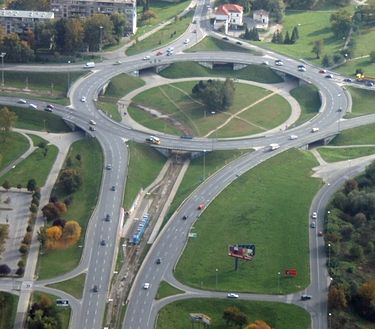
(Picture from here.)
This is the sort of thing my brain does. Which probably tells you more about me than you want to know. Indulge me. Next time I'll talk about space drives. I promise.
I live up here in Massachusetts. When I moved up here, back in the Cretaceous, I encountered something called a "rotary." It's also called a "roundabout", "circular intersection", "traffic circle" and other names. Some of which are even printable. They took a little getting used to but I managed. The problem with Mass drivers isn't rotaries; it's that they, and the state police, view traffic rules as mere suggestions or revenue sources. No one takes them seriously.
Then, in the 80s, there was a big push to get rid of rotaries. It is a certain truth in life that no intersection is so completely devoid of merit that a Massachusetts traffic engineer can't make it worse. Perfectly functional rotaries were replaced by obvious inventions of the devil. At left is a picture of what happened to the Route 2 Rotary in Cambridge. The black circle is where the rotary used to be. That mess is controlled by four barely functioning stoplights.
Get caught in this thing and kiss an hour of your life good-bye.
So, I'm driving into work today and not happy about it. To alleviate my boredom I took a back way in through Lincoln. The back way goes through a 5-points. This may be a term most people are not familiar with. It's a relic of my sordid youth in Alabama. A 5-points is a 5 way intersection. And, of course, there was little or no understanding by the drivers of who has which turn. I got through that and mused on intersections all the way in.
It came to me that intersections have an ascending complexity rule. It's an easy one to formulate. Let's consider the simplest intersection, a straight line with a stop sign. No cross streets.
Since the road is bi-directional, two drivers have to be considered. So each driver has exactly one choice. This is a complexity level of two. The next kind of intersection is three points. Each driver has to consider two choices. This gives us a rule of:
C = R * (R-1), where R is the number of roads coming into the intersection and C is the complexity level.
This number goes up fairly quickly. For R = 3, the C value is 6. For R = 4, the C value is 12 and for my favorite, the 5-points, the C value is 20. If you graphed this it would look like an ascending curve.
Rotaries have a different rule. Each entry at a rotary has, in effect, an R of 2. The choice is limited by 1) spreading out the intersections across the rotary and 2) determining that direction of travel in a rotary is one way. This turns the rotary into a series of R-2 intersections. The complexity of the entire rotary could be considered a sum of the R-2 intersections.
So, in this case, if we have a four way intersection, we have a complexity level of 8 as opposed to the R-4 straight intersection complexity level of 12.
Notice that while the curve for a linear intersection is an ascending curve, the increasing complexity of the rotary is linear. This means we can add complexity to a rotary with much less impact than adding the same complexity to a linear intersection. However, it also says that for a small intersection, the complexity of a linear intersection is less or equal to a rotary.
However, rotaries were often the victim of their own efficiency. One could get on a rotary faster than one could get off. This caused nightmarish congestion. The Brits came to our rescue and redesigned the rotary in the 1960s. The big change was the addition of a precedence rule: vehicles in the rotary have priority to those outside the rotary.
(This, by the way, was always the rule in Massachusetts but drivers often had difficulty understanding it. The problem driver precedence, I think, was one reason rotaries fell out of favor.)
But there is a hidden complexity in the rotary. The 4-way intersection is intended to be traversed one at a time. Time is not a factor except as measured by the impatience of other motorists.
In the rotary, however, vehicles are on the move. Time is a significant factor. The rotary has to be sized that a given vehicle has enough time to get on and off the rotary. Ideally, this is done without much slowing down.
If we take 30 mph as an ideal speed of traversal, that's 44 feet/second. Let's allow 3 seconds at a given intersection in the rotary just to have room. That's 132 feet between intersections. A simple two road rotary would have to be 264 feet in circumference or 84 feet in diameter.
I'm not sure how to evaluate this numerically. If 30 mph is the proper speed than as the size of the rotary increases or decreases, the complexity must increase or decrease. The number of choices remains the same but the time in which to make them is a variable.
When I was visiting my home town in Missouri I saw what must be the smallest rotary imaginable. It could not have been more than 20 feet in diameter. Two cars draped across the center would hang off both ends. This little thing had four roads coming into it. If you didn't hang hard on the steering wheel, you would drive off the road. But I digress.
This is the sort of analysis engineers do on all sorts of things. There's a reason that data going across a network is called "traffic." Many of the original network topologies use road metaphors. One of the famous problems of mathematics, solved by Euler in 1735, is how to determine the optimum path to traverse seven bridges in Konigsberg. That was the beginning of graph theory. Which was the start of that map program in your smart phone.
Which could help you navigate one of the Massachusetts rotaries.
Sunday, June 15, 2014
The Turing Test
Well, last time I spoke about how the Fermi Paradox irritated me. I'm on a curmudgeonly roll. Since it's in the news, let's go gunning for the Turing Test.
The Turing Test was invented, not surprisingly, by Alan Turing. It came from a paper entitled Computing Machinery and Intelligence and appeared in Mind in 1950. It was an attempt to determine whether machines could think without defining a "machine" or "think", since these were potentially ambiguous concepts. He wanted something that could get beyond this problem.
Turing proposed an "imitation game" where a judge must attempt to determine if a respondent is a human or a machine. To do this, the conversation between judge and candidate was made devoid of clues by using a teletype (remember, it was 1950). If the judge could not distinguish the machine's conversation from human, then the machine "won". If the judge could detect that the candidate was not human, the machine "lost."
Turing thought that if a computer could fool a human judge up it had shown itself sufficiently capable as to be considered "intelligent."
I don't have a problem with the Turing Test as long as we understand a few things about it:
- It is a very limited kind of intelligence that is being tested
- It is limited by the context of the test and the biases of the judges
- It does not imply anything about the humanity or experiential nature of the candidate.
- It plays into human biases in that it presumes that something that is capable of indistinguishable imitation of a human is as intelligent as a human.
Maybe. Maybe not. Remember it's still a dog. Dogs are not motivated the same as humans. Their sensory system is very different. We are sight animals. They are smell animals. That alone is going to make the conversation interesting.
But the Turing Test presupposes that a human response is the correct response regarding intelligence. Consider if the situation were reversed and the dogs were giving a Turing Test to the humans. Perhaps a question might be, "Are you smelling my excitement right now?" (One should think that dogs would make a Turing Test that they would be able to pass.) The human would be unlikely to answer correctly and the dog professor would say sadly these humans are just not as smart as we canines. We share a lot with dogs. An intelligent extraterrestrial or computer program is going to be much harder.
We live in the context of our humanity. We should expect other, non-human, intelligences to live in their own context. My point is that there are only two possible true successful systems that would pass a Turing Test. One is a program that is specifically designed to pass a Turing Test. It doesn't have to have any general intelligence. It's designed to show itself as intelligent in this very limited domain.
Which brings us to Eugene Goostman, the program that "won" the most recent Turing Test.
Eugene Goostman is a chatterbot-- a program specifically designed to hold conversations with humans. Goostman portrays itself as a 13 year old boy from Ukraine that doesn't understand English all that well. I've read the transcript of some of Goostman's conversations. I argue that without this context provided by Goostman, it would not have passed. Goostman's programmers gamed the test in my opinion.
But let's say a really clever program was designed from the ground up to hold meaningful conversations. Would it be intelligent? I don't think so. Intelligence is a tool that can be applied in many circumstances. Watson, the program that won the Jeopardy is a closer contender. It's intelligence won at the game. Not, the same system is being used in medical decisions for lung cancer.
An intelligent conversationalist would be one that donated its intelligence to the conversation. It might supply insight. Make connections. In short, do all the things we expect from a human conversation. It converses intelligently instead of having conversational intelligence. That is, its conversation derives from its intelligence. It's not just a smart program that's learned to fool us.
Which brings us to the second possible winner of a Turing Test-- a system (biological or otherwise) that is so smart it can model our context sufficiently that we would find it indistinguishable from a human being. Such a system would have to be more intelligent than a human being, not less.
But this all presumes the Turing Test has a purity it does not possess. Not only does the test only measure an extremely narrow view of intelligence-- behavioral conversation-- it presumes the judges are unbiased. As we saw with Goostman, this is not so. And it could never be so.
After all, humans imbue cats, dogs, insects, statues, rocks, cars and images on toast with human like qualities. We infer suspicion from inept sentence structure. We infer honesty when it's really spam. We infer love from typewritten conversation when it's really sexual predation. Put two dots over a curve and we inevitably see a face. Give us a minimum of conversational rigor and we inevitably determine that it's human.
Humans can tell what's legitimately human and what's not a lot of the time. But we don't do it from characters on a screen. We detect it from motion or facial expression. We detect it from tone of voice or contextual cues. We know when something that purports to be human, isn't, if we can bring our tools to bear on it.
For example, there's the uncanny valley. This is when an artificial visualization of a human being gets very close to presenting as human but not quite. People get uncomfortable. It happened with the animated figures in Polar Express. The characters animated on the train were just a little creepy. Exaggerated figures such as Hatsune Miku or the characters from Toy Story are fine-- they're clearly not human and don't trigger that reaction. Think of the characters in Monsters, Inc: monsters all, with the exception of Boo. But we were able to fill in any missing humanity they lacked. (The fact that the story was brilliant is beside the case.)
Alan Turing was a genius but, personally, I don't think the Turing Test is one of his best moments. It's an extremely blunt tool for measuring something that requires precision.
I invite the system under test to come with me to a family reunion with my in-laws. Navigating that is going to take some real intelligence.
Sunday, June 8, 2014
The Fermi Irritation
(I meant to upload this and thought I had. But I didn't. Oh, well. Sorry.)
I'm on my way home from work and I’m in a bad mood. So, I’m going to talk about something that regularly irritates me.
Like Pap in Huckleberry Finn, "Whenever his liquor begun to work he most always went for the govment." I go for the Fermi Paradox.
Enrico Fermi came up with it. Essentially, it says: the
universe is unimaginably old. We arose. If we’re typical, surely in all that
time some other intelligent race has, too. Why don’t we see them?
The Paradox is rather a Rorschach test. It reflects more the
point of view of the person discussing the Fermi Paradox than the Paradox
itself.
The Fermi Paradox has been discussed over and over, both in
science and in the science fiction communities.
The science community came up with the Drake Equation, a way
of formulating the variables of the problem. This comes right out of Wikipedia:
where:
- N = the number of civilizations in our galaxy with which radio-communication might be possible (i.e. which are on our current past light cone);
- R* = the average rate of star formation in our galaxy
- fp = the fraction of those stars that have planets
- ne = the average number of planets that can potentially support life per star that has planets
- fl = the fraction of planets that could support life that actually develop life at some point
- fi = the fraction of planets with life that actually go on to develop intelligent life (civilizations)
- fc = the fraction of civilizations that develop a technology that releases detectable signs of their existence into space
- L = the length of time for which such civilizations release detectable signals into space
But that’s really only saying what would have to know in order to figure out the
probabilities. Without the content of the variables, we really know next to
nothing.
There have been several SF books to explain why we haven’t
heard from our neighbors. Personally, I like Larry Niven’s idea from World ofPtavvs. He suggested that intelligence was a naturally occurring phenomena. But
a few million years ago a violent telepathic race of enslavers beamed out a
massive command to commit suicide when they were about to be overwhelmed by a
slave uprising.
It's pretty quiet out there. No escaping that.
Many people who discuss this problem one of two camps:
- We have no evidence of them. Therefore, human beings are a singular event.
- We have no evidence of them so we should keep looking. Something is surely there.
Personally, I’m in the latter camp. Not because there is any
real hope of detecting them—I don’t think there is—but because if there was evidence we’d be damned fools not to
check.
There are a couple of problems with the paradox itself. For
one thing, it is instantaneous: it must always be analyzed in terms of the
known world at the time of analysis. We didn’t have an indication until just a
few years ago how many variant planets were in the Milky Way. If planets were a
rare event, we would expect planetary life to be an equally rare event. Now we
have a better understanding of planets—there are lots of them. The current estimate of earth like planets, at least
size and mass, is about 100 millions.
About that is spread out over the whole galaxy. And it doesn’t account for time.
Life has been on this planet for nearly four billion years.
But we didn’t have eukaryotic cells until only about 600-700 million years ago.
Invasion of the land was about 300 million or so years later. Mammals didn’t
get their start until 65 million years ago and our genus didn’t get started until about 2 million years ago. Humans
have been thinking for less than 250k years and we’ve only been in a position
to actually detect extraterrestrial
life for a little over a century.
Of those 100 gigaplanets, how many, like Mars, had their
life opportunities come and go? For all we know, Mars had a thriving
civilization about a billion years ago.
All evidence points to a relativistic universe. That is, we
are limited by the speed of light. Physical travel between the stars is
probably beyond us—or it may require us to give up our humanity. We might end
up striding across the galaxy as powerful as gods, but we’ll no longer have a human perspective.
A better detection mechanism is to detect some sort of
photon emission—radio, visible light, etc. We can signal each other like
candles in the dark.
But even that has a duration. The span of frequencies that
we manipulate is called the spectrum. As we’ve found over the years, broad use of the spectrum is wasteful.
Consequently, the radio spectrum is cut up like fine cheese. In addition, not
all parts of the spectrum are created equal. Some portions—radio, for example—are particularly nice for wireless communication. Visible light is very nice for
carrying signal but it doesn’t broadcast very well. You can communicate with a
laser but you need to aim it particularly well—or push it down a pipe like
optic fiber. Scarcity and demand determine price and spectrum has gotten
expensive. It's not going to get any cheaper.
I expect that we (and by extension of our sample size of
one, everybody else) will refine our use of spectrum away from broadcasts that can be picked up by our neighbors and
direct more where it will be useful. That’s going to reduce our stellar
footprint. In addition, we are already getting farm more efficient in how much
signal we actually use. Some of our satellites barely put out more watts than a
cell phone, relying instead on better receivers. Detect that Antares!
And that is presuming a detectable civilization (i.e., us.)
even survives.
That, I think, is the biggest problem of Group 1 of the
Fermi Paradox. They are inherently optimistic that in the broad expanse of time
a single group must have survived long enough for us to detect them. Their absence
must indicate our singular existence.
Think back on our own evolutionary history. Life was here
for nearly four billion years before
we could detect or be detected. If, say, humans lasted a million years, we
could miss talking with our neighbors four thousand times by being out of sync
just a little bit. They started their climb a million years after us—we miss. A
million years before—we miss. And that presumes a million year life span for
human beings. It doesn't take into account that evolution is always going on. We have no idea what Homo sapiens will evolve into. Only that in a million years we won't be Homo sapiens.
There might be gods out there—species that were so stable
and intelligent that they have lasted across the time of our ascent. But they will have a
god’s perspective. Which means that there is no determining whether they would
want to or be able to detect us or if we would be able to detect them. If they
created a supernova to send a message over to their fellows in Andromeda, we’d never recognize
it as other than random
noise. Unless, of course, they took an interest in us. They just made a movie
about the last time we interested a deity overmuch. It’s called Noah.
But I don’t think there are gods out there. I suspect if we
have neighbors they're pretty much like us: fumbling our way into a greater universe
with the meager tools evolution gave us. Putting out enough radio waves to show
themselves but too far away or out of synch to be seen.
We’re probably not alone out here. But we may as well be.
Sunday, May 11, 2014
Song vs. Story
(Picture from here.)
My father was a musician and my mother was a writer. Apparently, it's harder to teach story than music so I started piano at four and have kept it up ever since. Think of me as a determined and talentless, but enthusiastic, amateur.
But my mother got me in the end.
Over the years I've been thinking over and over how music and narrative are related. I don't mean sound tracks intended to support or tell actual stories or things like opera where stories are performed with music. No, I mean the structure of music itself seems to be strongly related to structure of story telling.
I suppose this shouldn't come as a surprise. Story narrative and music both bind time. Narrative binds time in the form of a list of events-- even if those events are out of sequence. Though the binding in the case of stories is looser. A reader isn't forced to read stories, sentences or even words one after the other. Some (me, included) tend to read blocks of words, skipping forward and back within the block. In comics narrative can float across the page in all sorts of ways.
Music, though, binds time exactly. The note is played at a given time and no other. Even if the performer is improvising, once the note is played it cannot be unplayed. The note is fixed in time.
However, I think the relationship between story and music is even deeper. To prove my thesis I'm going to crawl through a fairly easy pop song I happen to like. It's called The Transient Apple Salesgirl. It's a Japanese song-- I like listening to J-Pop. I'm not distracted by the words. It has something to do with transience. And girls. And apples, I think. Listen to it here.
I mean I could do it with Beethoven but then we'd be here forever.
This song has a number of musical themes that happen at particular points in the song. It begins with a mechanical sound like the winding of a music box. Then a music box plays followed by a little singing. Then the song starts in earnest. It has the following themes.
- music box theme: trifle played on a music box
- descent theme: descending pitch theme that is reminiscent of the music box theme, but descending in tone rather than ascending
- bridge theme: a broken rhythm theme that ascends sort of like a counter point to the descent theme
- chorus: strong declarative musical line that seems to echo the music box theme
- crossed lines bridge (up and down): interesting theme where the voices go up and down but the background inverts it at the same time.
- Resolution theme: resolves the tension in the crossed lines bridge
Here are the times for these themes in the song:
0:00 - mechanical introduction (winding up of music box)
0:05 - music box theme
0:19 - music box singing
0:44 - descent theme
1:36 - bridge theme
1:49 - chorus
2:07 - crossed lines bridge (up and down)
2:16 - descent theme
2:40 - bridge theme full
3:07 - chorus
3:25 - crossed lines bridge (up and down)
3:33 - chaotic bridge based on bridge and crossed lines theme
3:45 - crossed lines bridge/bridge theme
4:00 - Resolution theme: inversion of crossed lines
4:28 - chorus based on music box
4:45 - chorus raised key
5:04 - crossed lines bridge
5:12 - instrumental fade based on resolution theme
5:38 - music box fade
Now, if you graph these themes you get the picture of the song visually. (Click to enlarge.)
One of the first things you can see is the repetition pattern. Note two of the themes that are first introduced, the descent theme and the chorus, are big in the beginning and get smaller towards the end of the song. Note also, that some of the small themes in the beginning increase towards the end. Similarly, some of the sections are blended.
It's also clear the sections get smaller and smaller as time goes on.
Some of the themes are constructed to echo previous themes. The chorus has a relationship to the music box. The resolution theme has a relationship to the crossed lines.
Good stories are filled with these textures, resonances and relationships. Often, something in the beginning of a given story might appear unrelated to what comes immediately after but by the end of the story makes perfect sense.
Some of the sections have more than one theme in them. There's a section at 4:28 where the chorus them is played against the music box. Similarly, there's a section at 3:33 where both the bridge theme and the crossed lines theme are played against one another. At 3:45 this same blend is played frantically, chaotically, in a climax to the song.
In a story, when the climax is reached, the scene nearly always presents elements that have gone before-- otherwise the climax doesn't make any sense. Would Neo's belief in himself when he faces the agent make any sense if he hadn't gone through a crisis of faith before. Would his saving of Morpheus make any sense if Morpheus hadn't reached out to him before? Would Neo's battle with the agent work if the agent hadn't betrayed a personal antagonism to human beings? All of these little resonances and nuances play out in story.
And they play out in music in pretty much the same way. In Apple, the resolution theme is built in part from the crossed lines bridge. The crossed lines bridge echoes the previous descent theme. And, of course, the music box bookends the whole song. In a story, we would expect the resolution to echo and relate the conflicts that came before. Similarly, the conflicts themselves would have resonances to the situation, the character and world of the story. We have expectations of the path of a story. We have similar expectations of the path of a song. Sometimes the story/song fulfills the expectations. Sometimes it confounds them-- to our delight.
It's hard to take apart a story. After all, you must read and understand the internal pieces of the story to make sense of them. And it's hard to keep from being swept away from it.
But you can engineer the experience with music. You can choose a small piece-- this one is only about six minutes long-- that's relatively simple. Choose one where the language doesn't interfere.
Then, pick apart the piece and get a sense of how the components mesh. That sense of things can then be translated into how a story works: The color palette can reflect something important. (The Cook, the Thief, his Wife and her Lover.) The image of scissors. (Dead Again.) The river can tie it together. (Huckleberry Finn.)
I heard in a lecture years and years ago that music is composed of equal parts surprise and inevitability.
What a wonderful surprise. Stories are, too.
Sunday, April 6, 2014
Evolution of the Lung
I'm getting over pneumonia so in a vain attempt to make lemonade out of lemons, I'm going to talk about the evolution of the lung.
The lung one of the major mechanisms-- if not the major mechanism-- that enabled invasion of the land by animals.
The necessity of lungs is based on the vast difference between gaseous oxygen and oxygen dissolved in water. For one thing, when water passes over the gills of a fish (or crab) it one fluid (water) passing next to another fluid (blood) across a thin membrane. This is very similar to what already happens within the body of a complex organism.
In fact, some organisms are so simple that they have no need of circulatory systems at all. It is sufficient that they are in contact with water that contains oxygen. The oxygen crosses the membrane easily.
But there are some downsides.
For one, the amount of oxygen that can be dissolved in water is less than the level of oxygen in air. At 0C, the amount of oxygen in water is 14.6 mg/l. Air weighs 1.2 g/l, of which 21% is oxygen. That works out to about 251 mg/l-- more in the historical past. In addition, the solubility of oxygen in water is temperature dependent. If you bring the temperature up to 37C (human body temperature) the amount of O2 available drops to 6.71 mg/l. (See here.) Biochemical reactions like to take advantage of heat. But there's an obvious tension between the oxygen available for metabolism and the heat loving biochemical reactions.
All through the ocean different organism act out this tension from the smokers down at the sea bottom to the rich green soup of some lakes.
Think of the ancient oxygen atmosphere before organisms invaded the land as a wonderful resource yet to be exploited.
Given the sheer amount of available oxygen in the gaseous atmosphere, why did it take several hundred million years for animals to make it to land?
Well, the lungs were hard to evolve. Different groups of organisms such as insects, vertebrates and scorpions, used different strategies.
All lungs are a mechanism of concentration and distribution-- gills serve the same purpose in water. The idea is to expose a specialized organ used to absorb the oxygen and serve as source to be distributed over the body. It's a compromise between the necessity of oxygn being available to all cells of the organism to oxygen and the engineering problems of exposing the cells to the outside environment. A consequence of this compromise is the contents of lungs (or gills, for that matter) have enormous surface area to volume ratios. The human lung, for example, has about 70 m2 of surface area-- a square about 8 meters and some change on a side. About the floor plan size of a studio apartment.
Arachnids such as spiders and scorpions have something called "book lungs". These are flattened air sacks adjacent to one another, with the intervening space filled with hemolymph-- the equivalent of blood. Air is moved through the sacks allowing gaseous exchange.
Insects do something different. They have entry orifices called spiracles, allowing the air to enter a trachea. The trachea branch smaller and smaller, finally becoming tracheoles-- dead end, water filled compartments. (See here.) The tracheoles deliver oxygen directly to the tissues. In effect, the whole body of the insect-- or at least where necessary-- is riddled with lung like structures.
Vertebrates have more than one strategy but they all have the concept of a central concentrator space where oxygen is absorbed and then distributed via blood and the circulatory system.
If you look at the drawing above, you'll see the evolution of the different vertebrate groups through time. We're all familiar with the different extant vertebrate classes. We'll neglect the fish for the moment. On land, they are birds, mammals, reptiles and amphibians.
The first lungs are thought to derive from the swim bladder of fish. This organ keeps gas under pressure-- usually oxygen-- in order to stabilize swimming. The swam bladder is filled from a gas gland which extracts out gas from the tissue and blood stream and pressurizes it in the bladder. The pressure can be quite high-- even fish deep in the ocean have working swim bladders. Lungfish use the same structure in their air respiration.
The lungs of amphibians are composed of a few septa-- separated sacks-- which contain a few large alveoli-- blind chambers where oxygen transfer takes place. Since amphibians also respire through their skin the lungs are not the sole means of oxygenation.
The first lungs that look familiar to us arose in reptiles. Reptiles have alveoli, as we do. They have complex branched lungs-- though less branched than ours. Reptiles have no diaphragm and move air differently. However, that's more of a description of reptiles in general. Crocodilians have a more complex story to tell. But we'll get to that.
We have mammalian lungs: complex branched structures that terminate in highly vascularized containers called alveoli. Like most vertebrate lungs, air proceeds through the lungs one way at a time. In, then out, in a sort of bellows arrangement caused by the diaphragm.
There are a lot of problems with a bellows system. For one, it means that there's a lot of dead air in the lungs. That makes the lungs inefficient. For another, the termination areas somewhat susceptible to infection. After all, it's just a little cell where air comes in and goes out through a whole. It's easy to close off.
One of the biochemical developments that had to occur for lungs to work was the evolution of pulmonary surfactants: chemicals that manage the surface tension on the wet inner surfaces. In the absence of the surfactants, when segments of the alveolar membranes touch, they stick. This is not a good thing. Surfactants allow them to unstick from one another. The development of these surfactants predates the lungs so they were right there to help early on.
Now, we come to my favorite lung system: that of the birds.
Birds do not have an alveolar system. Instead, their system is tubular. Imaging the bird lung extracted into a long tube. Air comes in one end of the system and comes out the other. Instead of alveoli, they have parabronchii-- small tubes where gas exchange occurs. (See here.)
There are host of advantages to this sort of system. For one thing, there's no dead air. There are reservoirs where little exchange occurs. These appear to have a mechanical purpose and aid in moving the air along. But there is no dead air in the parabronchii while there is considerable unused air in the alveoli. Remember your CPR. You exhale into the patient because there's a lot of oxygen left in your air.
Because the system is flow through, there's the opportunity for counter current exchange. Imagine you have two flowing tubes of water, one hot and one cold, and you want to heat one up with the other. You lay the tubes down against one another, right? What direction should the water flow in the tubes? The same or opposite?
If you thought "opposite" you win the prize. If the flow is in the opposite direction then there is a continued gradient as the fluids flow past one another. While in co-current exchange, the fluids reach equilibrium and exchange stops. The kidney uses this mechanism. An alveolar system can't because the flow is in and out. But the bird system, since its flow is one way, runs the blood supply in the opposite way.
This makes the bird system enormously efficient. Not only does it provide a means to reduce the size of the lungs-- important in a flying animal-- it also is much better at extracting oxygen at lower pressures. Climbers on Everest, wearing oxygen equipment, have reported seeing geese flying high above them.
The flow through system of birds actually may predate their dinosaurian ancestors. Crocodiles and monitor lizards have both been shown to have flow through systems. (See here.) Going back to the drawing above, crocodiles separated from line leading to birds way back when they were both thecodonts. So for crocodiles to have flow through breathing either means they developed it independently or the rudiments were there prior to the evolution of dinosaurs or birds. Which makes sense. Pterosaurs also popped off from thecodonts and there is ample evidence that they had similar respiratory apparatus as birds. Maybe the marine reptiles did, too.
A gentleman named Farmer (See here.) has suggested the alveolar lung evolved in the late paleozoic, a period of relatively high oxygen. However, flow through lungs evolved in the ancestor of crocodiles and birds to support apnea-- the stopping of breathing. Possibly this was an aquatic adaptation as it is in the crocodilians. Or for some other reason. Regardless, it did evolve and it was present in the archeosaurs. Which meant it was there and waiting when the dinosaurs came along. Then, came birds.
So, as I sit here and cough my lungs out, I look outside. The sun is shining. The birds are singing.
God I wish I was a bird.
Subscribe to:
Posts (Atom)