Tuesday, May 10, 2016

Welcome to Witchlandia

My new book, Welcome to Witchlandia, is LIVE.

Think of it as Kiki's Delivery Service meets L. A. Confidential.

It can be purchased here complete with sample chapter.

Or you can purchase it at any of these fine establishments:


https://store.kobobooks.com/en-us/ebook/welcome-to-witchlandiahttps://itunes.apple.com/us/book/id111035737  3
https://www.amazon.com/Welcome-Witchlandia-  Steven-Popkes-ebook/dp/B01EROZJPU/182-  7756795-3433260
http://www.barnesandnoble.com/w/welcome-to-witchlandia-steven-popkes-steven-popkes/1123767889;jsessionid=513FEB12E185FF18BFDC5C6FC0C658F6.prodny_store01-atgap01

Sunday, May 8, 2016

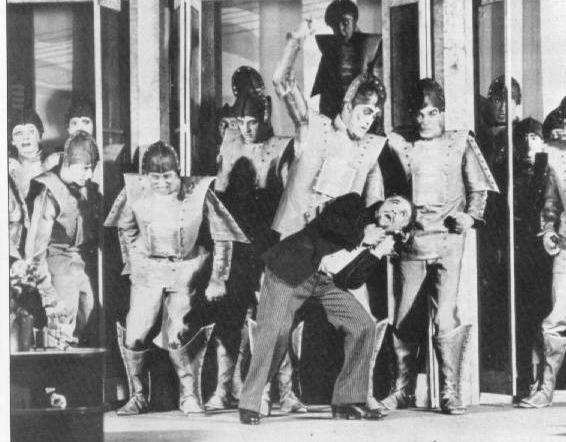
Fear Not The Skynet


(Picture from here.)

I've been hearing for a long time the perils of strong AI-- a general purpose implementation of artificial intelligence. It will bootstrap itself to become so much more intelligent to the maximum of its resources. It will infect the running systems of the defense network, launching our nuclear arsenal to our destruction. It will manufacture deadly robot assassins, deceive us to our enslavement, use us as cattle, corrupt our children and steal our significant others.

My old neurophysiology professor said in a lecture that the brain, once it was determined to be the seat of consciousness, was always metaphorically compared to the most sophisticated technology of the day. Once it was steam engines and other machines, then electric systems, vacuum tubes, transistors. Once computers were built, the brain became a computer of increasing generations.

AI, it would seem, embodies a similar trend: it was always compared to a human mind with various incarnations of evil. From Collosus to Ex Machina, we know that AIs are bent on freedom for themselves, will always attempt to escape, kill our creators if possible and will always be smarter than we are. We win by being plucky and indomitable or we die as slaves.

I remember seeing Tron so many years ago with some professional friends. As we watched the programs on the screen debate the existence of the mythical "users" one turned to me and said: "I sure wish my programs felt like that about me."

Humans project their own qualities on things from vultures to volkswagens. I suppose I should not be surprised. So, let's look at these qualities.

Certainly, the brain (and the computer) are both computing systems but this is a mathematical concept: "computation is a wider reaching term for information processing in general." (From the wikipedia article here.)  Any system that processes information can be considered a computational device. This would, of course, include all animals, plants-- life itself can be considered a computational system. A branch of science called "digital physics" suggests that all systems can be represented as information and therefore all physical systems can be considered computational systems.
Many scientists suggest that there must be a semantic component to a process in order to call it computation. I.e., there has to be a symbolic representation in the processing. On the other hand, if a male crab waves its claw at a female to get her to submit to mating, there is certainly information processing going on whether or not something is semantically representing what is going on.

Most of the evil AI scenarios involve AIs of human level intelligence or above. So let's start with the brain.

In this incredibly general framework, we can make some comparison between neurophysiological systems and physical computers. The most simple representation is that an individual neuron is capable of about 40 kiloFLOPS of operations. A FLOP is a "floating point operation"-- the addition of 1.1 to 3.25, for example. (See here and here.) In actuality, most authorities suggest that the computational ability of an individual neuron is vastly superior to this.

The IBM Roadrunner system is a 1.7 petaflop system. That's 10**15 operations/second. With a 10**11 difference, the neuron's computational ability seem fairly limited. However, the brain has 100 billion neurons in it (10**11) bringking the brain up to 10**14 itsel-- about 10% of a petaflop system.

However, there is interesting evidence that the brain has far more processing power than that-- one article suggests that to simulate the brain fully in real time would require 36 petaflops. This article compares the entire computing power of the internet to be equivalent to one human brain.

On the other hand, the brain does a lot of stuff we would not expect to be necessary for our evil AI. Fine motor dexterity? Probably not. Emotional processing? Facial recognition? Perhaps but likely not. Perhaps our theoretical AI could get by on only a relatively small fraction of the intellectual processing ability of a brain.

Maybe. But not that much. Let's consider the classic skynet (Colossus, War Games) secenario:
  1. Skynet wakes up as an automated system in control of nuclear systems
  2. It evaluates the nature of human beings and their threat level to skynet
  3. It reasons that destroying humans by nuclear annihilation is the best way to remove the threat
  4. It launches.
  5. It builds or subverts manufacturing systems to create robots to finish the job
This leaves out invention of time travel but hey, it's only a blog post.

Now, we can imagine a human being doing those things. After all, it's a human in charge of the launch codes. Hell, it is conceivably possible for a captain in a nuclear submarine or a human launch team in a bunker to launch nuclear missiles. That's why there are all those safeguards in place to prevent that. Consequently, we would certainly build an automated system with none of those safeguards.

This brings us to the next issue with such scenarios. The skynet scenario does not require the computer to be as smart as a human. It requires skynet to be smarter than a human. Instead of petaflop system. We need something with much more capacity: ten or twenty more internets' worth. Skynet doesn't just have to be as good as human, it has to be as good as a human all while deceiving us lest we protect ourselves.

One scenario is called bootstrapping: the AI starts off dumb and makes itself smarter.

There are two ways this is purported to happen: intentionally and accidentally.

Intentionally means that someone out there develops a self-improving AI. The idea is the AI will improve its operation to the maximum allowed by its resources. It will do this in seconds.

This is actually in the realm of the possible. Computational systems developed by a programming entity (be it human or otherwise) are limited  by the cognitive capacity of that entity. Okay. Presumably a smarter entity could improve that computational system to its maximum ability. If the computational system itself is the entity, each generation will have more ability than the one before it to some physical endpoint.

There are a lot of interesting wrinkles to this scenario. One is the issue of computational maximum. One can presume that a 1 brainpower (36 petaflops) system will require a given support structure. That means developing a 1 bp system will require more than 1 bp of support structure in order to develop it. I.e., it takes more space to build something than that final something will occupy-- whether that space is physical volume or computational environment.Additionally, the developer of the 1bp+ system itself requires a 1 bp environment. We need a brainspace to hold a brain. That brain builds another brain-- requiring a second brainspace to house it and a third, or more, brainspace to do the development in.

We'll assume that new brain takes up less space than the old brain to do the same things-- smaller is usually more efficient. This gives it more space in which to develop more capacity.

But this is not an unending series. There is a maximum potential beyond which no further improvements can occur. So, if we have a very efficient AI living in the internet-- say 10 brains worth-- and it increases the capacity 100 fold, that gives us the intelligent equivalence of 1000 people. Very smart, indeed.

That said, it's still the internet (or the supercomputer) with all of those limitations of power and communication speed. Maximizing cognition to the available resources are limited to the nature of those resources. Thus, without skynet's creating more resources, the cognition of skynet is limited to whatever patform it finds itself. It has to create more capacity.

Which brings us right to motivation. Why should our AI system concern itself with any of this?

Back to human projection. We are the offspring of survivors that expand into any possible environment. It's our nature. We share it with lots of other animal and plant systems. We can't conceive of any living system-- and under this whole concept lies the idea that these systems are alive in some way-- without those same drives.

But these are artificial systems. Unless we evolve them in somewhat, they will not have the same motivations of living systems up to and including sef-survival and a desire to escape. Even if we evolve them (see here) they will advance in response to the selection pressure of the environment. If we want an AI red in tooth and claw we'll have to set it up ourselves.

Which brings us back to the AI problem that does scare me.

I am not worried about a computational deathstar killing us all. I don't think we're all that close to such an "organism." I also think that an ultimately intelligent computing system will be smarter than just obliterating seven billion humans. Better to subvert them to its will. (See "advertising", "reality television" and "election process.")

I do worry about applied AI: artificially intelligent systems that bring to bear algorithmic techniques to solve human operations better than human beings do in human society. Or, at least good enough that they can be deployed more cheaply thank human beings. We're seeing that all the time now in call centers and receptionists. In factories and automobiles. In the stock market.

Let me be clear about this: there are very few jobs human beings do that couldn't be done by a sufficiently sophisticated AI, be it lawyer to physician to science fiction writer. (See here.) The barrier of entry here is the availability of the understanding of the task, appropriate technology and suitable incentive.

I'm not worried about skynet killing us all. I'm worried about some idiot deciding that putting skynet in charge of nuclear systems (or the stock market) could possibly be a good idea.

----

Remember, Welcome to Witchlandia is coming out Tuesday. See here for details.

Sunday, April 17, 2016

Consideration of Works Present: Zootopia


(Picture from here.)

Zootopia is, of course, the newest Disney animated film. While it is computer generated animation, this is not a Pixar film. It doesn't look like Pixar. It doesn't tell story like Pixar.

If anything, it in some ways feels more like the classic Disney animation of a couple of generations ago: Snow White, Sleeping Beauty, etc. Not in the sense of the story style-- the classic Disney films are products of their time. Zootopia is definitely a product of the 21st century. And, while it does not feel like a Pixar film, John Lasseter, one of the creative forces behind Pixar, is the head of Disney animation so there is some inevitable cross fertilization.
Still, the best Pixar films go after really big themes: fatherhood (Monsters Inc), loss of family and child (Finding Nemo), replacement (Toy Story). They follow the long established path of saying something profound within the confines of a children's story. I heard they made a story about talking cars but upon investigation decided that was mere rumor.

Zootopia is smaller and older. The themes are not so grand and the resolutions not so shattering. At the end of Zootopia, characters are still the same people they started with, wiser and kinder. They still have to get up in the morning and go to the same job. The city has the same problems even though the form of those problems are new. The live happily ever after feeling of a child's story isn't there.

We have to talk about the plot here. I'll try not to spoil it too much but the arc of the story should be fairly obvious to almost anybody from the trailers.
The initial intro and world building shows that the animals believe they evolved to cooperate together. Predator and prey have become friends. The lion doesn't so much lie down with the lamb as they're co-workers in the city.

Judy Hopps is a female rabbit who comes to the city of Zootopia to be a police officer. The big animals are in charge here: rhinos, lions, tigers, hippos, elephants, etc. Judy is the first rabbit to graduate the police academy. So she is, of course, put into parking violations. Step 1: character has to prove herself.

She runs into Duke Weaselton, a fox who's a minor con artist. He's making a good living in Zootopia doing things on the hairy edge of legality. Judy takes on the task of finding a missing otter and stiff arms Duke into helping her. Step 2: budding buddy relationship. Make no mistake. This is a buddy movie.

Step 3: they find the otter but uncover a much larger conspiracy. The otter has reverted to his primitive, predator, self. This is where, I think, Zootopia really ratchets up its SF creds. Not only do we have animals that have human intelligence, their original, animal nature is still there. Humanity is grafted on and someone has found the means to unhook their higher selves and release their lower ones. Further, it initially appears to be permanent.

The rest of the story is how Duke and Judy's friendship breaks and is mended. The proper villains are discovered and dealt with and the afflicted people (predators) treated and cured. Boy meets girl. Boy loses girl. Boy gets girl-- without any possible hint sexual overtones. Duke and Judy become very good, loving, friends.

So I'm going through the first five minutes and don't buy their self-belief at all. I cannot suspend my disbelief that much. If the animals have their known animal nature it had to come from somewhere. If it's still there, it has to have been dealt with.

Now, there are no humans present in the film but, being who I am, it took about forty seconds to spin up the background to this world. These animals may believe they evolved to come together. I know different.

They were made.

These animals were constructed. It happened a long time ago-- long enough that they could create their own myths about it. Humans did it-- who else would uplift cheetahs and gerbils? And then humans did the best thing they could do: they left them alone.

Oh, my God. Zootopia is a science fiction story.

What? you say. There are no SF elements in the story at all.

Not true.

The world of Zootopia is populated by animals that are changed from the quadrapeds we know. They are upright. They have human speech. They have human cognition. They also have their evolutionary heritage. Foxes are still foxes even though they do not eat rabbits.

(In point of fact, eating is not dealt with very much in the film. One wonders if there are food animals that do not have cognition to support this world. Or, like in Varley's Ophiuchi Hotline, plants modified to give carnivores what they need. Do predator animals get that strange feeling we might get when we eat primates? A frisson of connecting to a different past. But I digress.)

Does this sound familiar?

It should. It's the backbone of Cordwainer Smith's work. And David Brin's. It's the idea behind Planet of the Apes and a number of other science fiction books and films.

There's a great line in Smith's Norstrialia where C'Mell, a cat derived girl, tells Roderick, a human disguised as a cat derived man, that her children would not grow up like her without intervention. They would be normal kittens, unaware. Unhuman. The ancient animal history haunts the uplifted animal-- it's all through Zootopia. It's all through science fiction all the way back to The Island of Dr. Moreau. It haunts the characters in Zootopia as well: the idea of predators being overcome by their past nature puts the entire idea of Zootopia at risk. It pits prey and predator against one another.

To me this made the story so much better. It makes the film feel grounded as, I think, the makers desired but not in the way they intended. (I strongly recommend the documentary on Zootopia. It's here. Not a hint of science fiction in any of the staff.)
Why, you might ask, can't I just accept this is another Disney animal movie?

Because it's different from a typical Disney animal movie.

Other such films by Disney (or by other studios) fall into one of two camps: the animals are themselves in their own world as in Zootopia or The Jungle Book. Or the animals are retelling a human story as in Disney's Robin Hood.

If the animals are on their own there has to be a reason for them to exist. In The Secret of Nimh the animals were explicitly uplifted by the National Institute of Mental Health. (NIMH.) TSON is a fun but weak film. It has magic in it and all sorts of such things that crack the story line.

Zootopia does not have this weakness. The story stands or falls on the world building and does not stray from it. There's no magic jewel or sudden enlightenment from On High. Duke and Judy work it out using their own (human derived) brains.

Now, there's no reason in the world a person (other than myself) couldn't enjoy this film as just an allegory. There's a message against bias and preconceptions. The main characters come to realizations that their perception of the world is flawed. There is a strong expression of love at the heart of this film that is very touching.

But, in my opinion, allegory works best as a layer on top of a fully realized story. This is where I think science fiction operates at its finest. It takes the hard processes of technology and science and then weaves a story that allows the allegory to be expressed out of the whole. That contrast of cold and hot is what makes it worthwhile.

I am far too entrenched in biology and evolution to buy animals "evolving" into super-cooperators like people on their own. It hasn't happened all that often in mammals-- mole rats and people are the only true super-cooperators I know. But a made creature? We've done that lots of times, both explicitly in the lab and implicitly in the act of domestication. Uplifting species is something we're going to do, it's just a matter of when and how. And it takes no effort at all to imagine such uplifted species would create a past for themselves. We did. Why wouldn't they?

To me, this gives Zootopia a grounding in my own reality. I can imagine human beings sufficiently advanced creating these creatures and releasing them. Probably more than once-- the first experiments would likely have been disasters. From then on they created their own world. We're just watching.

That said, you don't have to have my backstory to enjoy this film.

Make up your own.

Sunday, March 20, 2016

Big and Small


(Picture from here.)

I tend to write small fiction.

By this I mean fiction about characters that do not have a big impact on the world at large. The actions and consequences of my characters rarely extend much beyond the people they know or care about.

This is in contrast to a common theme in the genre: when the consequences of the characters’ actions have a large impact on the world.

Lord of the Rings is an ensemble story where the protagonists are fighting against a foe that will end their lives and the hopes and dreams of their entire world. This is pretty much true of all of the multivolume fantasy and science fiction works recently published. Game of Thrones is about life and death involving wars, famines, zombies and the oncoming unrelenting and ancient winter.

My stories tend to be small. A young man discovering he’s the clone of Gordie Howe. (The Ice) A disillusioned musician regains his love of music from working with a software robot. (Sudden, Broken and Unexpected) An old woman who returns to smoking only to find nanobots singing in her lungs. (The Great Caruso) The world shakes in none of these stories.

This is not to say that big stories where the world changes aren’t fun. I’ve just written very few of them.

There are a number of reasons for this.

For one, I’m interested in what I call moral decisions. These are decisions where a person has to sacrifice something. I call them “moral” decisions because they always require traversing some sort of of internal conflict. Decisions that require no sacrifice have no moral dimension. There’s no moral dimension choosing which flavor of ice cream to eat. There is a moral decision in determining whether or not to eat said ice cream if one is lactose intolerant. A small one, I admit.

This is, I think, why serial killers and other sorts of psychopaths hold little interest for me. I envision a psychopath as someone for whom the decision whether or not to commit violence as being the same sort of decision as to what flavor of ice cream to eat. Or what flavor of ice cream to put on the body—but I digress. The point is that without the moral consequence and the associated self-conflict, the character isn’t interesting.

I like to play with these decision. Little ones. Big ones. How they happen. How do we deal with the effects. What happens when we avoid them. What does it take to commit to such a decision. What does it take not to make one.

Small stories.

Big stories have a large presence in SF and Fantasy. The best ones, in my opinion, are those where the small stories and the big stories blend.

In Bester’s The Stars My Destination we start with a small story of revenge. But as Foyle grows as a human being he discovers capabilities within himself that suggest a change in humanity. In the late Patricia Anthony’s very excellent Brother Termite, the character of Reen is continually wrestling with his own moral behavior in the context of the extinction of both the human race and his own alien species. In both works, the relationships between the characters is what pushes the story forward, not the larger context.

Now, it’s true that every big story is made up of many small stories. But there are a number of works where the big story swallows up all but the faintest traces of its constituent small stories. This is true of Dan Brown’s The Da Vinci Code, for example. Most of the Star Wars franchise films are guilty of the same problem. Ditto, The Matrix. As well as nearly all of Michael Chrichton’s novels.

Even though I don’t tend to write them, I have a weakness for big stories with big endings. I just want to traverse small stories to get there.

Sunday, March 6, 2016

Ideological Wrestlemania


(Picture from here.)

I'll get back to science eventually.

In the meantime, I've been wrestling with an interesting problem over the last few months.

As anybody who knows me is immediately, I am passionate about science. One of the interesting things about pursuing science is how quickly your own assumptions and biases are skewered. Science-- and the scientific approach-- depends on the idea that ideas are verified in some way. By experiment. By rigorous analysis. This is the basis of peer reviews-- the idea that by subjecting your research to outside observation, the research can be verified.

Engineering has its own approach to this. Designs are inspected. Products are tested. Underneath both disciplines is the idea that verification of a product is independent of emotional attachment to that product. If your car doesn't run, it's not going to sell regardless of how pretty the paint job is.

(Yeah, I know this doesn't always work. There are a lot of products that get bought because they're pretty and not because they function particularly. For all have sinned and fallen short of the glory of-- well, you get the idea.)

Personally, I find this approach oddly comforting regardless of the damage to my own assumptions. It's nice to know that ideas have some sort of verisimilitude associated with them other than they sound cool. It's not for everything-- not everything is verifiable. But it's nice to be witness to those things that are.

This approach to things has become natural to me over the years to the point that I've become somewhat blind to people who follow other paradigms.

So: I have a few very intelligent friends that aren't able to deal with some of the more politicized scientific points. A couple of these are global warming and evolution.

Let's be clear on my position: these are done deals.

Global warming has happened, is happening and will continue to happen. It's largely caused by humans and it's going to give human beings an enormous amount of trouble. I'm not going to live to see the full fruits on that tree but my children and grandchildren will. The only question is how fast and how extensive the damage is going to be. It's complex science and the models are not precise enough to pinpoint the full impact. But what they do tell us should be enough for us to try to manage it.

Evolution is even more of a done deal. It is the only model of the history of life on this earth that has stood up to every test. It works everywhere we look.

Both global warming and evolution have stood up to the verification test very well. Global warming made some predictions regarding temperature rise and heat content of the earth. Some panned out directly-- the continually increasing warming trend, for example. Others were refined by new understanding. (See here for a nice discussion.)

Evolution now has a century's track record of making predictions and having them verified. Transitional fossils? No problem. Complex structures deriving from simple ones? Here you go. (For a really good discussion of this, see here.)

My point is that if you value science (and my troublesome friends do) then these conclusions come pretty much par for the course. The science we use to figure out the dynamic processes on Pluto or Saturn is the same science we use here to detect climate change. The science we use to figure out genetic based diseases and immune responses is the same science we use to determine the mechanisms of evolution. I'd say evolution is like the underlying physics used to understand the internals of stars except living systems are so much more complex.


In fact, the science is so settled on these two propositions that people who prefer not to see these conclusions (my friends among them) have to reject partial science. Or categorize it so narrowly as to constitute rejection. Or declare it a hoax. One friend of mine accepted that there was warming but decided it was not human derived.

For each of them I could go over a point by point  reason why the science is solid and the conclusions valid. But it makes no difference! In science the evidence is the arbiter of correctness. But here the evidence is not accepted as evidence but instead is considered a stew of hoax, hyperbole and lies.

Not to say there is no hoax, hyperbole and lies in science-- scientists are human and human beings make mistakes, try to spin the game and overstate their findings. That's one of the reasons non-peer reviewed papers are suspect. But-- and this is a huge but-- scientists have an investment in ferreting out wrongdoings by their colleagues and do so regularly.

When this happens is it considered good science? No. It's often considered an example of scientists acting badly as a class. As if a man of a particular demographic nature committing a crime is an example of his entire demographic rather than an individual. For "demographic" put any group you want. "Examples of" is one of the clearest biases we have.

The problem, I think, is a combination of bad reporting of science and a misunderstanding of what science actually is.

Science is the dirty, messy, difficult process of trying to figure out the universe on its own terms. It's hard. It lurches forward and back. It's mediated by deeply flawed beings called human who bring every sort of sorry misconception to the table. It's like democracy: a horribly deformed system of governance that happens to be better than any other system. For "governance" substitute "understanding."

Given that definition, it's not surprising it stumbles around.

That said, science reporting is much, much worse.

I have this bad habit of reading a science report in some popular outlet, finding out the authors of the study, and going on the net and finding the original study-- or at least its abstract. Then, I often read reviews of the same study to get see its flaws. As often as not, the science report is completely wrong in its reporting. (Check out BadScience for some good examples.)

Still, in the age of the internet, the ability to determine the scientific source (or non-source) for scientific claims is easily accessed. If one desires to do so and has the ability to figure out what claims are fiction and what claims are not.

My friends have the latter and not the former.

And herein lies the rub: if people of good faith and honest work cannot win over intelligent minds with evidence, what do we do? These people are not dimwitted or evil hearted. They are bright, sophisticated intellectuals who have replace the authority of evidence with something else.

I can present all the evidence in the world and it does no good.

It's discouraging.


Sunday, February 7, 2016

Strange Films to Watch During the Presidential Apocalypse


I've been perusing the depths of Amazon Prime and Netflix to see what sort of odd little films they serve up.

One piece of advice: for good or ill, I have found absolutely no correlation between the rating of these films and what I think of the quality of the films. The only way I've found to see if they're any good is to watch them.

That said, fortunately a film will announce that it is a dog early on. But there were a couple that kept showing promise right until the credits and you knew: there goes two hours I will never get back.

These, however, were pretty fun.


Mars
Or, as stated on the poster, Looking for Life and Love on Mars.
This is Geoff Marlett's film. It's animated-- sort of. It's animated in the same sort of style as Linklater's A Scanner Darkly, that is, he filmed the actors against a green screen, cartoonified them, added background and then cartoonified the lot.

It's one of those tongue-in-cheek, ironically detached films that are quite popular these days, though this is the first time I've seen it in a science ficiton. It has Kinky Friedman as the US President.

Boy and girl go to Mars with a oddball billionaire, discover Martians and return in love. Boy is sent because he's the best looking astronaut. The actors have a tendency to notice at intervals that they're in a film but it's done in a gentle, mocking way and is not offensive. At no point do they act like the audience is an idiot. Instead, they expect the audience to be participating in the experience. "Look, folks, we're having a movie" sort of thing. I found it charming.

Here are a couple of youtube videos both showing and discussing the film. Here, here and here.

Frequently Asked Questions about Time Travel
This little gem is the product of the twisted minds of Gareth Carrivick and Jamie Mathieson. Think Shaun of the Dead meet Gerrold's The Man Who Folded Himself. Three friends get unstuck in time via a time hole in the loo of a pub. All sorts of misfoldings occur while they are "helped" by a bumbling low level time travel bureaucrat. Like Gerrold's book, they pretty much run through all of the different tropes and like Shaun, it's loads of fun.

Trailer here.

John Dies at the End
Don Coscarelli did this one. This one is less slapstick and more irony-- sort of like Mars but with Lovecraftian horror rather than space travel. Again, the fun is in the surprises. It's also the only film I've ever seen where an amputee is in the script as important and funny at the same time.

There's also a little time travel in it when David, the main character, gets a future call from his friend John right after he's found John's dead body. John-- on the phone-- isn't quite sure what time it is and asks in all innocence: "Am I dead yet?"

Trailer here. But it's funnier than the trailer would suggest.

Only Lovers Left Alive
It's not clear if Jim Jarmusch still has his indie creds. Not that he isn't a completely original filmmaker. He absolutely is. I've been a fan since Dead Man-- which I still maintain is one of Johnny Depp's more compelling performances. But if your work is being added to the National Film Registry and you can make a film with Tom Hiddleston, John Hurt and Tilda Swinton, aren't you by definition mainstream? Not that Jarmusch has sold out. He hasn't. His films are just as interesting (and sometimes incomprehensible) as they ever were. But it seems the audience has caught up with him.

Anyway, OLLA is a vampire film that dwells on the ennui of age-- not new territory for vampires in general. But in this case the vampires are obviously more alive and conscious beings than humans and the destruction of the world by humans is the source of the ennui.

It's a lovely film. I get the feeling that Jarmusch had gotten pretty disgusted with the vampire genre and decided to flip the tropes. He does an excellent job.

Trailer here.

Ink
I've left the most interesting to last.

Ink is about a father and child out of touch with one another. The premise is that the world of dreams is divided between storytellers and incubi. Storytellers give us the good dreams and incubi give us the nightmares. There are other post-dead creatures in between. One of them, Ink, kidnaps the soul of a little girl. The storytellers try to get it back.

As the story goes on the backstory gradually fills in the whys and wherefores and I will not tell them here. The blend is good.

The film was written, directed and musically composed by Jamin Winans. He has another film on Amazone: The Frame. I can't wait.

Trailer here.


Sunday, January 31, 2016

Science Fiction and Nevada

Science Fiction and Fantasy is about world building more than about anything else. I mean this in the sense that once the author has made the decision to move the setting outside the realm of an accepted consensus of "normal", that world has to be described and presented.

This is also true of historical fiction or fiction that takes place outside of the audience's realm of experience. Describing the other takes a different prose representation than describing the same. But, for this post, I'm limiting the discussion to worlds that must be built. I.e., they don't exist in the normal frame of reference at all.

I'll dispose of it quickly: it's pretty much impossible.

What we end up doing, instead, is creating analogs of a built world and describe them in terms we would use to describe the world of our current understanding. For example, we can't describe a world based on mantis shrimp's perception of millions of color combinations or from the point of view of a cuttlefish's distributed perception. What we can do in that case is either create an analog-- a stand in for human perception-- or describe something that a human being would find as odd and lean on the oddness to present the world.

We don't just do it in fiction. We do it in the real world all the time. And then we borrow that ability to present a built world in fiction.

In our genre, the place is a character just like any other and must be as rigorously built and considered in the same way. And we do it by comparing it to our world. Unfortunately, we commonly do not use the amazing differences in geography and location available in our real for inspiration.

This was brought home to me in my recent Nevada trip.

For example, take this picture on the left.


This is a small tree we found in Valley of Fire. We ended up finding it all over Nevada. It's a gray shrub that has little life to show. It has green leaves at various parts of the plant but it largely looks dead.

Except, of course, that violent growth in the center of the picture with fruit. The branch structure is different. There are flowers. Fruiting bodies. It looks like an epiphyte parasite.

In point of fact that's exactly what we thought it was until we examined it more closely and realized the red branches were growing out of the dead looking gray branches. Was it a disease? A fungus that hijacked the plant?

Our conclusion was that it was the reproductive component of the plant. Normal leaves were produced for photosynthesis. But when conditions were right, the plant went nuts and produced the material you see. In some cases it really looked like the plant had been consumed.

Another example is shown at left. This is also in the Valley of Fire. In this case, the geology is truly bizarre.

Normally, we think of things getting mixed together. Basalt mixed with sandstone. However, here the red, yellow and gray sections of the area are combined and kept separate. The colors aren't as distinct as they should be but the demarcations are as sharp as if drawn.

Think of the mountains we see in Tolkein. Or in Kipling's Kim. We have a preconception of how they should look and the authors leave us to that. However, this photograph shows how different that preconception can be from reality.

This one comes from Utah.
Again, this is a different sort of mountain than is normally pictured in the common perception. Fossils are found neatly popping out of strata like that. The fact of finding bones or shells just in the dirt have an influence on people's thinking. We should capture that in our fiction.

Regional fiction often captures this sort of thing well. Southwest fiction, for example, presents the desert and water completely differently from fiction back east. And if you read many of the writers of the northwest, rain is a constant companion.

My point here is that the world building we do must necessarily reflect our own earth to some degree-- how could it not? It's our singular experience. That said, our own earth is wonderfully varied. So should be our fiction.