Sunday, May 6, 2018

State of the Farm: Spring 2018


It has been a long winter.

Last year we had an incredible caterpillar infestation. Many of the fruit trees didn’t bear at all—either the blossoms or the early fruit buds were destroyed by gypsy moth or tent caterpillars. The garden wasn’t attacked by those little, bristly creatures.

We keep box turtles in the east garden and they love to eat anything that moves. I’m confident that any caterpillar that feel from the maple tree met an unpleasant, squishy death. The turtles grew fat. 

The main garden has an apple in it and while the apple was attacked, the caterpillars didn’t bother the vegetables. They left that for the cold, wet June. Many of our plants either never got warm enough to blossom or, if they did, never grew much. We had watermelons that set in August but up here in New England, what’s the point?

We got a few potatoes, a fair amount of corn. No peppers or eggplant to speak of. Not much in the way of tomatoes or tomatillos. We tried planting cold crops but as soon as they grew large enough to eat the hot weather came in and they didn’t do very well.

If it’s not drought, it’s wet. If it’s not caterpillars, it’s potato bugs. Welcome to New England.

I sprayed the fruit trees like a mad man. Wendy wrapped the trees the gypsies liked in tanglefoot tape. We were happy none of the caterpillars liked the pines since we have a lot of them on the property.

It’s interesting to watch the slow war that happens on the property. Half our property is wooded. In the south side there are two huge pines, a massive hickory and some smaller trees—including a small stand of struggling birches. . On the east side is a grand maple and oak and to the north and west a stand of sixty foot pines.

There are some deciduous trees amidst the pines on the west side. This is a stand only a half dozen trees thick between us and our neighbors. Consequently, they’re vulnerable to a windstorm. Every year I sweat the inevitably increasing storms, wondering if this is the one that brings a pine down on the house. So far. So far.

Because the stand is so thin there’s enough penetrating light to allow deciduous trees to get started: cherries, maples, ash. All trees we like. But they’re at war with the pines.

I mean it looks peaceful. These pines shed their lower branches as they grow so the understory filled by the smaller trees gives us a buffer in the summer. But a maple has height on its mind and these damned pines are in the way. The deciduous trees have a broader root base than the pines so I imagine four fifths of this war is taking place under ground.

Cutting the understory out is a long standing discussion. Cut out the ash? It’s under attack by many imported pests in our area but these trees are vigorous and strong. There are a couple of maples—one swamp and one sugar. Cut out the swamp? It will be a pretty tree, says one side. It’s going to drop the pines on us, says the other.  Cut out the cherries and lose the pies. This discussion has been going on for twenty years. It’s not going away soon.

The winter was hard on a lot of trees. It snapped to so fast in the fall several trees never lost their leaves. Then, in the late winter, we had a series of wet snow storms and lost a lot of branches and trees. Nice wood but still. I especially regret losing a lot of our chestnuts. We make a pretty good haul in chestnuts every year. Not this one.

That big hickory split four different massive limbs, the lowest is forty feet over the ground and droops menacingly over the drive way. I have a long saw but it’s not that long. Several birches fell down and a whole lot of pine boughs. We cleared up most of it but I left a pile in the corner of the lot. It took down the fence and has now replaced it in our dog’s mind. I can’t pull it out until I’m ready to repair the fence.

All that said, spring has been glorious.

Last year I cleared at least fifty gypsy moth egg clusters. Maybe a hundred. This year I cleared three. The trees are blossoming ferociously. None of them show caterpillar damage. (Yet. I keep telling myself.) This year we could get apples. There’s an odd kind of peach I have growing on one of the espaliers that I have my eye on. It’s never set fruit. Every one of the apples has blossoms—even ones that haven't had blossoms in twenty years.

We’re redoing a lot of the fruit trees. We have one nectarine that produces leather or brown mold reliably every year. It’s a grafted dwarf. Some squirrel gifted us with a volunteer in another corner of the property. That produced a nice nectarine so we think the root is the problem. We have a replacement but it hasn’t woken up. Not promising.

We also finally did in two plums that were covered in blackknot. We have replacements that I have to put in. We have seedlings waiting in the greenhouse.

The greenhouse fruits are also really kicking in. We have guava, pineapple and papaya setting fruit. No banana blossoms this year but we cut the trees down hard last year so it may be a bit. We picked up some interesting fruit trees from Logee’s last year—some lemons, kumquats and the like. We’ve had bad luck with the citrus in the past. They get a smut in the greenhouse we can’t seem to shake. But the Logee greenhouses have varieties that seem to tolerate it so we’re trying again.

Lastly, we have a wood crop this year.

Remember all that dropped wood we had last year? Well, I cut it up and then sealed the ends so they would dry without checking. (A fancy word meaning the ends crack. I just wanted to sound cool.) It’s been a year so they should be dry now. I’m going to pull the lathe out into the driveway and make some turning wood.

Things look (cautiously) optimistic.

Sunday, April 22, 2018

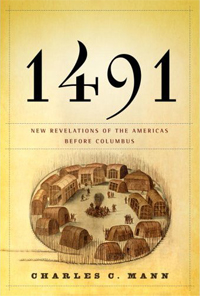
Consideration of Works Present: 1491


I just finished 1491 by Charles C. Mann.

I am very impressed.

There’s a lot to unpack in the book but fundamentally, it lays bare an assumption that I never realized I was making. One that I think we are taught continually in American culture.

I think it’s best phrased the following way as a sort of logic proposition.

  1. We know that in the “Old World” that humans put their mark everywhere they touched. It shows everywhere. In cities. In fields. In old monuments.
  2. We know that that humans are intrinsically the same. That is, all humans share the same capabilities of cognition, dexterity, etc. We express it different ways but one of the fundamental traits of being human is our ability to shape the environment to ourselves.
  3. Why should we ever consider “New World” humans any differently?

Once this proposition is exposed—and the obvious answer is that “New World” humans are not different—we have to look at the landscape differently. I.e., the “wilderness” we think of was not a wilderness at all. It was sculpted every bit as much as the “Old World”—differently, of course. Humans in the Americas had a different tool set than those in Africa, Europe and Asia and thus we can expect different outcomes. But that’s a difference in quality not quantity.

(For purposes of this discussion I’m going to follow Mann’s utilization of the word “Indian” to describe pre-Columbian natives of the America’s. He has a long chapter where he explains why he chose that word. Since he used it, and I’m talking about his work, I’m going to use it here.)

The reason that Europeans came up with the idea that the land they saw was “natural” was that by the time they explored it, the land was empty. Most of the native population died of introduced diseases long before they saw a European. The empty land was full of game and plentiful fruits and nuts—a natural paradise. Except it wasn’t natural at all. Europeans reaped the harvest without ever knowing how cultivated it was.

There’s a certain foreshortening of history that I think Americans are susceptible to. We have incredibly short attention spans and cling to myths and beliefs against all evidence. One of the problems with the American visualization of native populations is how it’s is based on a very narrow window of time. American imagery comes from the Time of the West—the forty years or so after the Civil War and before 1900. The remainder think about Thanksgiving but when they do, often they conflate the two, dressing the Indians in garb from two hundred years later and a thousand miles away.

The history between 1492 and the present—better than five hundred years—is, of course, much broader than that. The Indians didn’t all die at once—there were long stretches of time where there was significant comingling of the cultures. But vast numbers did die.

There’s one story that rung out for me: the story of Tisquantum who has become known as Squanto in the Pilgrim story. Tisquantuam was kidnapped to Spain about 1614 and spent several years attempting to return. When he left his village and the other villages in the area around Plymouth were vibrant and numerous. The coastal area was heavily populated all the way up into Main.

When he returned, it was desolate. His home village was gone. Where there had been tens of thousands there were not tens. The Pilgrims had squatted in the ruins of his old village. Tisquantum ended up living with them. Did he live there because this was the only thing that remained of his old life? Because after his time away, and this terrible loss, he ended up having more in common with those that lived in the ruins than the remainder of other tribes?

Mann tells these sorts of stories all through the Americas from Canada down to the tip of South America. Ecological triumphs such as the mispas—areas of combined cultivation of maize, squash and legumes where the heavy feeders (maize) pulled nitrogen from the soil that had been fixed from the atmosphere by the legumes. Some areas had been continuously cultivated for hundreds of years.

There were also ecological failures. The Mound Builders of Cahokia took to the introduction of maize with a vengeance and nearly destroyed the clay soil. There are evidences of washouts when the Mississippi flooded the area. Then, those washouts disappeared. The population figured out what they had done wrong.

There are stories of the rise of cultures through wonderful vision and the fall through nothing more than mean spiritedness in interesting parallels to similar patterns in the Old World.

Man introduces a number of controversial points and brackets them with the counter arguments and why he made his decisions. You can argue with these points and you’ll be in good company—these arguments are still going on as more and more evidence is being accumulated.

Even so, it changed my perspective and I welcome that.

Highly recommended.

Sunday, November 5, 2017

Consideration of Works Past: The Godwhale


First a heads up on happy information.

Recall earlier this year my story, The Sweet Warm Earth, was published in F&SF. It was picked up by The Best American Mystery Stories.

Well, it’s out. Here it is.

Okay, now that shameless self promotion is out of the way, let’s talk about The Godwhale.


TG was published in 1974 by T. J. Bass. Bass is one of those extremely interesting writers of which there’s not a lot of material to read. There were a number of these in the sixties and seventies. Bass’ isfdb page has two novels, a novella or two and perhaps four short stories. I read TG back when it was first published and read its prequel, Half PastHuman. I haven’t read HPH since so I can’t comment on it. Not that it matters. TG stands on its own.

TG begins a few hundred years in the future where there is a population issue but it is largely managed. The book follows the life of Larry Dever, a human that gets caught in an accident where the lower half of his body from the navel on down is amputated. He is put into suspension which introduces him to some intervening cultural periods, setting the stage to where he ultimately ends up. As he stays in suspension his genes become more and more valuable, being more ancient and primitive. In effect, he becomes a “wild type” human—a rich genetic source for future domestic crops (like humans) that have lost variability over time.

Dever ends up several thousand years in the future where there is nothing but the Hive, a continent spanning city-state containing a trillion human beings who term themselves Nebishes. Nebishes have been selected for this existence. They are small. Their calorie requirements are low. They have four toes. The Nebish city state is completely consumed with its own survival without regard to the cost to the rest of the world. Anyone who does not contribute or fails at his role may forfeit their right to active life and end up in suspension or demoted.

Bass has an interesting style. Reading him almost feels as if you’re reading dispassionate journalism. This happens. That happens. This person feels this. Truly horrible events are described without heat. It is the events that he relates that have a tinge of horror but the author doesn’t let the language be the vehicle. Not to say his prose is not compelling. It is.

There’s a lovely scene where Dever is resuscitated into the Nebish world in which, as a cripple, he cannot belong. But their ethics are strong where other humans are concerned. He cannot belong but they cannot kill him. Instead, they give him a painless poison in place of food. A citizen follows him around telling him how he has ruined her day. How miserable she is seeing him and he should just take the poison and die. Later, she is traumatized when Dever assaults her, takes her food and escapes.

The Godwhale of the title does not show up for some time. This is the plankton rake the Rorqual Maru. She is a whale that has been repurposed into a floating harvest factory. The Hive has left the entire outside world barren so she has no plankton to harvest. She sends her compatriot, a small unit named Iron Trilobite, to seek people for her to serve again. Instead, Trilobite becomes incorporated into the Hive. Where he eventually meets Larry Dever.

There are a few primitive people (the Benthics) that are stealing the sterile fruits of the Hive gardens. They survive by living in the sea.

Bass brings Dever, the Benthics, Iron Trilobite and the Rorqual Maru together deftly and they mysteriously bring about a reseeding of the oceans. Which, of course, puts them in conflict with the Hive for the same resources. This conflict occupies most of the book.

Bass was very interested in the nature of utilitarianism and over-population. One recurring theme in both of his books is the devaluation of human beings. While Bass never really states this issue in economic terms, in effect he proposes that as the number of humans increases to the point of resource contention, the individual value of human beings goes down.

While he never uses these terms, the Hive model is essentially a zero sum game system and the Benthics a non-zero sum game system. But this is not political ideology—the Hive is bound by its eternal struggle to match needs and resources. Once it’s made that decision, the zero sum game is the only game in town. The Benthics have scarcity but it’s driven by enabling barriers to the resources, not the limits of the resources themselves. Once the ocean is reseeded, the two methodologies square off and the Hive is the worse for it.

I want to be clear here. TG is not an ideological book. It’s a book with a strong plot and compelling characters that acts out aspects of ideologies because of logical necessity, not because of the invisible hand of the author. It really is an example of SF at its best: good characterization, an interesting world and circumstances that force the characters, and the reader, to grapple with complex ideas.

That said, there are some significant differences between the point of view of 1974 and the point of view of 2017. This is a good book but it is a book that is over forty years old. Two generations make a difference. Some might be feel a little squeamish on women’s roles in the book. Women are not trivialized as when presented under the auspices of Evil Heinlein. (As opposed to Good Heinlein.)

Like Cordwainer Smith, The Godwhale and other T. J. Bass work occupy their own little niche. I just wish there was more of it.

Sunday, October 1, 2017

State of the Farm, Fall 2017


(Picture from here.)
 
You recall last year when we had the worst drought I’d ever seen since I moved out here. Parts of our garden just twisted themselves out of the ground and we lost a couple of trees. Sections of grape arbors died and never came back. The birds, in their desperation, stripped one whole arbor of every grape that was there. The hornets and yellow jackets fought each other over left over orange rinds.

Everybody prayed for rain.

You recall that old adage, be careful what you wish for?

Well, it’s been a wet 2017. I mean, we’re not in hurricane class, but we got all the rain we needed. It was a cold rain, too. None of the melons set at the right time. The grapes came to fruition but they never got enough light or heat to really sugar up.

Sigh.

It was a good year for some things and a bad year for others. This was the best year we’ve ever had for apples. However, that’s not a high bar. Some folks would say that the measure was more a paint strip on the road than a bar. We got a bout thirty of the ugliest Granny Smith apples you’ve ever seen. I mean, these made those ugly dried face looking cabbage patch kids look positively handsome.

They made good apple tarts, though.

Back to the grapes.

I held off harvesting as long as I could, hoping against hope, they’d sugar up. We harvested the Concords and got an adequate harvest—maybe 15 pounds or so. Not much for that vine. They had a Missouri interesting flavor. (“My. What an… interesting looking baby.”) Not bad but  not too sweet, either.

Over the years I’ve moved to freezing the grapes before I press them. This has the interesting effect of making more of the juice available. But, since it ruptures the cells, other things come out in higher concentration. It gives a little something extra to the flavor. Sometimes it works as a wine. Sometimes it doesn’t.

So I froze the Concords and started up primary fermentation. I’ll get a hint when I rack the batch.
To make room for the Concords, I had to pull up some frozen peaches from earlier this year. (We had a good peach harvest.) That’s just finishing up primary so I don’t know how it came out.

We have two primary grape producing vines: Concord and Marechal Foch.

The M/F was the arbor that got nailed by the birds last year. Like the Concords, I held off as long as I can. Until I saw the birds paying too much attention to one corner. Okay. I attacked it last weekend. We got about 30 pounds of grapes.

It was interesting. The birds didn’t bother me but yellow jackets know no fear. I’d be working on a section when two wasps would decide that they wanted that bunch. No problem. I’d go working on another section. It reminded of a Leonard Wibberley quote from (I think) The Mouse that Roared.  It went something like this: “The pen is mightier than the sword but the sword is mightier than the pen at any given moment.”

I coexisted with the yellow jackets as the total amount of grapes gradually decreased. They flew near me once or twice but more as a sheathed threat than an active menace. Until the last bunches at the very top of the arbor.

I started pulling at the bunch and got seriously buzzed. This time one of them bounced off my head.

I figured I could do without that last bunch of grapes.

As I said, we got a good peach harvest earlier in the summer. Ditto the pie cherries. I hoped to get a few sweet cherries but, as always, the birds got there first. We did get a few plums.

The apples are always the last fruits of the season so we’re talking about what to do next year. We planted several new bushes and small trees: blue berries, sea berries, some paw paws. The nectarine has never produced well. The fruit is prolific but it splits and tears up the tree. It’s a dwarf. We got a volunteer nectarine across the yard. (Thank you, squirrels.) Its fruit didn’t split but the chipmunks got to them first. So I think it might be the base graft upon which the fruiting tree rests. Likely we’re going to tear it out and put something else in.

Ditto the prune plum and the pluot. Both appear to be reservoirs of black knot. We’ve been tip toeing around the problem for years because the prune tree has been with us for years. But no longer.

Likely, we’ll save the wood. We’ve been doing that this year. We had to cut down a birch and lopped the limbs off a cedar. Instead of just burning the wood, we coated them so they wouldn’t crack while they dried. When they’re dry enough, I’m going to pull out the lathe and see what I can make.

Musn’t waste things.