Monday, February 14, 2022

An Update on Updating

Updating has been sporadic of late. This is why.


I'm associated with the publishing cooperative Book View Café. All of my e-books and print books have been developed in association with them. As a cooperative, they help in proof reading, copy editing, book formatting and preparation. I work on their books and they work on mine. 


This virtuous circle enables production of my work.


Back in December, the site crashed and we took that opportunity to build a brand new site. This has occupied a bit of our time.


This blog is cross posted with the BVC blog. I've been somewhat loathe for the two blogs to get too far out of sync. It's happened anyway and that's the way it goes. All of these pieces will come back together in time, hopefully in the near term. But that hasn't happened yet.


Until it does, I will be posting entries in this blog that will likely not be cross posted to the BVC blog. 


I'm not sure the form, content, or schedule of those entries. We'll have to see what happens.


Monday, January 31, 2022

Multiple Narrative Points of View, Part 2


In the previous post, I discussed why one might choose a multiple point of view narrative over a single point of view.


This part of the discussion covers two questions: how to approach multiple POVs and how to manage them. The first is an esthetic discussion of how one could present multiple POVs. The second is mechanical: how to keep track of all those POVs over a long narrative.


Let’s get started.


How to approach multiple POVs?

There are a bunch of approaches. The ones I’ve seen the most are:

  1. Alternating scenes or alternating scene sections: This is where scenes are attributed to specific characters and the scenes are spread across structural components. Multiple scenes from different points of view in the same chapter.
  2. Specifically designed sections: All scenes from a particular point of view are collected into a structural component of the work. This can be chapters or parts.
  3. Mixed: this approach mixes the point of view in a given scene. This approach can be quite effective but is not terribly common these days as an intentional technique. More often, it’s just a sign of bad writing.

The alternating scene approach is the most common that I’ve seen.


There’s a lot of variations in technique. For example, Danse Mécanique, was in three parts. Part 1 was a close narrative, first person, of one individual. Part 2 was third person, alternating chapters from two different characters. Part 3 was another close narrative, first person, of one individual. All of the points of view were different resulting in four point of view characters.


In Welcome to Witchlandia, I had two point of view characters, first person, David and Katelin. In part 1, I used the alternating scene technique. (Though I used them as chapters. It made the structure cleaner.) In part 2, I stayed on Katelin’s point of view. In part 3, I shifted exclusively to David. In the epilogue, I returned to Katelin.


In House of Birds, I used alternating chapters for Part 1 for two different point of view characters. The chapters were organized around point of view. Then, in Part 2, I organized things differently. I used alternating scenes within the chapters and organized the chapters themselves by time. In Part 3, I stuck to a single point of view for the entire section.


The approaches in all three examples were dictated by what the book was about. In Danse Mécanique, the book was about an AI and its effect on humans. A single point of view wouldn’t have required the main character to continually comment on the changes seen from the AI—it wouldn’t have allowed direct demonstration of those changes. Welcome to Witchlandia was, at its heart, about failed love. Part 1 showed its creation. Part 2 began after the failure. Thus, Part 1 showed both characters. Part 2 followed the effect of that failure on Katelin followed by showing the effect on David. And, yes, it’s also about paranormal human flight.


House of Birds had a similar issue to Danse Mécanique in that it was talking about the effect of non-human beings on humans. That and the terraforming of Venus. Part 1 showed the initial effects. Part 2 showed the adaptation to Venus—hence the shift to organizing by time. Part 3 involved dealing with the finished product.


All of these approaches—and more—are valid techniques and have to be in service of what the work is about.


How to manage multiple POVs?

This is now a discussion of tools.


Multiple character points of view are hard. What’s the balance? Did character A get too much air time? Character B too little. Should the character B’s events being shown be from character A’s pov?


Managing POV characters is a superset of managing characters themselves. There are a plethora of tools for that out there and I won’t go into it. What I’m going to discuss are approaches, techniques, and tools I use to specifically manage multiple pov narratives.


I’ve tried various tools such as scrivener but without much help. I have used the following successfully.


Spreadsheets

Microsoft excel is my friend. I have spreadsheets showing dates and events. What character is the point of view in a given scene.


The book that is currently kicking my ass is an alternating scene approach. I have the following spreadsheets:

  • A character list with a brief description of each and a column showing which is and is not a pov character
  • A map of the parts by point of view characters, showing which scene each one shows up in.
  • A full date map of the book, showing events at specific dates and who is involved
  • A full timeline for the entire series.

And others that don’t involve characters.


Word

Microsoft word has an excellent feature in the (for Gates known reasons) find pane that shows the header styles: H1, H2, etc. What I’ve done is put the character point of view and the date in the separator of the scene as an h3. This means it shows up in the find pane as if it were part of the table of contents. I can write with it right there. It shows up something like:


Chapter x

   <1: character A, date>

   <2: character B, date>


This gives me a character driven outline of the scenes. When I have a lot of pov characters, I can use this to go scene to scene from character A’s point of view to make sure I’ve covered everything.


However, it only helps for those scenes from that character’s point of view. It doesn’t help when one pov character is imparting information or interacting with another pov character. In the above example, character A might say something important to character B that character B must react to in the following scene.


What I would like is a process that takes a word file and parses it for all character interactions and graph it out for me. Maybe I’ll write one some day.


In lieu of that, I have created what I call interaction diagrams.


Interaction Diagrams

I’m sure other people have something similar. The drawing proceeds from top to bottom indicating progression in time. Various figures show events. Specific icons show specific characters. An arrow is drawing from one character in an event to another character in the same or different event indicating influence, with a notation showing what kind of event.


This is done by hand. I haven’t found a software drawing tool good enough to replace a whiteboard. I tried visio for a while but found it limiting. Any suggestions?


Tuesday, January 18, 2022

Multiple Narrative Points of View, Part 1


Since we’re back and I’m a writer and this is, ostensibly, a writer’s blog, I figured we’d start out with a writing post.


Arisia, one of the Boston area Science Fiction conventions, was supposed to happen this last weekend. January, 2022, was too fraught with COVID for that to happen so they canceled it.


I was scheduled for three panels, one of which started on the convention’s opening night. The topic  of the panel was multiple perspectives vs single perspective in fiction. I was to be moderator. I had a very good suite of panelists including Andrea Hairston, Ken Schneyer, and the illustrious Anne Nydam.


Alas, it was not to be.


A side note about Anne, not only is she a prolific author, she is also a terrific illustrator. We found her work at Arisia some years ago and decided, then and there, she was to be the cover artist for Jackie’s Boy.


So, in unfortunate isolation and without the lovely synthesis of my worthy colleagues, I will put down what I thought about the subject.


To me, there are three questions that need to be answered regarding multiple points of view in a narration:

  1. Why multiple POVs?
  2.  How to approach multiple POVs?
  3.  How to manage multiple POVs?

 Why multiple POVs?


This will likely be the longest part of the discussion.


Single points of view have a lot to recommend them. It presents the opportunity to delve deep into the psyche of the character. The character presents an observation of the world at large. It gives the author to create a character that fits neatly into what the narrative is supposed to accomplish.


Multiple points of view have the bonus that one can create a gestalt representation of the topic. By this, I mean that if the subject matter is broad, different points of view can observe different facets of the problem separately. This allows the reader to pull those different facets together and observe the greater landscape—greater than that of any individual character point of view.


Consider this the Huckleberry Finn/Lord of the Rings problem.


The Adventures of Huckleberry Finn (Mark Twain/Samuel Clemens, 1884) is a novel that is tightly bound to the first person point of view of its title character. It’s a lightly written work that is directed at serious subject matter. I would guess that it would be called a black comedy, if it were written today. (Hm. Now, that’s an approach to a film adaptation.) Huck is an innocent and outsider throughout the novel. Because of this, he can observe what happens around him without moral judgment. This allows Twain to present terrible things to the reader and allow the reader to make the moral judgement for themselves.


It is clear from the presentation that the author thinks these things are vile but is unwilling to preach that horror to the reader.


I view Lord of the Rings (J. R. R. Tolkien, 1954) as a long discussion on the nature of evil and war. It is written from the third-person point of view of many characters. Some characters in the book know far more than others (Gandalf, for one) and that knowledge is carefully obscured from the reader by the structure of the narrative. None of the characters are true outsiders in the same way as Huck—they have a heritage as working members of the individual societies of the novel. By virtue of the impending war, all of them are thrust out of their original communities but carry the imprint of community membership with them. Each point of view concerns itself with the goals of the individual character and the larger goals of the character’s mission. But there is no in-depth discussion of the nature of evil or war. There is little investigation into the moral decisions they have made in the path of the novel. Evil is evil, after all. Like the Hulk in Thor: Ragnarok, it’s enough to look at Surtur and say big monster, just before hitting it in the head.


Instead, Tolkien embeds his opinions on the subject into the action and tribulations inflicted on the characters.


Could either of these works have been told differently? Maybe. I think changing either would cause the wave collapse of the universe. (Although, I have toyed once or twice in playing the story from Tom Bombadil’s point of view.)


But I think both are good examples of the narrative choice of point of view. Twain wanted to show the deeply embedded evil of slavery in a tight, personal way. He was uninterested in the larger societal ramifications—at least in this work. He wanted to show how individual people were tainted, root and branch, by this. How slavery reached across and stained whole aspects of life that were not generally associated with it.


Tolkien did not shy away from his characters being bludgeoned by the world. But I think that was more because he was a good writer than it reflected from LOTR’s goal. He was after a higher perspective—one that was attained by spreading the action across multiple characters.


I have this idea that a work is about something—by this, I do not mean something as simple as a topic or a theme. For example, John Dos Passos’ (the ultimate master of multiple points of view) USA is about the USA. That subject is beyond a theme or a topic. To target that subject, he used many, many points of view where none of the characters had any real knowledge of the subject matter. Contrast this with LOTR where all of the characters have intimate knowledge of the war and evil of the subject matter.


So, given this idea, what the work is about has a direct influence on why the points of view are chosen.


When I start a work, I spend a lot of time determining how the work is presented via the characters. Jackie’s Boy was tightly coupled with Michael, a boy of eleven. God’s Country is spread across five points of view. In both cases, the decision was based on what was being investigated. In Jackie’s Boy, I wanted to look the individual growth of a damaged child. In God’s Country, I was interested in how people reacted to the injection of the divine into their lives—well, my idea of divinity which will fit in no religion whatsoever.


Next: How to approach multiple POVs and how to manage them, for God’s sake.

Tuesday, December 21, 2021

Announcing House of Birds Release, 12/28/2021


What if God is an alien who inhabits the body of a macaw? Young Ian finds out when his mother's nasty-tempered bird turns out to be an alien that will cure her alcoholism if Ian will work for it.


What follows is a career spanning hundreds of years and identities, as Ian struggles to save at least some of humanity from environmental disasters: earthquakes, tsunamis, and lost species.


He gets used to lots of dying to find out if a terraformed Venus full of dinosaurs is worth it.


Ebook release 12/28/2021: Pre-orders here. UBL, UBL.


Print version available now. UBL.

Monday, December 20, 2021

Saga of the Lathe, Part 1: The Problem


Supposedly, Michelangelo was asked how he created David. He said it was easy. Just remove all the stone that doesn’t look like David.


While this is a frivolous take on the idea, building things is always a blend of adding and subtracting.


In the case of wood turning, it’s mostly removal. Take a cylinder of wood, spin it, and use some kind of sharp device to remove what you don’t want. The spinner is called a lathe. The device is called a turning tool.


I started wood turning a while back. I started with tiny lathes until finally I wanted to do some big things. This meant a big lathe. I looked around and found a used Delta lathe and bought it. This was a big thing: 14” inch diameter cylinders across a 42 inch bed. Better than 200 pounds of cast iron. I could take logs and peel them down to a workable size.


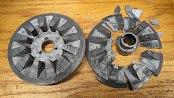
And after about a month, it broke. No, that’s not the pulley that broke this time. The first pulley to break was the motor pulley. The pulley shown is the spindle pulley.


Regardless, thus began the Saga of the Lathe.


A lathe is, essentially, four parts: the headstock, which actually turns the piece, the tail stock, which passively supports the piece against the headstock, the tool support you brace the turning tool that cuts the wood, and the bed that supports all of this. Nothing much goes wrong with the bed, tool support, or tail stock. But the headstock is another story.


The headstock is an astonishingly complex assembly. It’s a spinning hollow tube that allows placing all sorts of attachments in one end. This means it has a motor turning two pulleys: one end attached to the motor shaft (the motor pulley) and the other going inside the headstock to rotate that tube (the spindle pulley.)


We need to define a few terms here. RPM is revolutions-per-minute. This is how fast that hollow tube is turning and, by extension, how fast the wood being turned revolves. Torque is the rotational force coming from that rotation. Torque and RPM are completely separate qualities. There are high speed, low torque systems that you can stop with your hand. There are low speed, high torque systems that will tear your hand right off without slowing down. A 24 inch car wheel rotating at 10 rpm is, in effect, running at less than a mile/hour. But a human can’t stop it.


Most full sized lathes range between about 600 rpm and 2400 rpm using something like a 1700rpm, 1 horsepower motor. So, if you’re running the rpm of the lathe at the same natural speed of the motor, most of that horsepower is transmitted to turning wood. That’s a lot of torque.


Speed control is an important part of using a lathe. A twenty inch by twelve inch irregular log is barely manageable at 600 RPM (10 revolutions/second) and even then it’s scary as hell. Faster than that, it’s nightmare fuel. That said, turning a fine spindle at 2400 rpm is lovely and gets a beautiful, smooth surface.


There are several different mechanisms to change turning speed. The simplest, yet most expensive, is to use a DC motor and just put a controller in the circuit. DC motors will change speed relative to the power they receive. But this means you sacrifice torque—starve the motor of power and it certainly slows down but it gets weak, too. I’ve seen lathes turn at 60 rpm (1 revolution/second) that I could stop with my hand.


Most lathes, instead, use a constant speed AC motor and change the speed by changing the motor and spindle pulley ratios.


I love pulleys. They are human mechanical ingenuity its finest. Imagine two pulleys: one is, say, 2 inches in diameter. The other is 6 inches in diameter. Circumference is C = πD. So that 2 inch pulley is 6.28 inches around. The circumference of the 6 inch pulley is 18.9 inches. Connect the two with a belt so they must turn together. This means every time the 2 inch pulley turns three times, the 6 inch disk turns once. (More or less. Let's say that to avoid decimals.)


This is how lathes manage speed. They put the small pulley on the motor and the large pulley turns the lathe shaft. To change the speed, the ratio between the two pulleys is changed. Often, this is done by having a set of pulley pairs of different ratios and moving the belt from one ratio to another.


Changing the speed has an effect on torque as well. If the motor is running at a constant rate, when the effective pulley speed is the same rotational speed as the motor, the torque at the pulley is close to the torque on the motor. Let’s say the motor pulley is running faster than the spindle pulley (it’s the 2 inch in the previous example.) It’s already stated that the 2 inch pulley is turning 3 times faster than the 6 inch pulley. That means the motor has applied its horsepower to the motor pulley 3 times while the spindle pulley has turned once. Which also means the spindle pulley is getting three times the torque the motor pulley is supplying.


This is the way mechanical advantage (sometimes called leverage) works. It’s trading two related qualities across a conserved common quality. Think of a garden variety lever. What is being conserved is the angular rotation. Push down on one end of the lever and the other end goes up the same number of degrees. It doesn’t matter if one end is a mile long from the fulcrum and the other is an inch. Push down the long end of the lever ten degrees and the other end will rise ten degrees.


What is traded is the distance covered by the ends of the lever. If one end travels 10 inches and the other end travels 1 inch, 10 inches of force gets compressed to a 1 inch travel: a 10 to 1 mechanical advantage.


In the case of this example of pulleys, the rpm is being traded but the linear distance traveled at the pulley is constant. When the small pulley rotates 1 revolution, two inches of rotational travel occurs. On the large pulley, two inches of travel also occur. But the difference here is two inches is one rotation on the small pully and 1/3 of a rotation on the large pulley. Thus, three times the torque in a single revolution.


But moving the belt is inconvenient. In addition, there’s a limit how many ratios can be put in the headstock. (Usually, it’s four.) What if we want much finer control? And we don’t want to sacrifice torque like the DC motor approach?


Enter the Reeves Pulley.


I was unable to find out who Reeves was, although I did see pictures of pulley systems with a Reeves logo on them. Presumably, there was a genius mechanical engineer a hundred years ago that came up with this. I hope he was well paid.


Look at the picture at left. (Picture from here.) Note that we are looking at two pulleys, each made up of a pair of flat cones. In this drawing, the upper pulley is movable but the speed measurement is against the bottom pulley. As the cones of the upper pulley are pulled close together, it increases the force against the lower pulley, forcing the two cones apart. The circumference of the lower pulley is now small while the upper pulley’s circumference is large. Let’s use the numbers we used before. Each time the 6 inch upper pulley turns, it rotates the 2 inch lower pully three times. If the upper pulley is turning at 100 rpm, the lower pully is turning at 300 rpm.


Now, if the upper pulley is pulled apart, a spring on the lower pulley pushes the cones together. Let’s say, we’ve now reversed the ratio. The lower pulley is now the six inch pulley while the upper pulley is the two inch pully. The upper pulley is still turning at 100 rpm. This makes the lower pulley turn at 33 rpm. (A good calculator is here.)


Variable transmission with minimum loss of torque.


What broke initially on the headstock was the motor pulley. I hadn’t done my homework. Delta had skimped on the materials used in the pulleys and used an inferior zinc alloy. The motor pulley had shattered.


I looked around and discovered that Delta had been out of business for some time and there were no parts available. However, a competing manufacturer made Reeves pulley pairs that sort of fit my motor. The problem was they were too small. Remember the pulley ratios? I could go slow but I couldn’t go fast. The original top speed was 2400 rpm. I was running at 1600.


Oh, well. I coped for the next couple of years.


I had been making tops for a while now and my son asked me to make him a big one. Okay, I said. I took a big piece of ash, hammered it into place. Made sure the alignment was right and turned on the lathe.


*THUNK* Hash. Rattle. Rattle.


Oh, crap, I thought. I opened the headstock and saw chunks and pieces of zinc alloy inside. See the picture above.


The spindle pulley had exploded. This was also the part of the Reeves system that actually moved under control, unlike the motor pulley that moved passively in response.


Now, I had a problem.


Sure enough, a search on line told me nothing about the Delta parts situation had improved. I went back to the surrogate supplier to get a new spindle pulley.


To the left here is an exploded view of the headstock. If you look at the part numbers, parts 5-8 is the motor pulley assembly. In the same drawing, parts 14-47 is the spindle pulley assembly.


I had my work cut out for me.

Monday, December 6, 2021

Rumors Behind the News


(Picture from here.)


Those are the headlines. Now for the rumors behind the news.Firesign Theater.


I have a lot of science material running across my desk this week so I’m just going to hit the highlights.


These are not in-depth discussions. Instead, they’re more like look at this sort of thing. Links to further discussions are provided.


Let’s get started.


Top of the list is the James Webb Space Telescope. This intended successor to the Hubble Space Telescope can be considered an enormous boondoggle or the greatest potential tool for ferreting out cosmic mysteries, depending on your point of view. There is enough evidence for both points of view that the JWST could be both.


It is enormous.


The mirror is 6.5 meters across of a hexagonal construction. It operates in the infrared—which is, in some ways, a more forgiving frequency range than what humans like to use. Infrared penetrates much of the gas between us and the center of the Milky Way, for example. When—if—the JWST works out, the potential for observation is likely without peer for some time.


That said, there are at last count some 350 “single point failures”, i.e., non-redundant components, that might scuttle or damage the mission. The JWST already had a scare in November when a clamp band was unexpectedly released, jarring the structure. While the JWST will be packed and secured for launch, it was not so secured when this happened.


It’s scheduled for launch sometime on or beyond 12/22/21. Good luck.


Some discussion on the archeology of glass came by the other day.


Glass in the Late Bronze Age was prevalent but didn’t resemble modern glass much. It was opaque, colorful, and usually is in the form of beads and jewelry. Think of glass then as Aluminum was in the 19th century. Now, Aluminum is so ubiquitous we can use it to make soda cans rather than glass soda bottles because it is cheaper. But in the 19th century, Aluminum was so rare it surpassed Gold in value.


Glass was similar. Difficult to work with—Bronze Age foundries could not get a high enough temperature to get Silicon Oxide to melt complete. Instead, they found clever ways to reduce the melting temperature. Some of those additives gave the result some striking color. Notable, the color blue.


Interesting side note, early Iron smelting took advantage of a similar approach and figured out a way to reduce the melting point of iron in a bloomery. The resulting iron was beaten with hammers to essentially knock out the slag. This first blomery seemed to appear around 3000 BC. But, iron wasn’t utilized into 1200 BC. Glass beads have been discovered back as far as 3000 BC but the use of glass took off somewhere around 1600-1200 BC. Hm. Isn’t that an interesting coincidence? Did one technology feed the other? Were they developed independently?


No one knows.


Anyone who has spoken with me for any length of time knows that I have two big areas of interest: Neanderthals and dinosaurs. My first published story, A Capella, in 1982 involved a Neanderthal artist working on commission for some Cro Magnons. The source of that story was an exhibition of cave painting photographs at the Boston Museum of Science. One of the docents was introducing the photographs and said something like, “Who made these paintings? Well, it wasn’t this fellow here, the Neanderthal. He wasn’t capable.” That pissed me off and I wrote the story.


It seemed the height of arrogance that a close relative of ours whose longevity exceeded ours would not have similar characteristics. Since then, I have been happy to see the rehabilitation of Neanderthal’s image. Certainly, we find we have interbred with Neanderthals but I don’t really count that for much. Human beings will mate with anything.


But we have been finding Neanderthal artistic artifacts that, along with similar Homo sapiens artifacts, that it’s beginning to look like fashion has been with us as long as we’ve been human. See here.


Science isn’t always comforting and COVID is not reassuring. Now, no doubt, the omicron variant are words on everyone’s lips. But there’s more to consider.


The number of new cases in children is disconcerting, both here in the US and in other places, notably South Africa. Part of this is, of course, that children are the last group to be vaccinated. So, it is expected that they would be showing up more often. That said, the increase in child cases in South Africa is troubling. The African vaccination rate is low in comparison to the rest of the world so the same metrics might not apply. Since SA is also the source of the omicron variant, and many of the mutations are in the spike protein, one wonders if the relative resistance of children to COVID that we’ve seen throughout the pandemic might have been overcome.


Vaccination is the best way to combat this. Vaccination, masks, and social distancing.


More problematic medical news. There are increases across the world in fungal diseases.


Pathogenic fungus has been with us for a very long time. It’s a known danger to HIV patients. However, usually, humans (and mammals in general) have a good time resisting fungus attacks. Part of this is the fact we are warm blooded. Hard over on the endothermic scale, for that matter. Birds and mammals maintain a very high temperature relative to the outside world. Other branches of the vertebrate tree, such as fish, reptiles and amphibians, do not and are much more prone to fungus attack. Mammals that have variable body temperature, such as bats, have been fungus susceptible.


Some scientists have suggested that the reason mammals have developed this form of thermoregulation was, in fact, to ward off fungi attack. Certainly, it didn’t hurt. One scientist has suggested that what might have prevented the dinosaurs from retaking the planet after the Chicxulub meteor was that they did not have sufficient fungal resistance when the temperature of the planet cooled.


Our little hiatus from fungal attacks may be coming to an end.


In 2009, a patient in Japan contracted Candida auris on the ear. The species had been unknown to science up to that point. Within a few years, cases emerged in other parts of the world. At first, scientists thought this was a case of travelers carrying the disease. But genetic sequencing showed these were disparate strains without contact with one another. This is potentially serious as 30% of those infected die within 30 days.


Fungal infections occur more often in warmer regions—while humans are hotter than their surround, this resistance reduces when the environment is just as hot as we are. Fungi adapt just like anything else and they’ve adapted to the tropics. As the world continues to warm, more places begin to approach human temperatures and there are more places for fungi to adapt to.


Remember, part of the reason we’re seeing more COVID variants is because there are so many opportunities to adapt in the sea of unvaccinated human beings. We are, in effect, selecting for variants.


In creating more warm places on the globe, we are doing the same thing for other organisms, many of which view us as just so much real estate to occupy.


That’s depressing. Let’s move on to something more fun. Back to space.


It’s no secret the International Space Station is getting long in the tooth. Many don’t believe it will last beyond the end of the decade. It would be nice to have something to replace it.


There’s no shortage of candidates. China has the Tiangong. Sierra Nevada is talking about building its own. So has Russia.


NASA has selected a bunch of candidates to develop commercial stations with government funding. The three, Blue Origin, Nanoracks, and Northrup Grumman, have been awarded grants to come up with designs. Each is to be independent of the others.


While each of these companies brings a considerable expertise to the problem, even if they find excellent solutions, it’s not at all clear Congress will fund it. Congress hasn’t yet even funded the grants.


It would be really nice if the endeavor of getting human beings to the stars weren’t at the whim of a body containing people who believe in giant Jewish Space Lasers.


Finally, Transiting Exoplanet Survey Satellite (TESS) found a very interesting planet orbiting a red dwarf about 30 light years from here. Heck, that’s practically two blocks over. GJ 367b orbits its star every eight hours. It’s about half the mass of earth and orbiting so close that its tidally locked and the sun facing portions might be molten—even if they are iron. The estimated surface temperature is 1,745K. Iron’s melting point is 1,811K. However, impurities might reduce the melting point that any iron on the surface might be considered part of one big bloomery.


That’s it for today. Enjoy your week.