
Amazon has put the print version of my novel, Jackie’s Boy, on sale. They have cut the price nearly in half.
So: if
you want a print copy, now’s the time to get it.
Link is here.
So: if
you want a print copy, now’s the time to get it.
Link is here.

We’ve had a few changes here. New trees planted. Old ones removed. Experiments monitored.
We had two huge pine tries at the southeast end of the property. One fell down in a storm last year and we had the other one taken out a few weeks ago. The entire southern section of the property was driven by these trees. Substantial sections of fruit trees, grapes, and garden now get up to twice as much sun as they did before.
This has had interesting effects. For one thing, cedar apple rust from the nearby cedars didn’t affect the apples as much. (With the exception of the Granny Smith. It seems to reflect the wet June more than the other varieties.) The grapes are now practically ripping themselves out of the ground. Two varieties (Himrod and another I don’t recall at the moment) have been doing poorly. They are now doing well. We have flowers.
We’ve been struggling with watermelons for years. This year we’ve been getting much better germination.
In other areas, we’ve been having germination issues. The snow peas never came up. I wanted to try sugar beets this year. We planted three times with two different packets of seeds without success. We’re trying to germinate them in the greenhouse to see if it’s a temperature problem. This has been another cold, wet June—last night got close to the forties—and that has an effect.
We planted some new fruit trees. Some are doing better than others. We planted two jujube trees and one came in and the other is struggling. We had jujubes (also called Chinese Dates) and liked them so we’re attempting them here.
The Bloody Butcher corn is up and we have zucchini growing at one end and butternut at the other with beans planted around each corn stalk—the traditional “three sisters” approach. One group of beans germinated. Another did not. The ones that did grow were seeds we saved from last year. The ones that did not were store bought this year. The sugar beets were also store bought.
Hm. Could there be a pattern here?
We have three varieties of short season melons we’re trying this year—again, I forget the variety names and I’m too lazy to go downstairs and get the seed packets. I’ll report on their progress later in the summer.
The only really successful watermelons we had was the drought year when Ben was born, 1997. We have a great picture of Wendy holding Ben in one arm and pointing at the melon with her other hand.
The other news to report is how well the Birdies raised beds are doing. We purchased one set early in the year. The potatoes are looking very nice and the carrots between them are sprouting up their tiny, hairy leaves. So far, the deer are leaving them alone and the bed is too high for the bunnies.
Speaking of bunnies, we also lined the bottom three feet of the garden fence all around with plasticized chicken wire to keep them out. We lost many crops to them last year the way we lost the strawberries to the chipmunks. We have no outdoor cat this year but we’ll manage: Bugs is going down one way or another.
I’ll pull up a complete list of new trees for this year and a garden plan, if anyone is interested.
Back to work for me.
(Image from here.)
I’m irritated about gas prices (and all the knock-on effects) but probably not for the reasons you might think.
I’m irritated because it should have happened decades ago.
Let me explain.
Oil is a finite resource. (Less so coal, but I’ll address that in a different post.) There is always a calculus between oil demand, oil availability, and oil processing cost. This involves the cost to extract the oil, transport the product, and turn it into usable material. These are referred to as upstream, midstream, and downstream processes. Midstream processes are essentially the same regardless of source, so we’re going to neglect that until later in this discussion. Downstream process cost reflects the quality and cost of the oil produced, so we’ll leave that for later, too.
Demand is (or can be) elastic. The amount available is only elastic with respect to the cost to capture the oil. I.e., there’s a lot of oil in the ground with differing costs to capture it. As long as the demand can support the cost, there is oil available. (Within limits. More on that in a moment.)
Which brings us to upstream processing: the cost of extraction.
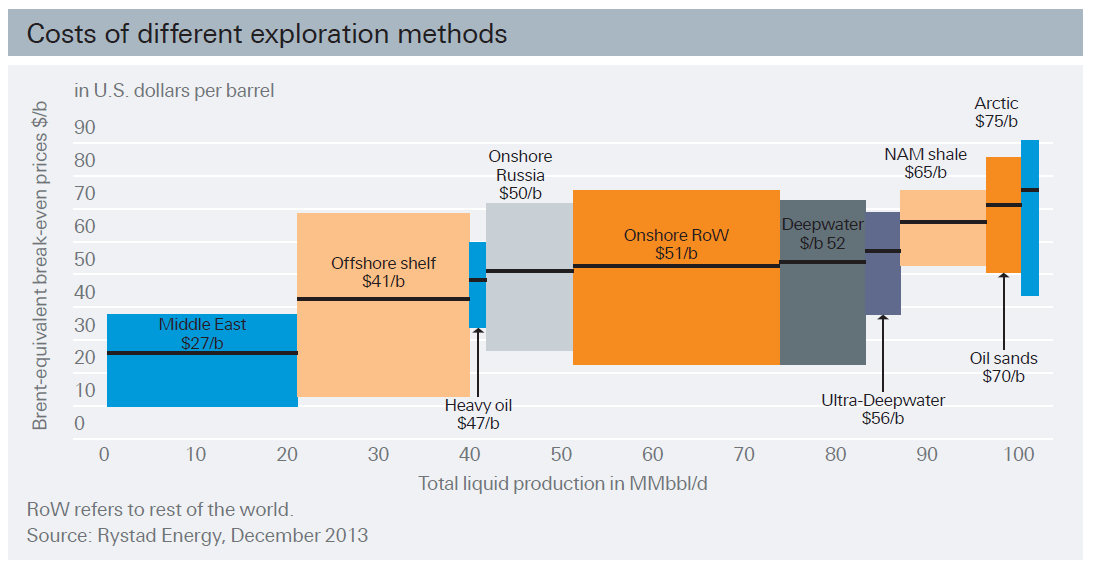
There are many different methods of extraction. (See here.) It should come as no surprise that each method comes with a price tag. Middle East oil—accessible from land, not too deep, not too viscous, not too much sulfur—is the cheapest. Costs increase with difficulty: off-shore shelf, onshore Russia, etc. The most expensive is extracting from shale deposits, oil sands, and the Arctic. Arctic oil is the worst but given global warming, that might change.
Costs come from technical challenges, exploratory expenses, and regulatory obstacles.
Thus, when oil was getting a lot of money/barrel, shale and oil sands were profitable resulting in fracking in the Dakotas and elsewhere. When the price of oil falls, those methods are no longer profitable and cease operation.
Note: these costs neglect the actual cost of oil production which would include the cost of pollution, habitat destruction, cultural annihilation, global warming, etc. Were that included, none of these efforts would be profitable. This is important to remember. It means the price at the pump in no way reflects the true cost of the product.
Remember I said oil is a finite resource? The costs of extraction reflect extraction difficulty. Profit-driven corporations look for cheap methods like a heat-seeking missile: cheap oil is the preferred target. Which means it will be used up first. As that resource dries up and becomes scarce, its price goes up and other sources become more attractive.
This goes on until the point of peak oil: the point where the economically viable extraction of oil must begin to decrease. As the price increases, the total amount must at that point begin to decrease. Eventually, oil wouldn't be worthwhile to extract.
People have been predicting peak oil since the mid-twentieth century. The date has been put off as technology improves. Remember, this is not oil depletion. There would still be oil in the ground. Peak oil is the beginning of the downhill slope towards where there just wouldn’t be sufficient money to pull it out, regardless of demand.
Peak oil is coming. We only have control over when and how we meet it. Some have estimated peak oil sometime in the next 10 to 15 years.
There’s a knock-on effect with the increase in the price of extraction. It drives up the costs of the midstream and downstream operations. Downstream operations (i.e., refineries) take significant energy to operate, much of it in the form of petroleum. Refineries use fractional distillation to separate components. This takes heat. The heat is supplied in the form of burning petroleum products. In addition, as we move away from the nice, pure crude we like to uglier, nastier materials, it takes more energy to refine them, upping the costs yet again. Thus, the increase in the cost of extraction drives up refinery costs. Midstream operations are largely transportation. Which—you guessed it—uses petroleum products.
People have this expectation that these cost problems will somehow be gradual. After all, we use these products at a more or less constant rate. We should see a gradual increase as the problems begin to crowd in.
But that’s not how these sorts of systems work—neither the economic system we’re discussing today or the thermal climate system it’s destroying. Instead, there are times of gradual movement punctured by an event causing sudden changes, followed again by a period of gradual movement. We can see this in gas price changes: periods of sudden increase responding to some event (war in Ukraine, I’m looking at you.) followed by a reduction in price to a point above the original. The price will not return to the original because of the increase in extraction costs. Its reduction is not certain. The price may remain very high.
BTW: this reminds me of Gould and Eldredge’s idea of punctuated equilibrium in evolution. Periods of stasis where the environment remains within narrow limits, followed by rapid responses to sudden environmental changes.
Thus, the costs we’re seeing now are inevitable and reflect a known progression in the underlying economics of the oil industry. It’s the cost’s stepwise nature that seems to surprise us.
But we could have avoided all this.
What we should have done is tack on a gas tax decades ago—a big one, of 100% or better—phased in slowly so we could get used to it and create adaptive mechanisms. Then, use that money not just for roads and bridges but for research to get us off fossil fuels, funding fuel alternatives, and public transportation. We just don’t need to drive as much as we do. If the pandemic has taught us anything, it has taught us that. It would have by no means been enough but it would have given us a disincentive to use cars and provide a funding mechanism.
And, yes, there would have been all sorts of issues in managing that money to prevent fraud and abuse. It is the nature of money that some will figure out how to game the system at the expense of others. We don’t seem to mind it when the defense and finance industries scam us but we get all pissed off when it happens in systems that are intended for our benefit. Then, we get all huffy and say, well, it won’t work, and scrap it. It’s an American character flaw.
This is why I’m irritated. Now, we have the same cost we should have had a long time ago, without any time to adapt or build mechanisms to protect us, and we’re getting nothing for it. Instead, we’re desperately paying like addicts when the dealer has upped the price.
I don’t have any sympathy for his increased costs, either.
.jpg)
Go here, for pre-order. Now for today's post.
To say that I’m not a fan of time travel stories is to
understate the issue.
This is
not to say that I don’t enjoy a good romp at time’s expense. Many films that
use time travel can be fun. (I’m looking at you, Back to the Future.)
Books, too.
But
often time travel is essentially an excuse for lazy writing or lack of
imagination. (Now, I’m looking at you, Star Trek.)
Science
fiction has so many avenues and opportunities for literary exploration that to
me time travel is usually superfluous.
All
fiction is, in some way, about the time, place, and idiosyncrasies of the
author. After all, the author has a point to make or the effort of making the
work would not have been written. The point might be as crass as “I want to
make a lot of money”—in which case, I suggest the author go out and become an
accountant. I’ve been writing for decades and have yet to see much money. Or,
the point might be “isn’t this scientific fact/theory/locale/time of interest
really neat? Let’s examine it.”
When it
comes to time travel, the point made most often has to do with using the locale
to target some interesting idiosyncrasy of the present. There’s a misalignment
with the states that were members of the Confederacy and the other states.
Hence, what if the South had access to modern weapons during the Civil War? (The Guns of the
South, Harry Turtledove.) Christian religion is on the rise. What if we
could go back and witness the life and crucifixion of Jesus? (Behold the Man,
Michael Moorcock.)
Novels
like this are examinations of the underlying subject matter. Time travel is a
narrative convenience, allowing modern sensibilities to be juxtaposed against
the period under scrutiny.
However,
many time travel stories involve thwarting the past or thwarting the future (The
Terminator movies, Back to the Future, every Star Trek time
travel story ever made.) In these stories, there is a contrived crisis that can
only be solved by dealing with time traveling. While I can enjoy some of these,
I don’t think much of them. It’s like eating peeps. After the first time, you
might regret it or chalk it up to a learning experience. About the fifth time
you’re muttering kill me to yourself.
These
days, time travel stories have a huge barrier of entry for me.
That
said, here are a few films and books where time travel is actually used in an
interesting fashion. Part of the fun—sometimes all of the fun—of time travel
fiction is the surprise the author/filmmaker gives you. Consequently, I’m not
going to give much away.
Primer: There
are basically two kinds of time travel stories: Stories where the past can be
changed and stories where the past cannot be changed. Primer is of the former
category—sort of. Primer’s conceit are two engineers that discover a
means by which an individual in the time field goes back in time for the
duration of exposure. The time machine, the “box”, is entered, the field is
turned on, the user waits in the box a specified period of time and then turns
off the field and exits at some point in the past. This means the past can be
modified, occupied by different representations of the same person
simultaneously, etc. Time can’t be broken—in the sense of the universe
be destroyed or some such—but the individual lives of people can be severely
damaged. Which is what this film is about.
Frequency:
This film takes the same idea of a malleable past but locks it down. In this
story, Detective John Sullivan discovers a way to talk to his dead father
(Frank Sullivan) twenty years ago via a ham radio. (Just let that go.) In this
kind of story, no physical objects can transit to the past. Objects can travel
to the future normally. But information can be transmitted freely
between present and past. John manages to tell his father how to avoid his
oncoming death. Thus, he suddenly has a father again. However, there are
consequences.
12 Monkeys: The
past is not malleable in 12 Monkeys. Humans can go physically to
the past but whatever things they do there are already accounted for. The
“present” of 12 Monkeys is in our future where most of humanity lives
underground in fear of a virus that has killed most of humanity. Scientists
keep trying to determine how to cure the pandemic. Leftover messages and scraps
of knowledge is all they have. Eventually, they manage to send James Cole to
the past to uncover what these messages mean. But the cost to him is high.
Predestination:
This film is based on Heinlein’s story, All You Zombies,
which I think is probably the best time travel short story ever written. Essentially,
this is a story about a paradox from the paradox’s point of view. I think the
film is better if you read the story first, but it still stands on its own.
The Man
Who Folded Himself: This novel runs the whole idea of time travel,
malleable or otherwise, until the bolts fall off. TMWFH is a lovely book about
Daniel, a not so lovely man who makes many, many mistakes with power he
probably should not have had. The thing that is so downright good about
this novel is that it is absolutely unflinching about consequences—even when
Daniel is trying very hard to avoid those consequences. The novel was
nominated for both a Hugo and Nebula. I think it should have won.

 Posts
All Comments
Posts
All Comments


