Monday, January 2, 2023

Cheese Ends, 20230102


What better way to start the year than with Cheese Ends?


(Picture from here.)


I’m getting older every year, so we’ll start with a possible approach to human longevity.


Anyone who has worked with culturing cells has noticed that after a number of generations—say 50, or so—the cells get bloated, sick, and generally unhappy. They quit reproducing. They become senescent cells. It’s not entirely clear why this happens or even if, in all cases, it’s a bad thing. Senescent cells have been shown to contribute to the healing of injuries, for example.


But if they—like a dinner guest that has overstayed its welcome—linger too long, they begin to have bad side effects. They produce noxious chemicals and tend to cause a continuing and deleterious immune response. They can also turn cancerous. In some aging tissues the number of senescent cells can approach a third.


So: if senescent cells are bad, getting rid of them would be good, right?


This was the approach in an experiment at the Mayo Clinic. In the experiment, they genetically engineered mice such that when cells became senescent, they became susceptible to their target drugs. Then, they raised the mice to middle age and began injecting them regularly. The mice lived longer and better. They had less issues with heart, kidney, and other organs. They were still susceptible to cancer.


There are a lot of potential issues. For one, it’s hard to genetically engineer human beings so a senolytic drug needs to be developed. One that targets senescent cells. For another, these things would have to be done delicately.


A long time ago I was at a presentation by a researcher that was chasing a general antiviral drug. His method was to link a virus recognition mechanism to a signal to the cell to self-destruct—apoptosis. The plan was to kill the virally infected cells.


(I went looking for a publication for this and couldn’t find it so I’m reciting the presentation from memory.)


He infected mice with a singularly fatal virus and administered the drug at intervals—one population of mice at one day infection, the next at three, etc. The mice recovered well enough until towards the end of the experiment, when the mice were close to death, the mice died more quickly with the drug than with the disease. What was happening was the number of cells that died from the drug were so great, the impact of all of those dead cells overwhelmed the animals’ ability to recover and they died of a kind of shock.


This could be a problem in treating an older population where organs can have a substantial population of senescent cells in their organs. It’s not good to kill Granny with the thing that is intended to prolong her life. Conclusion: hopeful.


Climate change is happening and its effects are, as has always been predicted, showing in the intensification of weather events. No surprise there. Here is an article that reviews 2022. I’m not going to talk about it. I find perfectly avoidable catastrophes depressing.


As we go forward studying the neurological behavior of animals, we keep getting thrown by them showing themselves to be more sophisticated and smarter than we expect. This happened first with primates when we realized that other primates had way more cognitive horsepower than we realized. Then, it happened with birds. Now, it’s happening with insects.


It turns out bees seem to play.


In the course of some experiments, some researchers in London were training bees to roll wooden balls in order to gain a reward. This, in and of itself, shows that an insect with the brain of 0.5 mm is smart enough to connect pointless activity and reward. During the course of the work, they noticed some bees that were not trained to a reward rolled the balls, too. They wondered if this could be play behavior.


They set up the experiment so the bees had plenty of food and left the wooden balls around. Then, they measured how often they interacted with the balls and whether or not there were possible associated rewards unconsidered by the scientists—i.e., there could be a reward the bees were getting of which the scientists were unaware.


The bees “played” within the parameters of the experiment. By this, the bees interacted with the wooden balls without any obvious reward or association with something the bees might consider inviting like a flower or something.


Did they play? By this, did they indulge in spontaneous activity that had no obvious reward or incentive and then return to the same activity? Well, yes.


Go figure.


Moving from the sublime to the ridiculous, there’s a startup that allows you to buy your way into geoengineering.


I’m not going to mention the company since I don’t want to promote them—you can find them if you want. Instead, I’m going to call them Idiot Engineering for my own demented purposes.


Idiot Engineering is proposing—and may have begun—to inject sulfur dioxide (SO2) into the atmosphere.


SO2 reflects back a certain amount of the sunlight received by the earth. Reduce the sunlight, reduce the warming, so the thinking goes.


This does work in the broadest possible sense. We’ve observed this when a given volcano erupts and sends gigatons of SO2 into the atmosphere. I’m looking at you, Mount Pinatubo.


Human geoengineering has a lot of pitfalls. SO2 + H2O yields sulfuric acid. We just managed to reduce acid rain so that’s not a great idea. It’s temporary because the sulfuric acid rains out. And it avoids correcting the cause of the problem. Even if it provided a viable solution—which is highly unlikely—we’d have to keep increasing the amount because we keep introducing more and more CO2. Remember, even if we stayed at the current level of CO2 emissions, we still haven’t reached CO2 equilibrium.


But where there’s one idiot with an idea, there’s always a venture capitalist right behind. Idiot Engineering has attracted money. They claim to have launched their first SO2 clouds and substantially reduced global warming.


I doubt it. But I’m still keeping my houseplants indoors.


Finally, to end on a good note, J. Robert Oppenheimer has been exonerated from the charges that were brought against him back in the fifties.


Oppenheimer was a very good physicist long before he was tapped to head the Los Alamos portion of the Manhattan Project. He was one of the first to predict quantum tunneling, something that enables fusion on the sun. His contributions before the Manhattan Project might ultimately have led to a Nobel Prize had he lived longer and didn’t fall under the anti-communist shadow of the fifties. His associated with Nobel winning work is quite prominent. For example, he predicted the existence of the positron in 1930 and six years later, Carl David Anderson discovered it. Anderson won the Nobel Prize.


Oppenheimer supported what would now be called progressive reforms. Since many of these reforms were supported by the Communist Party, he was guilty by association.


What Oppenheimer excelled in was scientific organization. After the Manhattan Project, he became director of the Institute for Advanced Study and later, chairman of the General Advisory Committee of the Atomic Energy Commission. At the IAS, he was involved in the cat-herding of such as Einstein, von Neuman and Gödel.


Those communist sympathies and associations came back to haunt him in 1949 when he testified before the House Un-American Activities Committee. In 1953, Oppenheimer was accused of being an agent of the Soviet Union. Subsequent investigations did not show any such direct connection but in the heat of the times, actions that today might seem innocent here painted with dark overtones. “Left wing”, in 1953, was synonymous with communist—a taint that seems to persist to this day. He lost his security clearance and that pretty much ended his government career.


He did continue to work, write, and lecture on the implications of nuclear war, nuclear weapons, and world policy. In 1963, John Kennedy awarded him the Enrico Fermi Award, presented to him by Lyndon Johnson after the Kennedy assassination. This was meant to be a symbol of political rehabilitation, though it seems to me, more a rehabilitation of authority over Oppenheimer rather than of Oppenheimer. Oppenheimer died in 1967.


Fast forward nearly seventy years.


In December, US Secretary of Energy Jennifer M. Granholm restored Oppenheimer’s security clearance, and stated that the revocation had violated the AEC’s own regulations, saying:


“As a successor agency to the Atomic Energy Commission, the Department of Energy has been entrusted with the responsibility to correct the historical record and honor Dr. Oppenheimer’s profound contributions to our national defense and the scientific enterprise at large. Today, I am pleased to announce the Department of Energy has vacated the Atomic Energy Commission’s 1954 decision In the Matter of J. Robert Oppenheimer.”


So, only a little over a week late, Happy Christmas to All and to All a Good Night.

Wednesday, December 28, 2022

Book View Café Sale


Sorry about not getting this out earlier.


Book View Café is having a year end sale for all the books, including mine.


Go get those books here!

Wednesday, December 21, 2022

Announcing Winters are Hard


My new story collection is now available on Amazon, among other places.


The universal book link is here.  

Print version here. BVC Version here.


Merle is homeless on Coney Island. He keeps remembering things from long ago.
 

Harry Linden owns a failing parking garage and has to hire an alien to make ends meet.
 

Tomas Coban is a retired dictator that was never quite sure he had done those things for which he was blamed. He meets someone that is certain of it.
 

Jack Brubaker just wanted to be with and protect his wolves.

They all have one thing in common.

They know winters are hard.


Monday, December 19, 2022

More on Developmental Evolution


Last time I talked about the evolution of structures—called morphogenesis, in biology.


(Picture from here.)


I spoke of it a bit frivolously in the context of anti-evolution conversations. I didn’t give it the airtime it deserved.


So. Today, let’s talk about how drosophila, cephalopods, and human beings can develop from a zygote into vastly different adults using very similar mechanism. We’re going to talk about homeosis, the transformation of one organ into another.


Such a transformation has to happen as a structural change. In animals, this happens in animal development. There are additional structural changes in those animals that undergo metamorphosis. But I’m not down that path this time. Besides, I’m not at all sure how a caterpillar can turn into a sack of goo and then out of that become a butterfly.


The evolutionary introduction of development presents the opportunity for natural selection to effect structural changes. One description of development is to consider genes as musical notes and development the organization of those notes over time into a symphony. This is okay as a metaphor, if there’s no real conductor, the musicians perform different tunes at the same time when in different places, and also perform different tunes in the same place at different times.


All development starts with the sperm and egg. In vertebrates, the sperm donates certain key proteins along with a significant DNA package. But the egg is packed with pre-programming. In the zygote’s first few divisions, the cells are symmetric. Cells have been broken apart in this period and formed identical twins. One experiment I read about in college involved a frog egg that had been separated at the first division and grew into two embryos. In humans—and other mammals—twinning can happen up into the blastocyst stage.


At some point in early embryonic development, mitosis becomes asymmetric. Different cells have different destinies.


The morphological destiny of those cells is determined by the homeobox genes.


Such a gene is a fairly small DNA sequence, usually around 180 base pairs long, that is directly involved in determining structure—large scale anatomical features. There are homeobox genes that determine the head-to-tail organization: put the head here. The tail goes down there. There are homeobox genes that determine where legs grow. Antenna. Eyes. A protein derived from these genes can regulate the expressions of many target genes at different times, often by inducing long genetic cascades resulting in cells differentiating into target cell types: blood, neuron, bone cell, etc.


One of the best known homeobox sequence are the hox genes. These specify regions of the body such as head-to-tail access and locality of anatomical structures. Hox genes specify which appendage occurs where.


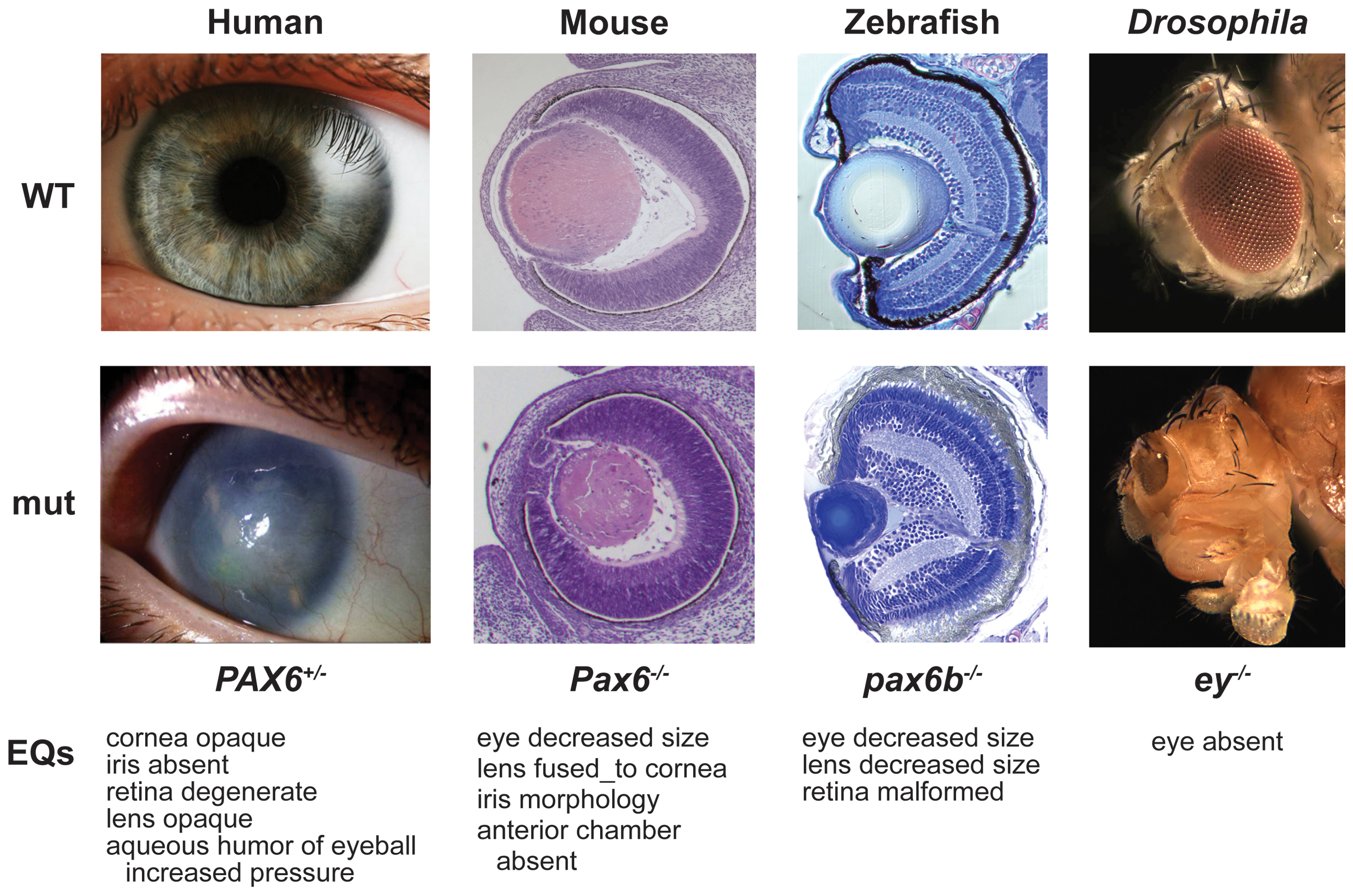
One of the interesting things about hox genes—and homeobox genes, in general—is how strongly they are conserved across animal divisions. The gene “eyeless” that creates eyes in Drosophila has been shown to be essentially the same as the gene Pax-6 in mice. (See here.) Modifying the genome, scientists have been able to cause fruit flies to create eyes all over their body—legs, arms, wings—depending on where the eyeless gene was placed. The Drosophila gene has been transplanted in frogs to produce extra eyes—showing that the same gene is causing the same behavior in a species evolutionarily separated by at least 400 million years.


Homeobox genes are not limited to animals. They have been found in plants and yeasts, as well. (See here and here.)


Thus, a change in a homeobox gene either in content or in location can have drastic effects.


This has tremendous effect in evolution of the organisms that contain them. Genetics create the organism but natural selection generally doesn’t directly on the genes. Natural selection only reflects differential reproduction of the entire organism. Consider the protein collagen. It is found everywhere in the mammalian body from blood vessels to muscles to intestines. Any change to the genes that produce it would reflect in all of those components. Thus, a selection for, say, longer legs would never show up as a change in collagen. Such a change might help but not be attributable to it.


But, say, a gene set that expresses variability in leg length would expose that trait to selection. This would allow selection of a trait directly expressed by gene set. Or consider where eyes are located: in the front for primates and predators, on the side for prey. (Think cheetahs vs squirrels.) That location derives from when those homeobox sequences are expressed. Variability there exposes that genetic sequence directly to selection.


My point is that the creation of gene controlled development created the opportunity for selection of those traits we find most interesting: the size scale of dinosaurs, the leg loss of whales, the brain size of human beings.


It’s as close to a direct feedback mechanism from environment to genes as we’re going to find. So far.


See also:

Onychophoran Hox genes and the evolution of arthropod Hox gene expression

Hox genes, homeosis and the evolution of segment identity: no need for hopeless monsters

Hox genes and evolution

Homeobox Genes and the Homeobox

Homeodomain proteins: an update


Monday, December 5, 2022

Evolution and Embryology


People who don’t believe in evolution make me tired.


(Picture from here.)


For one reason, it’s like saying I don’t believe in the sun. The sun is there whether one believes in it or not—the existence of the sun is independent of belief. The fact of evolution also exists independent of belief. The obscuration of the sun by clouds or night does not change the fact of its existence.


One of the most tiring objections to evolution is the “statistically unlikely” argument. This is the idea that something as complex an organism as a human being—or whale, fruit fly, or starfish—could not arise by random chance. It’s too unlikely.


This is true and has nothing to do with evolution. There is very little randomness at work in evolution.


Certainly, the frequency and location of mutations are random since many of them result from random events such as cosmic rays and the like. However, it’s interesting that many organisms (I’m looking at you, tardigrades) have evolved mechanisms to resist radiation induced mutations. This reduces the effect of random mutations. If there are mechanisms to repair damaged DNA, their random effect is reduced.


The other random effect—random to the point of the organism—is the change in the environment. A fruit fly that has evolved on a volcanic island for a couple of million years is unprepared for the next eruption.


These arguments almost always involve animals—probably because even the most hardened anti-evolutionist can usually recognize that humans have kinship with animals. Plant arguments rarely come up. By which I infer that evolution is okay for plants, bacteria, and fungi but not allowed for animals. Go figure.


But animals have mechanisms at their disposal that can introduce variation and drastic changes without the messy need for mutation: sex and the evo-devo gene toolkit. We’ll talk about sex first. Everybody likes to talk about sex.


Sex is a brilliant mechanism for introducing variation within a species. It tends to preserve a diversity of features since each organism results from a combination of features from the parents. It actively stirs the pot of genes in the gametes that meet and create the next generation. These features can be selected for or against—or both. In Sickle Cell Disease, when a child inherits a specific mutation for hemoglobin from both parents, the hemoglobin forms abnormally and the red blood cells are unable to carry oxygen efficiently. A bad disease that we would expect selection to work against. However, when a child inherits a single copy of the gene, it appears to confers some protection against malaria. Thus, there are selective pressures in both directions.


Sex provides the mechanism for bringing up gene combinations and present them for selection. It’s important to remember that natural selection is not operating against genes. It’s operating against the reproductive success of an individual organism. The individual organism’s success might—or might not—be a result of the organism’s genes. For example, consider a herd of bison in Wyoming at the end of the last ice age. The ice is in place, limiting their reproduction in the area. The ice retreats, opening up new areas for grazing. The bison numbers increase. None of that is due to the genetic nature of the bison.


Consider, though, the same bison when the ice cools down the area. The bison with the longer hair and better fat distribution might have a longer reproductive life span and therefore spread their gene combinations throughout the herd. That is natural selection against the feature set of the organism.


The anti-evolutionists like to call changes like that microevolution. The don’t like what they call macroevolution, like the creation of eyes or wings. Generation of novel structures, like eyes, or unique adaptive characteristics, like giraffe necks, cannot be the same mechanism that just makes hair longer.


Interesting idea. You could redefine the terms into trait evolution—such as hair length, skin color, or tail length—versus structure evolution—such as eyes, bones, fingers.


There is some merit in this since changes in structure are fairly rigid in their degrees of freedom. An organism evolving a new feature—eye, ear, voice—must begin with something to start with and as the features change, there is no opportunity for the feature to function negatively. A structure on the way to an eye, for example, can’t have an intervening stage where the structure is maladaptive. Then, natural selection would work against it.


The evolution of structure is a tricky business.


Animals undergo a process of development from fertilized egg to reproductive maturity. Depending on the organism, there are differing numbers of stages and differing quality of changes. Egg to human is relatively straightforward even if extraordinary complex. Egg to butterfly involves a midpoint change where the soft larval organism turns into a gelatinous goo that reorganizes itself into a hard shelled adult. The whole process of egg progressing to larva progressing to adult is an dance orchestrated by genes.


That said, it’s important to know that there is no gene for a giraffe’s neck or a the elephant’s size or a the fish’s flipper. These are the emergent properties from the process of development.


Development is the process of expressing genes in sequence, with each cell responding to other cells in different ways and at different times, such that the result is a functioning organism. The toolkit genes control that sequence.


The toolkit genes are ancient and highly conserved across phyla. The genes responsible for eye creation are similar between insects, vertebrates, and cephalopods. The hox genes are responsible for body plan expression. The axis from head to tail, where limbs form, etc., are the province of the hox genes.


Many people have the idea that genes determine the organism and that is true. But along with this is idea that there is a single gene controlling a feature—a gene for height, intelligence, musical ability. Certainly, genes are involved in these things but not in a one to one fashion. There is no gene that gets turned on strongly to make Einstein and didn’t turn on so strongly to make me.


Development is more like improv under direction. The hox genes say make a limb here and a collection of genes are turned on that create growth centers that then propagate bone, blood vessels, and nerves. One gene might get expressed many different ways in many different places at many different times. Different combination of genes might cooperate one way and make a toe. The some of those genes cooperate with a different set of genes and make a kidney.


Think about it. Humans have been determined to have about 20,500 genes. There are far, far more than that many traits being expressed in a single human being. Therefore, there can’t be single genes for every trait. Certainly, there are some chemical compounds—like hemoglobin—that are so incredibly important that there are genes specifically dedicated to creating them. Genes are responsible for proteins and hemoglobin is a protein. Most traits—the shape of your nose, the olfactory acuity of the dog, the sense of balance of a cat—are the products of scores of genes acting together.


This presents the opportunity for the evolution of novel and complex structures. Again, all natural selection needs is diversity of features and differential reproductive success. Selection to create a large brain requires brain size and structure variation. Selection to create the lungs of birds requires variation in lung development. Selection to create the hollow bones of dinosaurs from which bird bones derived requires variation on bone development. All of these must derive from variations in structural development—changes in the evo-devo toolkit, where a slight change in timing or quantity can have far reaching consequences.


But I can hear the anti-evolutionist respond: “Well, the evo-devo toolkit is too complex to have evolved on its own.”


Really? At this point, finding a deep homology between humans, fruit flies, and round worms one might think: give it a rest. 


It’s not about you. If something did create the toolkit back in the dawn of time long before the vertebrate lineage, it wasn’t interested in us.