Saturday, February 27, 2010

Down the Freedom of Choice Rabbit Hole


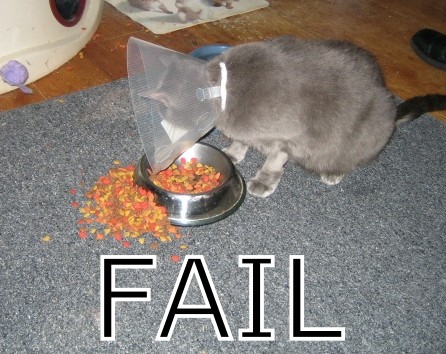
(Picture from here.)

I've been thinking about the bible panel from the Friday night Boskone (see here) a bit. The more I think on it, the more important it seems to me a response I didn't make. This was the thought in response to the idea that moral authority had to derive from a a higher power.

The more I think about it the more I think that this is the fundamental problem I have with religion. And, I think, it is a problem that religion has with itself. My understanding of Islam and the more eastern religions (Hinduism and Buddhism) are much more limited.

Here's the rub.

Christianity (and to different extent Judaism) is all about free will-- the freedom to make a moral decision. The freedom to make the right choice and, by extension, the wrong choice. Determining the nature of the rightness or wrongness of the choice is inherent in the freedom to make the right choice-- if there is no inherent analysis of the nature of the choice, there is no freedom to make the moral decision.

There's no inherent moral decision in whether or not the choose vanilla or chocolate ice cream. There is only personal preference that is independent of morality.

Investing divine authority in the choice ("rightness" being defined as following a particular moral code as handed down by God) weights the choice. If one believes in the reality of the divine authority, there is no freedom of choice; there is only evasion from responsibility. If God himself hands down kosher laws, then not following them is evading the contract-- no different than evading the contract with a car dealer or a mortgage house. Divine authority can elevate the contract to sacred status-- in point of fact, the contractual relationship between God and man in the Torah considerably raises man's status from supplicant to junior colleague-- but the very presence of divine authority reduces the significance of the moral choice.

To be sure, finding the right choice isn't easy. The Talmud is a record of the discussions of very, very smart men trying to figure out the essential right choice as implied, but not explicitly stated, in the Torah. The fact that the Talmud is many times larger than the Torah is no accident. Living the right way is not for the faint of heart.

But because of the avowed divine nature of the material, the first moral decision must be to accept or deny that divine origin. Accepting pushes the moral decisions into the complex dance of how to fit in and find the right path within the framework of divine will as expressed in a poorly understood manuscript. Is slavery an ethical institution? It's in the bible. Should adultery and homosexuality be punished by death? What is metaphorical example and what is deliberate edict?

My experience with Christianity takes it to a different level. If the New Testament is revelation of divine will, how is it to be reconciled with the previous version of the divine contract? If you thought Talmudic convolutions were complex, now we're in the position of reconciling the metaphorical examples and the deliberate edicts of two completely different personalities. The Old Testament was largely concerned with governing your behavior. The New Testament is more concerned with governing your mind. There is a huge amount of literature that is chiefly concerned with taking "prophecies" in the Old Testament and showing how they were fulfilled in the New Testament.

(My own inclination is to say that if it's not considered a prophecy by the authors-- and in a lot of these references I would argue the purpose of the quote is clear in the context-- it's not a prophecy at all. And, furthermore, if the author in the text says clearly what he's referring to, it's bad revisionist history to change it. But that's just me.)

Even so, once the divine authority of the text is accepted-- in even in the broken metaphorical way some modern scholars have managed-- it reframes the nature of the moral decision from what is the right thing to do into what have I been told is the right thing to do.

Denying divine authority pushes moral decision out into a new and unknown desert.

Out here in the scrub lands we have to decide what is the right thing to do without any other guidance than human beings. Is it enough to follow the herd? What is the personal cost of trying something new? What do I have to lose? My family? My children? The divine contract becomes the social contract, renegotiated every generation. Perhaps this is what Jefferson meant when he said "Every generation needs a new revolution." (See here.) It's the nature of revolution to look at things anew and not accept unchallenged what has been stated before-- divine or otherwise.

Moral decisions take on a new dimension if the only person deciding the nature of morality is the person acting on it.

"I almost wish I hadn’t gone down that rabbit-hole—and yet—and yet—it’s rather curious, you know, this sort of life!"
-- Alice in Wonderland, Lewis Carrol
=================================================

Friday, February 26, 2010

Wall of Idiots


(Picture from here.)

Usually, I let the Wall of Idiots speak for themselves. But it's been a while, I'm bored and there are a lot of them.

First, let's not forget state lawmakers as they attack evolution and climate change. As always, Texas school board also has its spirit deep in the heart of denial. To put another nail in the coffin of those in denial, here is an analysis of Darwin's Dilemma, the latest anti-evolution screed.

Judge Cherie Blair, wife of Tony Blair, decided that it was okay to put a Muslim man on probation after he broke another man's jaw because he was religiously devout.

Tea baggers supporting Scott Brown are a bit disappointed that since he campaigned as an independent thinker he might, actually be independent.

The Arizona legislature has decided Obama needs to produce his birth certificate. The fact that he has does not sway them. None of them appear to have volunteered their own.

Kudos to Northwestern University for inviting Blagovitch to a panel on ethics in government.

More kudos to Sen. Jim Inhofe (R-OK) for voting for the passage of the same jobs bill he had not voted to end cloture on.

The American electorate gets their own little award for voting in people to solve the problem by magic.

Deregulated airlines also get their own since they sure can't get an award for quality.

Finally, here's a fact check on the pre-hype of the health care summit: Here. Here.

The health care debate is so steeped a battle of sound bites that it's hard to discuss without exploding.

However, people rarely actually talk about what insurance actually is. They talk about government take over, death panels, and a lot of other lies.

Insurance is a hedge against catastrophe. It works on a pool. Everybody puts in a bit of money when they are in a position to against the time when they can't. Life insurance works this way. Automobile insurance works this way. Social security works this way to some degree. And, believe it or not, health insurance works this way, too. If you have a hundred people, the chances are that some of them are going to get sick. Everybody pays in and the money goes to the sick ones.

So, if you always stay healthy, you don't need insurance, right? That would be correct if you had any idea of your chances. The fact of the matter is that such things are random-- and therefore cannot be individually predicted. You can smoke and drink and live to 100 but the chances are against it. You can avoid smoking and drinking and die next week. Insurance is a hedge against randomness. Health insurance is a hedge against the random elements of being sick.

The next thing is that the larger the pool, the greater the probability of a majority of healthy people. This means that the premiums, shared against the entire pool, will be less. If you have a lot of sick people in your pool, which happens if the pool gets drained of healthy people, the premiums go up. Solution? Get as big a pool as possible and keep people in it.

That's called national health insurance and it works fine everywhere in the world where it is used.

Somewhere along the line this basic understanding of what insurance actually is has been dropped from the debate.
==========================================
Links of Interest
50 weird animals
New space engines
Storage of carbon using hydrogen
Simulations of a black hole
People of Wal Mart
Fail blog
V: Paper wars

DIY
Floor planner software
Foundry
Liberty Tool Company
Snow Nash
Child dome tent

Tuesday, February 23, 2010

Boskone 47, Sunday Afternoon

Sunday 2pm Werewolves (and Other Shapeshifters): Finally Getting the Respect They Deserve? Steven Popkes, Moderator
Leah Cypess
Adam Golaski

We got into Ovid and metaphorical shape shifting almost instantly. The notes became moot.

Notes:

1) Werewolves are shapechangers by any other name. The difference, surprisingly articulated in Harry Potter, shapechangers are voluntary and werewolves are not. Might the pain of transformation reflect the lack of choice?

2) However, this has always seemed to me to be an arbitray distinction. Teen Wolf was somewhat voluntary. My own story, Stegosaurus Boy, was semi-voluntary. Sort of like teen erections. Usually, they happen on demand but not always.

3) Vampires have gone through an evolution. Starting from the original stock, Bramus stokesaurus, they radiated in their niche (Belus lugosi, Christophus hammeri) until finally they reached commodity status. (Twilightus rediculosi)

Vampires are rehabiltated sexy zombies. Zombies radiated successfully.

What's in store for werewolves? Will they face the same commoditization that vampires and zombies have seen? Twilight of the Werewolves? World War W?

4) Two veins (heh) of werewolves: inherited and infected. Infected follow the same issues as zombies and vampires. Inherited reflects degraded shamanism. (Le Guin, the wizard who liked becoming a bear so much only the bear remained and he killed his own son.)

5) Werewolf as wendigo.

Monday, February 22, 2010

Boskone 47, Saturday Afternoon

Important News Bulletin.
We interrupt this blog to give you an important news bulletin. Steven Popkes goes live on the Book View Cafe today. Here is BVC. Here's his bookshelf.
We now return you to your regularly scheduled blog, already in progress.

Saturday 4pm Graphic Novels, Film Audio, Web Comics, +!? - Different Ways to Tell the Story

Bruce Coville, Moderator
Steven Popkes
Everett Soares
Rene Walling
Jane Yolen

I was the least qualified person on this panel and didn't have a lot to contribute. But I got to sit next to Jane. That was enough.

Notes:

1) Visual medium vs. read medium vs. aural medium
(films/comics vs. prose vs. podcast)

2) Linear medium vs. non-linear medium.
(prose stories vs. hypertext vs. firesign theater)

3) Medium of narrative discovery vs. Medium of reader experience.
(The story is told to the reader vs. the reader discovers the story through his choices. story vs. gaming)


4) Some things just work better visually: comic book material works best visually, in comics and film. Doesn't work so well in print. Some comics, imho, don't work as film.

5) Theater of Images, The Theater and Its Double, Antonin Artaud. Does primal material work best visually vs. intellectual material work best in prose?
Waltz with Bashir, Ari Folman
Logicomix, Apostolos Doxiadis
Masterpiece Comics,
Berlin, Jason Lutes
Maus, Art Spiegelman

5) Plot conservatism of material versus cost of production. Cheap production means radical thought. Which is why we should be looking to cheap print production (or internet produced reading materials) for radical departures. Why haven't we seen it in prose? We HAVE seen it in webcomics.

6) Scott McCloud's books.

7) Rule 34.1: If it exists, there is a webcomic containing it:

Steampunk: Girl Genius
Who's Afraid of Virginia Woolf: Something Positive
Zombies: Dead Winter, Raising Hell
What happened to the Midwich Cuckoos: Freakangels
What happened when Vesuvius blew up: SPQR Blues
Witches vs. 1984: Heart Shaped Skull
Absurd, self involved characters: Nerf This, among others
Absurd Advice to the lovelorn vampire: Ask Dr. Eldritch
Absurd nastiness: Saturday Morning Breakfast Cereal
Absurd science fiction: Life on Forbez
Absurd mathematics and physics: XKCD
Absurd mathematics, physics and art: Dresden Codak
Absurd Japanese gaming: Megatokyo
Absurd Wartime medieval Japan: No Need for Bushido
Absurd pre-history: Dawn of Time
Absurd Highlander: Platinum Grit

8) www.stevenpopkes.com-- webcomics section under interest. About 100. However, I have many more that I have glanced at but not investigated.

Sunday, February 21, 2010

BVC Intro

Here's my BVC intro. Cross posted here.

Check out the Book View Cafe. I'll be live on it tomorrow.


I'm a new addition at BVC as of tomorrow, 2/22/2010. I must introduce myself-- something I'm not very good at.

I always liked the beginning of Joe Haldeman's Mindbridge: "I was conceived sometime in the spring of 2024. We'll skip the next eighteen years or so."

I think a person's history is less interesting than what they do.

With that, I--

  1. Play as good a piano as can a person with great ambition and no talent.
  2. Build things of wood, usually for a purpose, such as furniture or insulation systems.
  3. Build things of metal, usually for no purpose, such as Stirling engines and mechanical toys.
  4. Garden and grow fruit-- I make terrible wine. By the gallon.
  5. Read, constantly.
  6. Think, always. Curiously often on evolution.
  7. Implement software to control machines. Sometimes rockets.
  8. Pilot small airplanes
  9. Help raise a young man.
  10. Write science fiction and fantasy.

The last concerns the Book View Cafe but the preceding entries inform it.

If I had two regrets they would be: I haven't traveled enough or learned enough physics.

That pretty much covers the essentials about me.

The stories have to stand on their own so I won't talk about them much. Sometimes they have interesting stories associated with them-- the Tom Kelly house of Tom Kelley's Ghost does exist. We live in it. But as far as I know he was not involved in an abortive robbery or knew Mayor Curley.

My web site is here. My non-BVC blog is here.

I'll be blogging here every other Sunday. Some about writing. Some about science. Some about mantis shrimp-- as clear an indication as could be that we've been invaded by aliens.

Should be fun.


Steven Popkes is a new writer at the Book View Cafe. Learn more about him at his bookshelf.

Saturday, February 20, 2010

Boskone 47, Saturday Morning

SF/Mainstream Convergence?
James Patrick Kelly, Moderator
Kathryn Cramer
Steven Popkes
Vandana Singh
Melinda Snodgrass

What's interesting about this subject is not topic but the opinions held. This panel is all about boundaries, who's in favor of keeping them, who's in favor of abolishing them. Whether the boundaries are marketing ploys, whether they reflect a difference in audiences, etc.

Notes:

1) Convergence can only be good: We get Michael Chabon/The Yiddish Policemen's Union, they get Robert Jordan/The Wheel of Time. We get Salman Rushdie/The Satanic Verses. They get Terry Brooks/The Sword of Shannara.

2) Convergence seems to run only with fantasy. SF novels, by and large, remain genre-fied.

3) Robert F Jones/Blood Sport, Salman Rushdie's first novel, John Gardner/Grendel

4) The big danger of a genre is commoditization. At that point we all engage in a race to the bottom.

5) Genre writing is often safe writing. But much of the fantasy that is coming out of mainstream is edgy and often of higher quality.

6) Genre fiction shows lack of nerve. Chabon, for example, imagines a world without a Holocaust and shows us that many of the things would still be the same. Alternate world stories try to tell us what will be different, neglecting or ignoring that which will be the same. Turtledove's reimagining of R. E. Lee, for example, turning into an apologia for Lee.

7) Tom Disch suggested that SF/Fantasy was really children's literature in disguise. The emphasis on individual revolution, Good and Evil, and clean resolutions.

8) The word "comfort" fiction was bandied about. An analogy to "chocolate" was used. I don't think fiction should be comfortable. Or, perhaps, I find discomfiting fiction comfortable. Fiction should change the reader in interesting and/or profound ways. When we engage in "comfortable" fiction we create the opportunity for commoditization. Then, it's back to the race to the bottom. The "bottom" being sf/fantasy being sold as a commodity for a unit price like beans, peas or pornography.

9) Science Fiction may be becoming less popular than Fantasy since it requires the reader to at least be science literate. Something we're losing these days. A far cry from when Theodore Sturgeon was included in the best short stories of the year for The Man Who Lost the Sea.

10) New term: Revisionist Aesthetics. When we change what we think is good because of marketing or other means of popular voting.

Friday, February 19, 2010

Book View Cafe's Shadow Conspiracy in SFSignal Giveaway

As some of you know, I'm now a member of the Book View Cafe, an author's cooperative.

SFSignal.com is giving away two copies of the BVC e-book, The Shadow Conspiracy, a steampunk anthology from Book View Press. The Shadow Conspiracy is a collection of stories set on alternative earth, a place powered by steam and magic. This world of dreamers, experimenters and engineers, soulless humans and ensouled machines was born of most unlikely parents: four poets who gathered one cold summer on the shores of Lake Geneva in 1816.

All-new and never-before-seen, these stories explore the unfolding consequences of that gathering — and how it changed everything we thought we knew about science and ourselves. Contributors include Maya Kaathryn Bohnhoff, Sarah Zettel, Steven Harper, Pati Nagle, Jennifer Stevenson, Nancy Jane Moore, Brenda Clough, Judith Tarr, and Irene Radford. Editors are Phyllis Irene Radford and Laura Anne Gilman.

Available Formats include PDF, EPUB, Mobi, .prc, .lrf, and .lit.

For a chance to win a free copy, visit the SFSignal contest page: http://www.sfsignal.com/archives/2010/02/ebook-giveaway-shadow-conspiracy/

Contest ends Wednesday, February 24, 11pm US Central Time.