Wednesday, January 18, 2012
Much Ado about Methane
Real Climate article Much Ado About Methane gives a real analysis of the methane release in the arctic.


Tuesday, January 17, 2012
Book View Cafe News

Irene Radford re-releases her master-work series Merlin's Descendants through the Book View Cafe
Beginning with Guardian of the Balance 978-1-61138-138-2 $4.99 $3.99
Exclusive to the Book View Café, an introductory price reduction
Caught between her beloved father, the Merlin of Britain, and Arthur Pendragon, the old ways and the new, Wren must find a way to balance the forces of Chaos with peace. She nurtures the land and the people, creating a haven for anyone displaced by the turbulence. And for the safety of all she must guard her heart against the deep love she shares with Arthur, a married king who holds the future of all the Britains in his hands and his sword.
Sunday, January 15, 2012
Biological Revolutions of the Mind: An animal perspective.
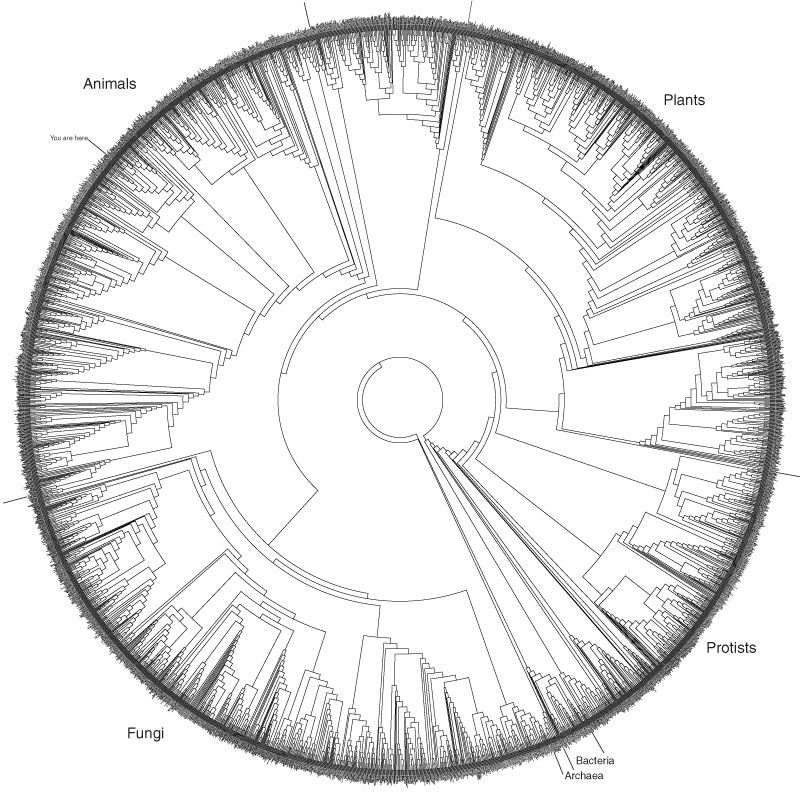
(Picture from here.)
I've been thinking about the long view recently. Specifically, the age of life on this planet. Wikipedia's timeline of evolution is interesting but it compresses as it approaches us, in effect giving the same weight of the rise of complex cells to the rise of insects. This tends to trivialize the magnitude of complex cells.
I think we can consider a few points in the timeline as truly revolutionary:
- Abiogenesis revolution: the rise of living systems. Most of these are likely extinct.
- Prokaryotic revolution: bacteria and the like. About 3.8 billion years ago.
- Eukaryotic revolution: complex cells such as found in amoebas and human beings. Say, 2 billion years ago
- Multicellular life: About 1 billion years ago.
- Neurozoan revolution: Anything with a nervous system. This allows integrated system response to local stimulation. Somewhere between 1 billion and 600 million years ago.
- Cognozoan revolution: Centralized response driven life forms. Life forms with brains or central nervous systems (CNS.) Say 600 million years ago.
Cognozoan is my own. Do you like it?
I do not use the term "revolution" lightly. While nothing really compares in scale to the abiogenesis revolution, each of these so-called revolutions changed the landscape of earth. Once we had prokaryotes we had the ability have true inheritance via DNA and variability in metabolism. We got photosynthesis and an oxygen atmosphere. Once we had eucaryotes we could have fungi-- which pretty much created something called "soil." All complex life forms from trees to sea anemones are multicellular. I suspect the roles of predator and prey, as we know them, originated here.
Neurozoans: all free living animals. Period. Full stop. End of story.
Once we introduce cognozoans, we have abstract behavior. Mating dances. Specialized predator/prey strategies. Fish. Crabs. Beetles. Starfish. Squids. Anything with a CNS. Most animals past the size of mesozoans have a brain. One could venture a guess that a central processing system is required beyond a certain level of behavioral complexity.
While this is an animal centric perspective I may be addressing some plant concerns as well.
I'm going to be going over these revolutions in the next few weeks and talking about them one at a time. Each of them is worth a blog entry of their own.
This is going to be fun.
This is going to be fun.
Thursday, January 12, 2012
Arisia Schedule
I'm doing Arisia this year. Here's my schedule:
- Friday 7pm: The Future of Bioetichs as Portrayed in Film, Alcott
- Sunday 10am: Trash to Treasure! — Fast Track 1
- Sunday 4pm: A "Self" or "No Self?" Neuroscience in SF, Independence (3E)
Monday, January 9, 2012
Sunday, January 1, 2012
Anatural Selection

I've been talking about "natural selection" a lot. Natural selection is defined to be the differential success of reproduction between related organisms based on the context of that organism's reproduction.
I use the word "context" precisely here. We like to think about natural selection by way of success in foraging or in evading predators or being predators. But differential reproduction covers a lot of ground. The context of the peacock is how pretty that male's tail looks to Lady Peacock.
Biologists like to talk about how such secondary sex characteristics show fitness but it ain't necessarily so. "Fitness" is a long term view of things-- it's a biological form of "Mister Right." But Lady Peacock isn't so much interested in Mister Right enough as much as she's interested in Mister Right Enough.
For example, let's consider bettas, or Siamese Fighting Fish. Male bettas display to one another to show dominance and to get the attention of females. A common biology demonstration is to create a model that stimulates bettas to display. It's not hard by alteration of color and shape to get a model that triggers a stronger display in a female or a male than an actual male betta. Betta display is costly in that it takes energy to display and fight and bright displays attract predators. So bettas are in a continuous mini-max race to woo their mates and not cost their own life while doing so.
Consequently, as long as the display does not impair their ability to reproduce it helps it. You could argue a "fitness" representation to this but I think it's reaching.
However, selection happens everywhere: politics, palate, fashion. The survivability of the apple is based on how well it tastes to humans. The success of dogs and cats depends on how much they engender caring emotion from us. The prolific triumph of raccoons, rats and cockroaches in the urban environment rests solely on their amazing success in exploiting what we choose to cast aside.
But this is not limited to organisms. Objects, too, can be selected for or against. Religion, car styles, hairdos, family size, presidential politics, all respond and change over time. They survive or don't based on the our ability to adapt them to changing cultural shifts of context.
These cultural artifacts are called memes and selection and modification of memes have been demonstrated. They "evolve."
I think memes are analogous to viruses in that they are packaged bits of information that have an affect to a target system.
(You can extrapolate from that idea that I don't think viruses are alive and you would be right. I think of viruses as biochemical systems that can undergo selection but are not, in and of themselves, alive. I think of it more as complex biochemical poisoning where the poison catalyzes the production of more poison.)
Virus reproduction is extremely interesting. For example, some viruses bring along their own polymerase to enhance the environment where they are produced. Some don't. Replication of living systems have mechanisms to prevent error. Viruses depend on error to introduce variation-- they are indiscriminate in the assembly of the virus product allowing selection to weed out those virus fragments that are not infective.
As I talked about in the Signs of Life entry, living systems have a certain constancy level required for viability. Viruses also dance to this constancy/variation tune. Some are quite constant, one generation to another, some are quite variable, some have parts that are variable and constant in the same virus. You can have two related viruses attack a single cell at the same time and the resulting virus has DNA from both.
Ideas and institutions have similar behaviors.
Even small ideas can have significant staying power if they can be abstracted beyond the context of their birth. There are scores passed on emails that talk about the excesses of congress or the president or Wall Street. They sound just plausible enough to be passed on. I have read emails talking about Obama that were originally credited to the Carter administration. I've read emails dissing congress I'm convinced were originally popularized by Mark Twain. These memes have thoroughly transcended the original context of their birth.
As viruses require living organisms to propagate, memes recombine. I have seen religious rituals in Mexico that clearly derive from both the original Mayan religion and the Catholic tradition. The Christmas tree does not originate from Christianity though it has been associated with the Christian holiday.
There are natural boundaries to memes that consist of such things as culture and language. Memes that have shed enough of the original context down to the bare essentials have managed to cross these barriers. Hatsune miku, for example, is a Japanese phenomenon I spoke of a while back. It has not crossed the walls of culture terribly efficiently. Pokemon, however, did.
One of the interesting things about memes is how we modify them intentionally. Pokemon is a good example of that. But nothing compared to Bill Bright 's Four Spiritual Laws. Bright boiled down Christian theology into four principles: 1) God loves you 2) Man is sinful and separated from God 3) Christ is the bridge between holy God and sinful Man 4) You need a personal revelatory experience with Christ to bridge the gap.
By abstracting the evangelical problem to its most simple term, Bright created an elegant evangelical solution: present the dilemma, propose a solution and explain the solution's implementation. This meme was simple enough and divorced enough from its original context it could easily jump cultural and language barriers-- though not without its detractors.
Like viruses, memes require active human participation to be reproduced and transmitted. An idea unpropagated is no different from a crystallized virus: inactive and unchanging.
The evolution of memes can proceed quickly or take generations. "All your base belong to us" came, went, came back and is now pretty much gone. Lolcat has a surprising longevity. Zoroastrianism had a good run of close to 2,000 years. Christianity and Hinduism are with us yet, though I think neither of them reflect their original founders all that much.
A question I hear about biology a lot is why is it so complex? Physics and chemistry are complex but nothing like biology.
One of the reasons I think is that in physics and chemistry fundamental laws and principles have been established and verified. Atomic theory covers most of chemistry and physics rounds out the rest. In physics, there are a collection of basic principles that govern such things electrical and mechanical phenomena. While there is much we do not know, we would be inordinately surprised to find fundamental conflicts. E.g., the OPERA neutrino experiments.
We do not have the fundamental laws and principles of biology. We know some things. We understand the principles of selection. We know that heritage shapes the subsequent modifications of organisms. But we have no mathematical model that can predict these things. Without the underlying model we fall back into studying individual examples and hope from them to discover the fundamentals.
Given the apparent resemblance of principles between, say, selection of inherited traits and selection of inherited religious principles, I think we might find out more than we expect.
Subscribe to:
Posts (Atom)

 Posts
Posts

