Monday, March 18, 2013

Netvibes vs. Google Reader

As most know Google is discontinuing Google Reader in July. You would think there are a bunch of alternatives out there, wouldn't you? Guess again.

It turns out that even with the Reader redesign (one wonders why redesign something to be discontinued but I digress) as far as a simple, workable user interface Reader is pretty darned good. Having the ginormous Google server farm behind it probably doesn't hurt.

I actually use an RSS reader. It's not just a fun thing to play with. I have a few thousand (that's right, thousand) articles that I process every week. In some cases the processing is simply scan what's there and say "crap" and go on. In others it involves careful reading. And, of course, that's the way I get through a few hundred webcomics I follow. As in anything else, niggling details often scale up from inconsequential to insurmountable.

Reader had the following features that made it the best for me:

  • Compeltely web based
  • Simple interface
  • Fast updates
  • Reliable behavior (lack of unexpected behavior)
  • Stability
So, as soon as I found out Reader was going to die a horrible death I went out looking. Of the ones I found it seemed NetVibes was the best in that it had a Reader like interface-- coincidentally called "reader." 

Ha.

There's no way to sort the reader mode. I have a few hundred items I want to have in one place-- I process them in date order so the number doesn't matter unless I'm looking for a particular one. Of course, if I'm looking for a particular one it would be nice to have them sorted in alphabetical order-- like everything else on the planet. But noooooooooooo! I found no way to have it sort. Couldn't find it in the manual. In fact, when I looked on the web I found many people complaining of the same problem and the answer lost in silence. 

And let's talk about stability and updating. I find that Netvibes is hours slower than Reader. Not to mention that it's failing. A lot. I't been down more than up this morning. Probably because of all of the Reader expatriates. 

Okay. Deep breath. Netvibes is still better than anything else you looked at.

This move by Google is a harbinger of things to come. This is not a denial of a particular product. I think this is the beginning of the end of free services-- which, in fact, may be a good thing. I wouldn't mind paying for a Reader like service if I could afford it. (Note: monthly cost of Netvibes beyond the free service is $500/month. This includes social networking analytics which is useless to someone like me.) There are discussions across the net that blogger (what you're reading) might be the next to go. Frankly, I don't think anything is safe. Up to and including gmail.


Wednesday, March 13, 2013

Interesting Things

First, we get to see a comet starting Friday. Check out here.
Russian scientists have found "unclassified" biological DNA from Lake Vostok. See here.
Another 111 government experimental chimps have been retired to chimp haven.
Robots play MacBeth. Here and here.
RC Plane makes it to space and back. Here.

Tuesday, March 12, 2013

Miku Watch

Well, now we know that Hatsune Miku is a true celebrity. When she's used to hawk Domino's pizza. Video here.

Monday, March 11, 2013

Writerly Rules

A friend of mine turned me on to the Aerogramme Writers' Studio. A couple of interesting things they have posted:
Given some of Pixar's films I suspect that on some projects the rules were honored more in the breach than the observation. Still, they're good rules. RSS feed here.

One of the Gaiman rules is interesting:

"Remember: when people tell you something’s wrong or doesn’t work for them, they are almost always right. When they tell you exactly what they think is wrong and how to fix it, they are almost always wrong."

I think this is also true for writer's talking about writing. They are almost always wrong in what they say they do. You have to look behind what they say.

I was at a conference on computers in medicine a number of years ago.  A woman gave a paper on automated tissue analysis. She went to a bunch of pathologists and asked them how they determined if a tissue sample was cancerous. They gave her a bunch of answers that didn't do her much good. One idea was "texture." How do you quantify something like that? The answer is that you can't.

What she did instead was to look at samples that had, to the pathologist, the right "texture" and analyze the sample for commonality. (The algorithm was pretty cool. She used a derivative of a linguistic analysis. The same sort of algorithm that can predict the probability that an "h" will follow a "t" or a "u" will follow a "q" in English text.) She got a quantifiable result that seemed to approximate the same result for "texture" when used by the pathologist. Yet, when the result was visualized it did not resemble cell texture in any way.

I think writers are similar in this way. They wrap words around something that makes sense to them-- these are "magic words" in the sense that they mean something very special to the writer or the writer's audience. But in and of themselves they have little meaning.

Personally, I always liked Ray Bradbury's rules for writing:
  1. Relax.
  2. Don't think.
  3. Work.

Sunday, March 10, 2013

Brain meets Brain


(Image from here.)

A very exciting piece of research came across my desk this week. We have been hearing about Brain-to-Machine-Interfaces (BMI) for a bit now. Not that they've become humdrum at this point but we're familiar with them.

Two labs, one at Duke and one in Natal, Brazil, led by Miguel Nicolelis have successfully created a Brain-to-Brain-Interface (BTBI) using two rats.

That's right. One rat gets data directly from the brain of another rat.

How, you ask? Through some fairly brilliant experimental design.

(Image from original paper. See below.)

We start with two rats, both are fitted with an array of micro-wires implanted over the M1 motor cortex. M1 is the primary route that data is fired down the spinal cord to effect muscle movement.

The encoder rat takes data that is coming into M1 and encodes it into a protocol that can be transmitted. The data is then transmitted. The decoder rat receives the encoded data, decodes it and stimulates M1.

Both rats were trained. Encoder rats were trained to expect a reward based on a stimulus. Decoder rats were trained to expect a reward based on stimulation. Then, once the rat was trained further trials were used to determine how to encode the M1 data. Then, the rats were hooked up to one another. The encoder rat was given the stimulus after which the decoder rat got a reward.

A second wrinkle of the experiment was to similarly connect the two rats but instead of inserting the array into M1, it was inserted into S1: the somatosensory cortex responsible for tactile information. They were able to show that sensory stimulation of the encoder rat was able to evoke similar responses in the S1 of the decoder rat by passively stimulating the encoder rat and measuring the S1 of the decoder rat.

Further, they showed that the sensory data of the encoder rat was able to influence the behavior of the decoder rat. Both rats were trained to expect a reward, when a reward was available, in either a "narrow aperture" or "wide aperture" portion of the cage. In this case, narrow or wide was defined in terms of how the rat facial whiskers touched the sides of that portion of the cage. When the encoder rat found a reward in one of the two possibilities, the decoder rat found a reward in the same location a significant portion of the time.

This was done in real time. At one point one rat was in the Duke lab and the other was in Natal, Brazil.

There are a number of interesting wrinkles to these experiments. First, in the M1 experiment, one rat was trained in effect to supply stimulation and the other rat to receive it. In effect, the rats were communicating that something had happened but the nature of the event was of a fairly low granularity. There's little difference between the decoder rat responding to the encoded rat material or something synthesized. You could consider this more of a brain-to-machine-machine-to-brain interface.

The S1 experiments were much more interesting. In this case sensory data that originated in the encoder rat was interpreted as sensory data by the decoder rat. This is much more akin to true brain to brain interaction.

A few caveats. First, the success rate was not great. 64% is significantly better than chance but not terrific. Second, we're talking about a simple binary choice. We're not talking telepathy. We're talking about a rat getting some data from another rat that it cannot know is from another rat.

However, Miguel Nicolelis has done some other interesting BMI work. Notably, training a monkey to use a virtual arm and get sensory data in return among other experiments. This is clearly a significant but early step.

Via Io9

Original paper
Miguel Nocolelis lab
Nature discussion article
Original IO9 article


Sunday, March 3, 2013

Everything is Material


Sorry about last week. The fewmets hit the windmill at work and when I looked up it was Tuesday.

Science fiction is an art form in which ideas form part of the fabric of the story. The nature of SF causes one of the perennial questions writers get: where do you get your ideas?

For some reason there's a sort of sub-culture mythos surrounding this question as if it were some sort of bad question to ask. I find this curious. If you asked someone who had written about a dysfunctional town regarding the source material I don't think there would be any problem with answering.

Maybe the problem is the question is too broad. "Ideas" isn't really a specific term.

I like recasting things. This question can be recasted to "what serves as inspiration for stories?"

Well -- (a moment to stretch out my fingers) -- I can answer that.

Here is a collection of article references that tweeked my particular fancies. They may or may not serve as inspiration for a story but they certainly get me thinking. And thinking, after all, is really where ideas and stories come from. These are sort of notes.

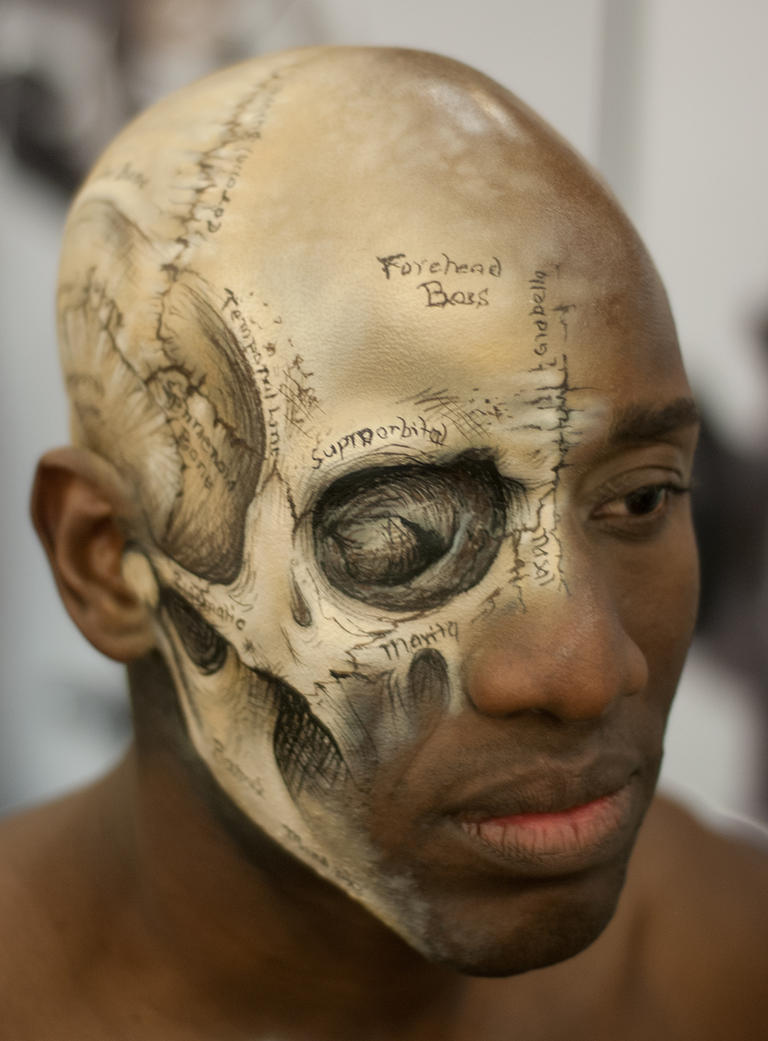
This image is called Gray's Anatomy. It's on deviant art here. By Lisa Breczel and was done for the International Make Up Artist Trade Show in L.A. Consider the imagery of blending an anatomical print on top of the actual anatomy of a living, breathing human being. Humans have a natural tendency to modify their own looks. Think bower birds, too. We've seen body modification like this in SF-- in Neuromancer  for example. It's central in The Stars My Destination. Like to see Berczel do the tattooing for a TSMD movie. But, more importantly, think creatively about this sort of thing for future inclusion. (Via io9.)

How to be a Psychic: From skeptic.com. Base a story on a fake psychic? One of the best elements of the otherwise overly sentimental Ghost was Whoopi Goldberg's reluctant psychic. On the other hand, think of Stan Marsh in South Park: "Whatever is behind life and death has to be way more amazing than the things this asshole does." Go with manipulation. When is it immoral to manipulate another person? We do that as parents all the time. So do politicians. Ministers. Priests. Is everything a magic trick?

This was an attempt at a high speed, over water, transportation system. It was huge-- the ekranoplan had a 37 meter wingspan and weight 550 tons. Essentially flew in ground effect. Smaller version (the Lun) was actually used. Imagine effect of high speed, cheap over water transport. No problems with reefs-- "flew" at up to 20 meters over the surface of the water. Attempted in the 80s before modern 21st century materials. (Via io9.)


Nikolai Kardashev created the Kardashev Scale for civilizations. This was based on energy usage. Type 1 use all energy available to the home planet: sun, geologic, chemical, etc. Type 2 use all energy available from the home star-- possibly enclosing it in a Dyson Sphere. Type 3 use all energy available from the home galaxy. We're not yet at a Type 1 status. This was based on a 1963 view of the universe where the energy is viewed centrally (planet, sun, galaxy.) However, we now know that the majority of mass and energy in the universe is distributed in the form of dark energy and dark matter. How should that view our thinking of ET civilizations? (Via io9.)

Mauritia was the continent that linked Madagascar and India way back during the Precambrian. Looks like it may have started to resurface due to volcanic activity. Think about the ramifications of deep time. A time travel story that has to take plate tectonics directly into account? Or a story on another world that also has plate tectonics where the surfacing of an ancient (Via io9.)


Krampnitz Kaserne was first a Nazi military complex and then a Soviet military complex. It's just outside of Potsdam. Must get there and see it. Pictures of ruined structures. Ruins always a good setting for just about anything. Just look at it! (Via io9 and Environmental Graffiti.)

And so much more. The Hilton Sisters. Predicting the future of civilization. A comet hitting Mars in 2014. Robert Lazar. Popping soap bubbles at 18,000 fps.

These bits came from io9.com. That's the site I looked at today. I've been following io9.com a while now and they provide a lot of good material.

Remember, everything is material.