Monday, November 9, 2020

State of the Farm, 2020: Staples


(Picture from here.) 

I was going to write some long eloquent essay on the election but, frankly, it's too depressing. 

The only thing I will say is that in 1984, George Orwell postulated a whole English industry and ministry dedicated to making people believe in untruths that were beneficial to the party and not to them. Here in America, all we needed were 140 character segments.

Suck on that, George.

*sigh*

One of the goals we've had going forward with the "farm" is to move from foodstuffs that we have to buy to those we can grow for ourselves. Complete self-sufficiency is not a goal nor would it ever be in the cards. Can't grow gasoline or pharmaceutical products. 

But there are things we can do.

As both my readers might have observed, we've had fairly good luck with fruit and greens. Not terrific luck this year, but not completely terrible, either. We had a good crop of apples, Cornelian cherries, persimmons, and peaches. A fairly good crop of greens and squash. Somewhat on the beans. Not so great on basil and tomatoes. Wretched on potatoes.

By this I mean we did alright on non-staple crops and fairly poorly on staple crops. By "non-staple", I'm speaking of crops that provide nutrients, fiber or flavor but aren't reliable for purposes of day to day calories. I put fruit in the category because though they supply a lot of sugar, they are relatively nutrient poor. One peach supplies about 60 calories. One potato supplies 160. In addition, fruit are much more difficult to store while staples tend to be more stable over time. After last summer's quite respectable showing, I had high hopes that this year's potato crop would do well. We expanded and ended up feeding a lot of rodents. I was discouraged.

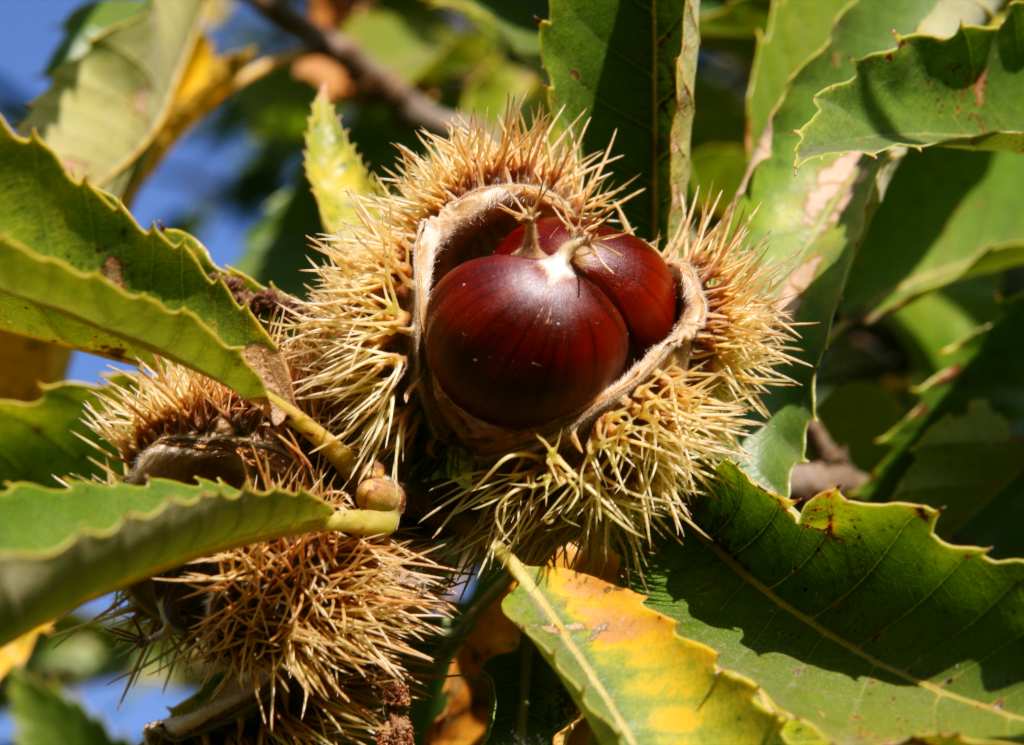
But I had not taken into account another staple crop we have: chestnuts.

We've been harvesting chestnuts for some time. We have three trees. A mature producer, a younger tree that started really producing this year, and an immature tree that hasn't produced any so far. This year we had a bumper crops. We are still harvesting the nuts.

Chestnuts require a fair amount of processing. We have to first pull off the outer husks-- no mean feat since the spikes on a chestnut will go right through most glove material. Most people wait until the chestnuts do this themselves and drop the exposed nuts on the ground. Of course, that puts us in a scramble for the nuts with the squirrels. Then, we have to get the nuts out of the inner husks. Finally, we need to dry the resulting exposed nuts.

Wendy has developed over the years a good mechanism for getting to the inner nut once it's been exposed from the outer husk. 

This year we have managed to harvest in excess of 50 pounds of nuts. I'm guessing the final dried nuts have lost about 20% of mass so that's >40 pounds of raw, dried calories.

Chestnut flour is somewhat higher in fat and lower in protein than wheat flour. It has no gluten so cannot substitute for flour in bread making. They can, however, be used to make pasta. I've been making a lot of bread this pandemic and I've started substituting chestnut flour for regular flour. A 3.5/.5 cup ratio appears to get the flavor benefits of chestnuts without loss of structure. I'm still increasing the ratio. We'll see where the fail point is.

In addition, I'm looking at the hickory nuts we're getting. It's hard to find a hickory nut nutrition profile. I used the pecan for that purpose. Here's the comparison:
  • Wheat flour/100g: Calories: 339, fat 1.87g, carbo: 72.6g, protein: 13.7g
  • Chestnut flour/100g: Calories: 371, fat 3.67g, carbo 78g, protein 6.55g
  • Pecan/100g: Calories: 691. Fat: 72g. Carbo: 14g. Protein: 9.2g
The problem with hickory nuts (as opposed to pecans) is getting the meat out of the shell. I'm running some experiments on that.

Given the above, our staples have become:
  • Corn
  • Squash
  • Potatoes
  • Beans
  • Chestnuts
  • Hickory nuts (Maybe)

We're pretty good at growing corn and beans-- not this year, so much. We did well on squash. Beans we did fairly well but we had a rabbit problem. We planted a bad variety of corn as an experiment. It was an experiment that failed. When we plant our preferred variety (Bloody Butcher) we get good yield. We have about ten to fifteen pounds of various corn varieties stored.

Given the 40+ pounds of chestnuts we have, 10+ pounds of corn and various beans, etc., we're not in terrible shape going into winter. 

(We did our apcalyptishopping earlier in the year and bought >150 pounds of flour. This will extend that.)

Given the above, how did we do this year regarding staples?

I have to say: not bad. If we go through about 150 pounds of flour/year-- the pandemic has given us good insight to our utilization of foodstuffs-- we can cut into that by about a third. 

Not bad at all.

So what do we do next year?

I want to try potatoes again. I haven't figured out how to protect them from rodents. One idea I've seen is to grow them in tall beds-- greater than three feet in height. Of course, if we can let our cat out, that might take care of the problem. Especially if we move the potatoes near the house. We will see.

We're going back to Bloody Butcher for corn. I want to see if we can get forty or fifty pounds.

Chestnuts, obviously. 

We need to industrialize our approach to beans. We get beans but we've never planted enough storage beans to actually have enough for the winter. That's going to take some planting. 

I'd like to expand the squash-- that's a problem for several reasons. We do have squash bugs. Also, squash take up significant square footage. (Though we have grown the vines up into interesting places. There's nothing more interesting than a pumpkin growing in an apple tree.) Also, we need to store them. I'm investigating what it might take to dry a large amount of squash. I'm not sure we can even do it.

If the experiments with hickory nuts pan out, I have some ideas on how to build nut harvesting traps that keep the squirrels at bay. Might work for chestnuts as well.

If we can get >100 pounds of staples, I'll call it a win.

Monday, October 26, 2020

Wasting Time on YouTube


(Picture from here.)


Okay. It's the pandemic. It's been a godawful long time. I just saw one of my best friends, in person, for the first time in seven months. If you can call it that. We were both masked. We stood six feet apart and made grotesque long distance hugging motions at one another. 


Who am I kidding? It was the best moment I'd had for months with someone who wasn't living inside my house. Of course, it was the only good moment I'd had for months with someone who wasn't living inside my house.


That said, there are some really good diversions on youtube. 


(Yes. I've been watching a lot of it. For one thing, the news sections pops up effectively in headlines so I can be depressed without the horrid experience of actually watching the news. Small mercies.)


So: these have been good at getting me through the night.


In no apparent order...


Realistic Fishing

We got into fishing in a big way this year. It's outside. It's doing something. We can spend some time together outside doing something. It's fairly easy to maintain social distance. 


I mean it would be great if I actually caught fish. Wendy and Ben did. Turns out fried fish fresh from the lake is pretty good. 


RF fishes a lot and has a lot of videos. He shows you what he does. He shows you when it works and when it doesn't. There's a lot of "doesn't" in his show. He usually catches a fish eventually but you get to watch him cast six or eight or forty times before that happens. This is endearing to me since I cast a lot and don't catch many fish. 


It's also true RF isn't proud. If he can't catch bass, he'll catch bluegill. Pretty much anyone can catch a bluegill. Bluegill range from not very big to extremely small. But RF likes them all. 


In all his videos I only saw him keep a few fish.


On the con side, he really has some very good spots down there in Tennessee. Wendy and I are looking at a bunch of shad feeding. RF tosses a hook into the swarm and hooks one and then uses it for bait. 


We stop at the shad feeding point. We never see that. 


Scishow

Scishow is great for 8 or 10 or 20 minute discussions about interesting scientific things. This can be the evolution of sharks or the nature of the Big Bang Theory. (The scientific theory. Not the show.) The hosts don't dumb it down but they don't bludgeon you with math either. 


There are several hosts but one (whose name escapes me) looks a whole lot like Peter Dinklage if PD were six feet tall. Being lectured to about science by Peter Dinklage is far from the worst thing in the world.


That said, the only thing that would make Scishow better is if it really were hosted by Peter Dinklage. 


I would love that. 


Joe Scott

Joe Scott has two basic video blogs. One about science ("Answers with Joe") and one about his emotional state. ("TMI") Both are fun.


Answers with Joe is Joe Scott trying to figure out science and technology and explaining what he's found out to the viewer. This can be a lot of fun since he is not a scientist but does have a real drive to get it right. He's also the first to admit when he runs off the edge of his understanding.


TMI on the other hand is Joe trying to make sense of his life and this current world situation. It's very personal and, frankly, I don't listen to it as much as I listen Answers. There are some real nuggets here, though. For example, he did one TMI where he wondered if social media is a possible Great Filter


(The Great Filter is one of the hypotheses on why we're not hearing lots of conversation from out there. The idea is that there is some kind of event, probably self-generated, that prevents a species from getting off planet and getting out there riling things up.)


Hijinks ensued.


Outdoors55

As both of my readers know, I've been experimenting with making knives. I have Outdoors55 to thank for this. I mentioned him earlier, though not by name. (See here.) It was his video that made things understandable enough to me so that I could try it. 


Outdoors55 has a particular point of view on everything he does. It's extremely practical. For example, the video I watched about making a knife said, basically, make a knife from a file because the file is already heat treated. In another video, he built a tiny forge out of four bricks and a couple of torches. It's a very serviceable  forge for tempering a knofe and it costs about six bucks. 


A lot of very good advice that I'm probably not smart enough to take.


Overly Sarcastic Productions

I cannot say enough good things about this site. OSP has two hosts: Red and Blue. Red talks about fiction tropes and mythology. Blue talks about history. They make extremely interesting, extremely funny videos about what interests them. 


There are also some serious ones, too. Red's Trope Talks are interesting and not particularly funny-- except that Red is funny just by herself.


I've seen them all. 


She has the best take on Journey to the West I've ever seen. Also, her take on Lovecraft should be seen by everybody.


exurb1a

I found this one very recently and I have to say I'm in love. These are, really, flash fiction or short stories with fairly minimal illustration. 


The video We're the Last Humans Left begins:


Or species probably began about two hundred thousand years ago and judging by the fucking state of us I think we can all agree it was a terrible idea.


Which gives you an idea how his nihilist side works. But that's not the only good thing about his material.


Letter to Marble 3 begins:


To our excellent friends of Marble 3. Congratulions on decoding this message from the Cosmic Microwave Background Radiation. You must be getting very clever. Don't ask us why it's written in your languages. Give us some credit. We're gone now. But we left this message behind for when you're ready to hear it.


It's a lovely, hopeful, and not terribly sentimental letter to us to keep trying to be better. 


Which is pretty much all there is, isn't it?


Warlord of Noodles

Also called Betsy Lee.


This is a very strange site. There are a lot of different pieces to it. There are two main story lines: No Evil and Swingers Side Show Dance Club. The dance club story line is, sad to say, now defunct. It's worth watching but it ends abruptly.


No Evil is an entirely different kettle of fish. 


Imagine meso-american mythology being told with the point of view of Appalachia. 


No Evil is convoluted and mysterious. Several parts or flat out obscure-- you know that what is happening has a reason behind it but the reason is not forthcoming. It may never be forthcoming. 


I'm fine with that. No Evil has interesting characters and a good plot. Some of the singing is heartbreakingly beautiful. (I'm looking at you episode 10.) It blends music and folk lore seamlessly. 


Some singing, I think, is by the production team. Some comes from old recording. 


The sense of it reminds me of the Grand Old Opry and other like music I heard when I was a child fifty or sixty years ago. 


And that's it. 


These are interesting sites. Things I like might not be things that you like but give them a whirl.


Monday, October 12, 2020

North American Megafauna


(Smilodon image from here.)


This is what used to be called Columbus Day. It is now called Indigenous Peoples Day. 


People came to the "New World" at least 15,000 years ago. There is some evidence that they may have made it here as much as 20,000 years ago. Regardless, the ecology here was very different from where they had left. I am referring to the megafauna that were here for quite some time and seemingly disappeared about 11,000 years ago.


These were the animals living here when the Native Americans arrived.


When Columbus sailed into the Caribbean there were thriving populations of human beings already here. Some of the largest cities in the world were in the "New World"-- cities supported by agriculture without the aid of cattle or horses. Smarter people in that they had to be ingenious in different ways without domesticated large animals.


One wonders how North America might have turned out if humans had realized they could domesticate the horses and camels that were already here, long before they "old world" humans figured it out. SF writers: go for it.


The animals usually spoken of in this context are, besides the horses and camels, were mammoths, mastodons, smilodons, giant sloths, glyptodons (an armadillo on steroids), short faced bears, an American cheetah, a giant beaver, and the dire wolf. Many were much larger than equivalents at the same time in the "Old World." Of course, humans had fifty thousand years to take care of them


My two favorites are smilodons and mastodons. 


Smilodons were the saber toothed cats you saw in Ice Age. They ranged from medium cats coming in at 55-100 kg (Smilodon gracilis) up to 280 kg (S. fatalis). To give some comparison, modern lions top out at about 225kg. (BTW: there was a North American lion, Panthera atrox, that weighed as much as 420kg.) 


These were extremely successful predators until they weren't. They hunted things like bison or camels-- one wonders if they left the really large herbivores to the American lion. No one knows if they hunted in packs or singly. But they arose 2.5 million years ago and came to an abrupt end along with all the others.


While smilodons were in the cat family, they were unrelated to tigers. They were no more a saber toothed tiger than a similarly named Tasmanian tiger. It would be interesting to know which was the apex predator: P. atrox of Smilodon. Most of the literature I read suggested Smilodon was an apex predator. However, it's hard for me to believe that when P. atrox is on the scene and twice as big. As far as I can tell, atrox had not abandoned its predator ways. Of course, without a precise knowledge of animal ranges, it's hard to tell. Smilodons might have been apex predators in locations not frequented by P. atrox.


Lions and Smilodons appear to have different strategies for killing. Smilodons sacrificed bite force for precision with their sabers. Where lions and their relatives developed significant jaw bones and muscles. This is one possible way they co-existed: different prey selection. However, one study suggested the dire wolf, Smilodon and atrox hunted the same prey, suggesting all three were in competition. I find this interesting. Unless there were a huge diversity and quantity of prey available to them, this could not have been permanent. 


Let's move on to mastodons, the mammoth's less popular, scrappy little brother.


Mammoths get all the press with their curvy tusks and long hair. They're taller so they get all the attention.


Mastodons are smaller, flatter and have long, flat tusks. Mastodons ate rough fair: woody small trees and bushes. Mammoths were grazers and liked grass. Mastodons were everywhere, all over North America, Russia down into China and down into Viet Nam. Mammoths had a comparatively narrow range: a band in North America, northern Russia and China. Mammoths ranged further north than mastodons. Mastodons ranged much further south.


(Although, I think this opinion might be revised. There was a tremendous mammoth site found in mid-Mexico recently. Or maybe they just managed to get far enough south to reach the end of their range. Also, I'm including the range of all the mastodon species here, including some where the genus attribution is still under discussion.)


While mastodons have been depicted as hairy as their mammoth cousins, there's no evidence for this. Some studies have suggested they were more like elephants-- which might account for their relatively southern range. They looked more like elephants than mammoths but were only distantly related to either one. 


One study of mastodon mitochondrial genomes suggests significant dispersion along with the glacial shifts. Different groups would migrate into new areas as the glaciers retreated and then get pushed into new locales as the glaciers returned. This pushed different groups together, isolated one group from another and mixed things up. All of this appears to be shown in the variation in mitochondrial DNA.


People have a tendency to come across a given place and presume that it's always looked like that. The state we initially encounter is what we think of as the natural state. Subsequent changes are compared against this natural state. When the Europeans came to Atlantic coast and found these huge forests, they thought that state was primal and without human intervention. Given that human beings had been there at least thirteen thousand years by that point, nothing could be further from the truth. Of course,  the vast majority of Native Americans had been obliterated by European diseases and couldn't argue the point. (I strongly recommend reading 1491.


The ecology of North America had been isolated from human beings for millions of years. The megafauna I mentioned above was integrated into that ecology. And disappeared virtually overnight. 


Mastodons , like most of its elephantine relatives, were drivers of that ecology. (Another such driver was the beaver. I suggest reading Eager, an ecological analysis of the role of the beaver. But I'm not going to discuss that right now.) They, along with mammoths, had played that role for over two million years when glaciers came and went. Then, they were gone. Smilodons, gone. Giant sloths, gone. But the ecology they drove didn't disappear with them. It just stumbled along with great holes punched in it.


Herbivores-- especially giant herbivores-- exert a strong downward control on vegetation. (See here.) They limit the spread of trees and buses by eating them-- only a subset survive to become large. They can increase grasslands by knocking down or eating grass competitors. Elephants have been known to dig out waterholes when they extract minerals. The elephants go on their way but the waterholes remain. The vegetation responds. Some take advantage of the animals by using them for seed dispersal or pollination. Or just by using the enormous amounts of dung-- a mammoth might eat 300kg of food a day. That high quality fertilizer had to go somewhere. 


Apex predators have a similar influence on the size of their prey. Predation is expensive. A predator can't end up expending more energy getting food than the energy that food will supply. So, large predators imply large prey. Not always-- baleen whales can be considered predators for the herring and krill they consume. But usually, on land, a large predator tends to hunt single relatively large prey animals rather than consuming many, many small animals. Again, not always-- this is a tendency, not a law. There has been some evidence that in the north country of Canada of wolves consuming large amounts of rodents. But those same wolves are also hunting deer and elk. 


When predators get big, some of their prey get bigger to escape them. Very large predators escape them altogether and at that point the predators descend on their sick and young, leaving much of the population intact. Since, then, the predators go after smaller herbivores, they are, in effect, reducing the competition to large herbivores. Smilodon went after horses and camels-- mid-range, grass consuming herbivores. This left the field open to mammoths.


An interesting side effect of increase in size is this large increase in biomass. The consequence of that is ecological control. By "control" I do not mean the mastodons are sitting around figuring out their next move, I mean the population is interacting with the ecology towards a new equilibrium.


This study shows that dispersal of phosphorous (an essential mineral for life) was radically different in the megafauna age compared to now" "...we estimate that the extinctionof the Amazonian megafauna decreased the lateral flux ofthe limiting nutrient phosphorus by more than 98%, withsimilar, though less extreme, decreases in all continentsoutside of Africa." This resulted in a long term decrease in phosphorus all through the Amazon that is still ongoing.


The ecological implications of the megafauna extinction to parasites, micro-predators, medium predators and mega-predators are interesting. (See here.) The giant vampire bat (Desmodus draculae and D. stocki) were not able to switch prey and went extinct. Smilodons, the dire wolf and  P. atrox went extinct-- which meant medium prey such as bison and elk had less predation until smaller predators stepped up. 


The question always comes up: why did the megafauna go extinct?


One study suggests the shift towards megafauna was a response to ecological instability. This instability came to an end around 11k years ago and the result was that there came a selection against large megafauna in North America. Recently, as these systems equilibrated, the world evolved into "stripes"-- areas  that had a reliable temperature and rainfall. These areas supported a different selection criteria for animal size. They suggest the extinction didn't happen suddenly but over the last 100k years as the ice age ceased and the climate stabilized. Thus, the "stripe" that allowed megafauna became sections of India and Africa and the temperate megafauna downsized to bison and cattle sized animals. 


Humans might have played a role. The "overkill hypothesis" suggests the Clovis hunters with their superior technology were able to bring these large animals down. It's certainly true that mammoths and mastodons were hunted by human beings. While their great size proved an impediment to the larger predators, it did not seem to deter people. That said, it's unlikely that there were enough people in North America to directly hunt these animals to extinction.


However, it's also true that all of the megafauna species were under some stress. One idea was that humans hunted enough of the larger animals to shift the ecology and that shift served the final blow. 


My own feeling is that humans pretty much devastate the landscape wherever they go. I suspect this is what they did to Neanderthals. Not so much kill them but leave the land barren enough to push them over the edge. There were no Neanderthals in North America, so we made do with the megafauna.


Tuesday, September 29, 2020

Announcing The Long Frame


M novella, The Long Frame, will be on sale here at BVC today. Here it is. It's sort of my answer to consciousness upload fiction. 

As I think about it, there's a substantial subgroup of my work that is, in part, a response to existing tropes and genres. Another example of this is The Secret Life of Fairy Tales. What happens is I get dissatisfied with standard treatments of a given idea and it festers until I know what it is that bothers me. At some point, I get a take on the idea that is congenial and I blend the take and the irritation into a story. Hopefully, I get something new.


Monday, September 28, 2020

The Long Frame Announcement and the State of the Farm, Fall 2020

As far as we were concerned, summer 2020 pretty much sucked.

We had a pretty severe drought. That was problem enough in the best of years. It put an enormous stress on our fruit trees as well as on the animals living in the surrounding forest. We've had a cherry tree on the corner of one of the espaliers since we built it. This year it bloomed and looked very nice and then promptly died in July. I haven't had the heart to cut it out yet. I will, of course. And seal it so that it doesn't crack. Then, maybe I'll make something of it. But I'll miss that tree.

We had one final plum of the original five plums we planted back when we started this project. The others all succumbed to black know. But this one was far enough away that I had hopes that it would escape that fate. It didn't. We had to cut it down, too. 

We did get more apples this year than any previous year. That has been the gift that keeps on giving. I plan on harvesting the apples on one corner tree today. The Granny Smith apples aren't ready yet-- that tree has been trying my patience for a decade. This last winter I trimmed it severely. I'd think that paid off but the other apples also did well. Go figure.

We had a good peach harvest-- a couple of the young trees produced a few tasty fruit. The old standard produced its yearly bushel. Peach trees are supposed to last only a few years but that one has been going strong since 1994. 

Good yield on the Cornelian Cherries. 

This is all of the stuff that we'd have to discuss in normal times.

But these aren't normal times.

Wendy figured out this might be coming back in mid-January. (A tip to people out there. Marry smarter than you are. I did and it has never been anything but a blessing.) She had been following the news out of Wuhan for a few weeks. Her Ph.D. in biochemistry and microbiology didn't hurt, of course. When we went to Arisia, we attended a panel with the head epidemiologist for the State of Massachusetts and other like-qualified individuals. They talked about various things. In the Q&A, Wendy asked about the Wuhan corona virus. They all had this deer-in-the-headlights look. 

She took this as a sign of Things to Come and we were apocalypti-shopping before February. We started our lock down with 150 pounds of flour in the basement and the freezer filled with meat and other things.

Which brings us to the problem of harvest. Usually, we freeze most of the harvest. This year we don't have the room. Instead, we canned the Cornelian Cherries and dried most everything else. But now it's time for the grapes. I've held off as long as I can and they have to be harvested today. My standard plan is to take the grapes, bag them up and freeze them. Then, later in the fall when it's cooler, I thaw the grapes and make the wine. The freezing frees up (IMHO) more flavor. Also, since I have to heat the grapes to thaw them, I can use any grapes that dried out. The water fills them out and they have more flavor. Otherwise, it's like putting grape-nuts into the wind.

Not this year. This year I have to process this directly. Which is an incredible pain.

It helps a little bit that the Concord grapes were severely overgrown and I cut them back, hard. Which means I don't have much in the way of harvest this year. Most times this would be bad. This year it's good.

It also doesn't help that the whole world is in the crapper. It seems like I'm walking around with a constant base level of depression. Wendy agrees. That slows us down. I'm working but it sometimes seems that's all I'm doing. Other things don't get finished, get done slowly or don't get started. 

The garden properly got a little out of our control this  year because of this. We got some basil and tomatoes and the squash harvest was good. Excellent beans. But the gem corn didn't work out. Nor did the cucumbers and other things. 

As I said: 2020 sucked.

That said, there was a bit of brightness. 

Back in the 80s I built a little cabin in Vermont. We've been going up there ever since. But in the last few years, between troubles at home, health issues and work, it got away from me. I pretty much gave up on it and we were looking to sell it. 

Ben, my son, really likes the place. He has gone up several times this year both to quarantine himself when necessary and to get away from his folks. Lock down has its cost. 

While he was up there he did some clearing. He returned and urged me and Wendy to go up and clear the place. The field that immediately surrounded the cabin had become forest. 

So we went up there with chain saw and shears and cleared off the trees in the acre or so immediately surrounding the cabin. A neighbor of our (big shout out to Fred for this) came over with his tractor and mowed down the remainder. Where before there had been close forest, now there was an open field. Where before the air did not move through the close trees, now the wind blew over us.

It was like a load lifting from my heart. Suddenly, I could see the sky again. And the northern Vermont night sky is something to see. 

2020 hasn't been all bad.


Wednesday, July 1, 2020

God's Country and the making of a knife


First, an announcement.

On July 7, 2020, my novel God's Country will be released. You'll find it on Book View Café, Amazon and Barnes & Noble.

If you have ever asked the question what does sex, prostitution, crooked cops, televangelists, psychopaths, an eclipse and illicit neurochemistry have in common? The answer would be my novel, God's Country.

This is the beginning of a trend.

Welcome to Witchlandia came out in 2016. Simple Things came out December, 2019. Summer, 2020, it's God's Country. September, 2020, my novella The Long Frame will be released and next December comes my novel Jackie's Boy. 2021 isn't yet planned though I have some ideas.

So: stay tuned.

Now, on to Doing 2: The Making of a Knife.

I have been collecting old metal for a while. By "collecting" I mean not throwing away stuff or grabbing thrown away metal when it comes my way. This includes rusty shears, old files, broken lawn mower blades, etc. Part of it is my incredible reluctance to throw things in landfills-- especially things that show embody significant effort.

Think of it. A file is a chunk of hardened steel. It was pulled out of the earth as stone, smelted into steel, drawn and stamped into shape and ground (I think) into its final form. Can't I think of something to do with it other than throwing it into a whole?

I have a lot of stuff like this. I dread what my descendants will have to do when I pass on. I remember what my sister and I had to go through after my mother died.

I'm not a hoarder. I'm a deep recycler.

At any rate, I've been thinking about the classic "turn a file into a knife" for a bit. If you enter that into google you will get a million and one websites and videos on how to do just that. Most of them involve heat treating and I've been reluctant to build a forge.

Then I ran into Alex's Outdoors55 youtube channel and this particular video.

To summarize the video for the purposes of this blog (but not to deny the video. It's good. Go watch it.) file steel is intended to be hard. It's purpose is, after all, to grind steel. So it has to be harder than that which it is grinding. Makes sense, right?

But there are dimensions to the nature of steel. Steel can be soft, hard or tough. Pick one.

Soft steel is ductile and useful for twisting into shape-- a garden fence. Cheap steel railing. Wire. Good for some things but not for a knife. Steel can be hard-- good for ball bearings and files.But hard steel is also brittle steel. A knife has to be tough, hard enough to take and edge but soft enough that a sudden impact won't shatter it.

All of this is done by handling the knife with temperature and quenching.

Most of the knife making videos and website (especially those that start with something hard like a file) first make the metal soft with heat. Alex pointed out that this might be unnecessary since we're starting with something hard.

So, following his procedure, where's what I did.


First, I took an old file and ground it down to the rough shape as you can see here. The important thing here, according to Alex and my own observation, is to make sure you don't get the pesky thing too hot. If you do, you lose all that wonderful temper.

It's pretty ugly here. There's no bevel on the knife-- what separates a knife from a slab of iron.


The knife shined up pretty well here on the sander. Here's an example of a lack of decisiveness on my part. I never made a clear decision what to do with the grooves on the handle. I started to sand them away then changed my mind.

This had knock on effects in that the handle was no longer exactly flat. Something I'd have to handle later.


Once I had the knife about where I wanted it, I had to change the temper. Remember, the steel from which the file is made is hard. I wanted it tough.

My understanding is very basic but here's what I gleaned in my reading.

  • Soft iron: take the iron, heat it up to where it's no longer magnetic and let it cool slowly-- some people bury it in vermiculite as a non-burnable insulator.
  • Hard iron: take the iron, heat it up to the same point and quench it in oil or water. The sudden heat shock makes the iron hard.
  • Tough iron: take the hard iron, after it's cold, and heat it to 400 degrees and hold it there fore two hours. (Some say 3 hours. Some say break it for 10 minutes or so in between.)
The result is stained yellow. This is desirable. Sand or buff off the stain gently so as not to take out the temper you just achieved.

Now, I had to put a handle on it.

I've been keeping wood scraps around for a while. If we cut down a tree, I look at the wood to see if I can use it for something. (See above about saving metal. Maybe I am a hoarder.)

In this case, I had some apple wood from a tree we had to cut down. The two halves (called "scales" in this case) were cut more or less to fit.

Here I ran again into a problem. I've been building my shop for decades using the cheapest level of tools available to me. If it weren't for bad tools I'd have no tools at all.

Mostly, this has been fine. But here they failed me. My bandsaw wouldn't bandsaw. My drill press wouldn't drill the steel handle to put in the pegs.

I did what all brute force carpenters do: I reached for the expoxy. This had the nice side effect of making up for the lack of flatness in the steel handle-- see indecisiveness above.


Once I had the above mostrosity, I had to pare it down to something usable.

I tried sanding. I tried the bandsaw again-- it didn't.

Then, I found a lovely little tool I had purchased years ago. That odd, little cylinder is filled with holes and cutting surfaces. I think it was made by micro-mesh but I don't know where to get it now.

It tore through the wood. I shaped it in about 45 seconds.


All that was left was sanding and polishing. The result is at left.

I am not a production knife maker. I can see about forty different things I'd do differently. This was a proof of concept to me to see if I liked it.

I did. I'd like to make more knives.

But I have been made humble by the inadequacy of my tools.

It's said a poor workman blames his tools. But a good workman should have good tools-- since I'm a poor workman, I need good tools to make up for my shortcomings.

Hm. A bandsaw that bandsaws? A drill press that drill presses? What could I be thinking.

I've been saving my pennies...


Saturday, May 23, 2020

Novel Coronavirus 19


These are pictures of the station and parking lot where I catch the train into work every day. It is sparse-- I'm guessing less than 10% of normal use. I have never seen so few people on a weekday.

And it's certainly because of COVID-19.

Massachusetts declared a state of emergency on Tuesday, 3/10.

I'm not going to talk about how the coronavirus works. That is better discussed here. Or how it produces symptoms. Go here for that.

What I am interested in is why we have to take this bug seriously and why preventing spread is a good idea.

People who should know better have spouted a lot of nonsense how this is no more than a bad flu. It's just a cold. How back could it be? All that sort of thing.

It's not terribly surprising that a virus comes along that is related to (but with radically more serious symptoms than) the common cold we don't take it seriously. It doesn't help that figures of authority who should know better are also not taking it seriously.

We need to.

Let's start with the demographics. For the record, I'm pulling a lot of data from here.

Unsurprisingly, COVID-19 attacks the elderly, immune compromised and those with co-morbidities harder than young healthy people.

The lethality of the virus ticks up beginning at age 50.


In part this is science's fault: we've gotten too good at handling diseases.

The big epidemics were still in evidence in the fifties when I grew up. Immediate relatives had died from Spanish Flu. If you didn't actually know someone who'd had polio, you knew someone who knew someone who'd had polio. FDR was still on everyone's minds and he'd had polio. There were people in my family who'd died of diphtheria in the thirties. One aging cousin of mine had lived through a case of lockjaw (tetanus).

When vaccines for measles, polio, and others came out people stood in long lines to get them. Sure, there was a risk. But they'd seen first hand the consequences of the disease and the risk was worth it. Most of those diseases were wiped from everyday life and, unfortunately, apparently from American consciousness.

We've never successfully developed a general vaccine for influenza. It comes every year. Some fairly small population dies of it. We get sick and we go on.

I am not saying influenza is trivial. It is most certainly not. Thousands of people die from it. Tens of thousands get sick from it to the point of hospitalization. Hundreds of thousands to millions get sick enough to stay home. It has high personal and economic costs.

But we're like the proverbial frog in boiling water: it happens every year and we're used to it.

So, it's not terribly surprising that a virus comes along that is related to (but with radically more serious symptoms than) the common cold we don't take it seriously. It doesn't help that figures of authority who should know better are also not taking it seriously.