Monday, February 13, 2023

Notes on the Plagues in SF Arisia Panel


First the news: I’m going to be on some panels at Boskone the weekend of 2/17/2023.


I’ll be on the following panels:

  • Noir & Moral Ambiguity in SF, Saturday, 2/18, 1:00 PM
  • Climate Change in Speculative Fiction, Saturday, 2/18, 4:00 PM
  • Seven Easy Steps to Taking Over the Universe, Sunday, 2/19, 10:00 AM

Come see me.


In that vein, here are my notes on the Plagues in SF panel I did back in January for Arisia.


Picture from here.


Observations:

  1. Plagues in SFF have to serve a narrative purpose.
    1. The purpose can be just to create an apocalyptic landscape
    2. My purposes were different.
      1. When I started working on my “future history”, the Howard Cycle, I was faced with an immediate dilemma: The number of people on the planet was overwhelming. The effects of that population would dwarf anything I wanted to do.
      2. Consequently, I came to the conclusion that, narratively, I had to reduce the population size. This had to be done in a way that served the narrative.
      3. Of course, the aftereffects of the apocalypse would resonate for generations in the narrative and that had to be dealt with.
  2. It’s terribly easy to create a cozy catastrophe with plagues.
    1. Such a thing happens when the right people survive or die depending on what the author wants to achieve, without regard to the larger horror. Like a catastrophe where only the poor die and the more successful luxuriate in the result. (Which actually happens since the wealthy have better access to health care. Suddenly, leveling the playing field with a zombie apocalypse becomes attractive.)
    2. The problem, I think, is with apocalypse fiction in general. The post-apocalyptic landscape is preferentially friendly to the target group of the author. Ultra-violent evil—got that covered, Road Warrior. Catholic monks—see Canticle for Leibowitz.
    3. In past events, many of the elite had the capability to leave when the plague years hit. They didn’t always escape the consequences but they had a better time of it than the poor souls left behind. Thus, an account of the plague years in a beautiful villa in Italy is going to differ wildly from the same time in a Roman slum.
    4. It’s true now. Those that could escape the consequences of COVID did so.
  3. Most terrible plague events have two phases
    1. Phase 1: the plague (or other apocalypse) hits. Lots of people die. Terrible things happen in the ruins. Think Dresden in WW II or the Black Plague in Europe.
    2. Phase 2: Recovery when the plagues run their course. Did this make things better for the survivors? Fewer people/less competition for resources. Worse? Fewer people/less ability to exploit resources. See European recovery after the Black Death.
  4. I think an apocalypse—where humans are in real danger of losing civilization—has to go in these phases:
    1. Phase 1: see above
    2. Phase 2: Possible recovery, if there are enough people left and enough remaining infrastructure and knowledge. Again, see European recovery after the black death.
    3. Phase 3: Reconstruction based on restoring lost infrastructure as long as generational knowledge is retained. Rebuilding factories to smelt steel. Build tools. Transportation architecture. Etc. The knowledge of how to do things is preserved but the mechanisms have been lost. Dropping back to basic iron technology because the industrial infrastructure is lost but with the knowledge that industrial infrastructure existed and how it worked.
    4. Phase 4: Rediscovery based on recovering lost technology where generational knowledge has been lost. E.g., drop back to basic iron technology with only rumors and myths on how skyscrapers were built. The knowledge has to be rediscovered.
  5. The problem then with any apocalypse is what is left. Plagues are nice in that they are like neutron bombs: people die but structures are left standing.  

 Plagues in SF and Fantasy, Dan Koboldt

  1. Plagues don’t have to be viruses to be deadly. See Black Death in Europe and syphilis in Europe.
  2. Plagues don’t kill a certain population. I.e., plagues aren’t just going to kill a target group like Arabs or Jews or adults.
    1. This is sort of true. Often, the binding site for a given organism’s cells is conserved across the species population. Thus, a given virus suitable for humans can infect most or all humans. It might also infect other species—rabies is a good example of this. It infects any mammal.
    2. That said, just because an organism can potentially infect an individual doesn’t mean it will or that it will be successful in inducing disease or being lethal. Smallpox comes in two varieties, Variola major and variola minor. Variola minor has a death rate of 1% or less. The variola major death rate is closer to 30%.
    3. An individual may have immunity to the organism—that’s how vaccinations work—or the individual binding site might be different enough to discourage infection or prevent it.
    4. Thus, saying a plague doesn’t kill a certain population depends on the words “kill” and “population.”
      1. Most diseases don’t kill high percentages of the target population. Some do—the Black Death, for example, which killed between 30% and 60% of the population of Europe, or any of the plagues that struck the indigenous people of the New World. As for population, that depends on the resistance of the target population. Thus, killing a particular population depends on the nature of the population’s susceptibility to the disease.
      2. Historically diseases that were relatively benign in the Old World were deadly in the New World.
      3. There is also “combination” hypothesis for syphilis being brought from the New World to the Old World in that the original parent organism was brought to the New World over the Bering land bridge and did not die out in the Old World. But new varieties originated after that time were brought back to the Old World in the Colonial Period. This new strain responded to new selective pressures and evolved into syphilis. (See Alfred Crosby)
    5. Unnatural plagues—designer plagues—could be configured to target a particular group:
      1. Provided that group had a specific biochemical profile that was 1) presented such that the agent could recognize and act on it and 2) the agent would only react to that profile.
      2. However, this is unlikely to be so specific as to target a human invented trait such as race or ethnicity. A plague wouldn’t recognize just Arabs—that’s a human designation that has little basis in biology.
      3. Conceivably,  a plague could be two-fold: one component that recognized a group that then activated a second component that activated the disease state. However, once the disease state was activated, it would be unlikely to remain in the target group.
  3. Scientists are not always creating new viruses, OAN’s opinion notwithstanding.
  4. Diseases need vectors and transmission mechanisms.
  5. High speed infection and death isn’t advantageous to a toxic organism. If the target dies too fast the vector doesn’t get a chance to spread.

10 Scariest Plagues in SF

  1. Captain Trips from The Stand. My comments:
    1. Kills too fast to be useful.
    2. And kills too universally—which is to be expected from a divine virus, I suppose
  2. Vampiric/Zombie plague from I Am Legend. My comments:
    1. Interesting in that it doesn’t kill everyone.
    2. b.       Instead, it modifies the surviving subset into a new species of human
  3. Infertility Pandemic from A Handmaid’s Tale. My comments:
    1. This is an example of a narrative plague. I.e., a plague that creates a certain outcome useful to the author.
    2. Note: infertility plagues have been used many times. Note Children of Men and Graybeard for example.
  4. Blindness from See. My comments:
    1. See Day of the Triffids
  5. Wild Card virus from Wild Cards: kills most leaves the remainder with superpowers
    1. Me: Meh.
  6. Legacy Virus from X-Men: kills mutants when they use their powers. My comments
    1. Interesting that if one exercises one’s defining characteristics, one dies. E.g., Tiger Woods succumbs when he plays golf.
  7. Protomolecule from The Expanse. My comments:
    1. This is one of the most interesting plagues in SF. It does not kill anyone. Instead, it repurposes living mechanisms.
    2. While I really like it, that is an enormous amount of intelligence to pack into a molecule.
  8. The Cruciform Parasite from The Hyperion Cantos: confers recurring reanimation after death.
  9.  Zombie viruses. Any zombie virus. My comments:
    1. Anything that acts in minute->hour timeframe is not an organism. It’s a toxin that generates a specific reaction.
    2. The best zombie plagues are those based on behavioral modification of humans based on the zombie fungus Cordyceps and like organisms. (See The Last of Us.) There was an interesting story I read years ago (whose title and author I forget) about an organism that lives in humans that possesses them to reproduce to get the next generation of parasite.
    3. One of the interesting things about fungi is the enormous amount of genetic information available to be used—far more than a bacteria or virus. In some groups, the cells have multiple nuclei, increasing by orders of magnitude the data over even “higher” organisms. If I were designing a really complex plague behavior, I’d look at working with fungi.
  10. Xenomorph from Alien. My comments:
    1. This is a lovely idea of humans becoming entwined in a parasitic wasp style life cycle. It has major problems:
    2. It is too universal: any organism can be infected by the aliens. Dogs, cats, predators, human creators—it’s all just grist for the mill. There is, in Prometheus, an idea that humans, being created organism, are susceptible to the same parasites as their creators. But then, apparently, any mammal, as well. Even rabies has limits to infection.
    3. It’s too successful. Eventually, all susceptible organisms become xenomorphs. Parasitic success relies on not being so successful that the target prey species dies from being overly parasitized. Xenomorph parasitism is so successful it will eventually kill all the hosts. Then, the aliens need a second mechanism that does not parasitize to survive—hence, the required invention of the queens.
    4. Of course, these biological problems go away if the organism is designed.

Plagues in Fiction, LA Public Library

This site lists some interesting works including The Plague, Albert Camus, and Journal of the Plague Year, by Daniel Defoe. It’s interesting to note that plagues in SFF are a subset of the larger plagues in general fiction.


10 Fictional Pandemics that will make you sweat

Another list. Two interesting ones: The Fireman, Joe Hill, where a spore is causing people to burst into flame. Mary Shelley’s The Last Man, showing how politics will really doom us all. And Station Eleven, where the plague aftermath is considered.

Monday, February 6, 2023

Arts & Crafts II


I made a knife from scratch.


Well, to be absolutely honest, I made about 70% of a knife. I took an intro class from Elijah Kelly, a knife maker here in town. He is very accomplished and has an intro class where we start with a billet (the raw steel) and over four weeks create a knife.


The class was over four nights: pound the crap out of steel to get a feel for it, forge out the knife blank, tune the knife with an initial grind and heat treat it, grind it into shape.


Sounds easy, doesn’t it? Not in the least bit.


(I apologize from the beginning: these pictures are not great.)


I did it with my friend Asher and in the first night, we turned a piece of rebar into a railroad spike. This involved heating it, burning my hand, pounding and shaping it while it was cooling. From the time you take the heated metal from the forge until the point where pounding it won’t do any good is somewhere between a minute to a minute and a half. This is why you see demonstration blacksmiths move quickly. They’re trying to get the work done while they can.


So: the billet. (See above.) This is a raw piece of steel. Shown is not my billet. Elijah had selected that one out and then welded a rod to it so we could hold it while we forged. First we hammered out the blade and then took off the rod. Then, we held onto the blade while we worked out part of the handle. Elijah then took over and finished the handle. There were two reasons for this: 1) this was a fairly time consuming part in that the tang had to be lengthened and then curved. And 2) he used his trip hammer. This is a device that lifts a big long column of hardened steel and drops it, again and again. There is no safety here: your hand gets between the two pieces of steel and it’s instant jelly.


Elijah showed us how the trip hammer and hydraulic press worked and then he wisely didn’t let us use them. We were going to have enough trouble not hurting ourselves as it was.


This, then, is the result of that first night of hammering out a knife followed by shaping the knife with a grinder. Note: no point.


The next session, we ground it down as a sort of first measure. That resulted in this. What I had now was a very rough, very thick chunk of iron in the shape of a of a knife. At least, now it had a point.


We had been working with soft steel at this point. To over simplify things, steel comes in three states: soft, hard, and tempered. Soft steel is easily worked, easily ground but not worth much as a knife. A good club, maybe. But that’s about it.


To make a knife you have to transition that soft iron to hard. To do this, you take the steel, heat it up to the right point, and quickly quench the knife in oil. (Water, it turns out, is not good for quenching. The creation of steam gives a randomness to the process.)


At this point, any imperfections in the metal will suddenly show up.


Backtracking a bit, when we did that first coarse grind to get the shape, there was a fat bit of metal above the point that I didn’t like. I ground it down with a file.


When my knife was quenched, there was a bend at the tip—right where I had done my filing. No good deed goes unpunished. Elijah took it from me and tried to straighten out the bend and the tip snapped off. The good news is that the bend was gone.


Note the snipped off tip. Elijah wasn’t worried. There’s no such thing as a bad knife. There are only shorter knives.


Now, the knife had to be tempered. This would soften the steel to a point between hard and soft. It would make the steel touch: able to take and hold an edge but not so hard as to be brittle. I did this at home by putting the knife in an oven at 400F and leaving it for two hours.


The result was this. Note the golden tinge on the blade. This indicates the blade has been tempered.

Now, the knife had to be ground to thickness and given an edge.


The edge came first. (Shown to the left.) We did this on a long belt grinder that would cut your finger off or expose bone, depending on how you misused it. I have a cut from this and a burn from the forge so I’m happy. Result here. Note that we ground the tip back in.


From there, we used the bevel of the edge and brought it back up to the back of the knife. This was hard—every time the belt touched the blade, it left an flat spot. That flat spot had to be taken out. It’s tedious, dusty, work. Frustrating, too, as it’s not always clear that you’re working on the right part of the blade.


But I did finish.


Then, it was medium grind to get this result. My knife is at the top. The other two were projects Elijah was working on. Note the Damascus steel, something he likes to work on.


After that, it was a final polish. We had been using what is known as a flat grind, where the bevel proceeds from the edge directly to the back of the knife. It’s the favored shape for kitchen knives.


Elijah took it back and touched up the edge. I can now shave my arm with it.


Four sessions, about 10 hours total.


I loved it. It was great fun. It was nice finding out my injured shoulder would take it and I got a knife out of the deal.


Asher wants to get a forge. I’m not that enthusiastic just yet. I want to know I can create something of excellence rather than just being able to say I made a knife.


That said, I made a knife.


Monday, January 30, 2023

Environmentally Pro Nuclear


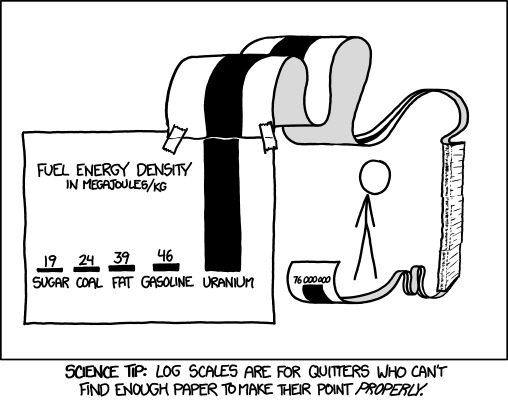
 (Picture from here.)


 These are the kinds of posts that get me in trouble.


I am quite pro-environmental. We have as much solar as we can possibly afford at the moment. Our power supply is aggressively electric. The only place where we use fossil fuels is in heating—which, in the northeast, is a difficult thing to do without. (We are looking at heat pumps but we’re trying to figure out how to handle the extra electrical load with solar. Besides, we haven’t figured out a good way to use a heat pump in the greenhouse.) We have purchased a good hybrid. (Ditto EV.) We are trying to grow as much of our own food as possible.


We don’t live in an earthship but we can see it from here.


There are enough renewable technologies and storage co-technologies that I suspect most residential and business needs will be met in the next few years—providing our politicians don’t shoot us in the head in their misplaced loyalty to fossil fuel corporations.


That said, there are needs that are unlikely to be met easily by renewable sources: either by the intense power requirement over a short period of time or for the relentless necessity for heavy power over long periods of time. In the former, think the Large Hadron Collider. In the latter, think the Pentagon or backing up the grid in the case of cascade failures. There is also the issue that we are talking about renewables taking over the power supply now. The need for electrical power is going up, not down, and I suspect it will be every modality on deck before this is over.


All that said, many problems can be handled by not wasting energy either at the point of consumption or in transmission and just being more frugal. But that doesn’t solve the future problem. For example, about 10% of US energy is consumed cooling the interior of buildings. (See here.) That is going to go up as the earth warms. There is technology in the labs and in startups that might make a dent but I suspect this will, at best, bring us back to the starting point. I.e., the advances in technology won’t reverse the trend. We’ll just break even.


For other future work, we all want to go to space, right? That takes a huge investment in chemical energy. SpaceX’s propulsion systems are driven by methane/oxygen combustion, which results in CO2 created in the earth’s atmosphere during launch and is only marginally adequate as propulsion in space. It takes on the order of five months to get from here to Mars, cooking astronauts the whole way.


We need a high density energy production system. Well, the highest of high density energy is nuclear. Note the figure at the beginning.


It is my contention we need reliable nuclear energy sources, will need them in the future, and would be foolish to leave them on the table.


That said, these sources have to be safe. They shouldn’t use 2% of the nuclear material and throw away the west. They should be easy to build and comparatively cheap for what they deliver.


Source #1: Nuclear Fission


This is the one that’s been around the longest and scares people the most. It has the most issues with waste and has injured or killed the most people. Note, however, that global warming has killed and injured and will kill and injure many more people than fission power generation has ever done. The problem with nuclear fission is we’re scared of it.


Not that we shouldn’t be. Note energy density above. Anything with that level of energy density should be treated with respect. You don’t juggle sticks of dynamite. It’s unhealthy.


Part of the problem is categorical. We treat problems encountered with nuclear power as examples of the danger of nuclear fission. For example, the Titanic sank because of a combination of bad judgement and bad engineering. But that did not halt the use of ships. The Chernobyl Disaster also happened because of bad judgement and bad engineering but has been used as a cautionary tale for nuclear power.


It is a cautionary tale—for bad engineering and bad judgement.


Which brings me to the traveling wave reactor.


Most nuclear reactors have at their core a “rod” full of enriched Uranium pellets. Uranium comes in multiple isotopes, depending on the number of neutrons in the nucleus. U-235 is the most fissile and the “enriched” part of enriched Uranium.


The fuel rods generate heat from the Uranium decay. This heat will, if uncooled, will generate enough heat to melt themselves. This is the “meltdown” people talk about. The nuclear fission reaction is mediated by free neutrons and these neutrons are mediated by a material that absorbs them. The controlled release of thermal energy is used to heat a transfer material—usually water—that drives a turbine just like any other regular power plant. When the enriched Uranium burns down to the unenriched Uranium and non-fissile byproducts, the fuel rod is “spent” and must be handled. This is the really dangerous nuclear waste people talk about.


TWRs also use heat energy to drive some kind of turbine but the difference is in the nuclear reaction.


In a normal reactor, U-235 splits into other elements and releases free neutrons and some gamma radiation. These neutrons and radiation are absorbed, transforming into thermal energy.


In a TWR the reaction operates differently.


The TWR fuel rod mix is somewhat different. It is far less enriched in general—most of the material is U-238 with a small bit of enriched U-235. As the U-235 decays in this environment, it creates more fissile products that themselves will decay and transform the U-238 ultimately into Plutonium which continues the reaction. The exciting prospect here is that the same material that is “waste” in a traditional nuclear reactor, is fuel for the TWR. Since the TWR keeps creating the fissile materials it needs as it operates, the percentage of useful material is much, much higher. In addition, the remainder when the reactor burns out can be reprocessed into fuel. Not only does it not produce the dangerous waste, that same dangerous waste can be its fuel.


The other issue of fission reactors is the meltdown problem. In all of the meltdown scenarios we’ve seen—Chernobyl, Fukashima, Three Mile Island—the problem the reactor required active cooling. Failure of the cooling system of the reactors resulted in a runaway reaction. Therefore, the principles of good engineering dictate that the system should cool passively. If the system fails, it should cool itself.


TWRs have not been built yet. The most well known company developing it is TerraPower. TerraPower is using a molten salt design instead of water. The idea here is that if there is an emergency, the fuel drains into tanks where it solidifies and cools. It is passively cooled in an emergency.


TerraPower had a good thing going in China that was halted by the Trump administration’s concern on technology transfer. Now, it looks like it will be building a demonstration system at the Idaho National Labs.


Source #2: Nuclear Fusion


I know, I know: We’ve been hearing we’ll have fusion power in twenty years since World War II.


Fission happens naturally—Marie Curie noticed it by the glow of the material that ultimately killed her. Fusion does to, just 93 million miles away. The other joke is solar power is really fusion power when you think about it.


That said, fusion might well be workable but its utilization usually violates my sense of esthetics: we’re using the fundamental forces of nature to turn a steam turbine? Like it was coal? Aren’t we better than that?


Enter Helion Energy.


What I like about Helion is how they have bypassed the spinning turbine altogether. Imagine a dumbbell shaped device. Each of the large ends contain plasma. The two plasmoids are accelerated toward one another at high velocity while being further compressed, driving up the temperature. When they collide, they create a very hot, very compressed single plasmoid where fusion occurs.


The expansion of the plasma from fusion induces current. That current is the generated power. No turbines need apply.


Helion uses a Deuterium and Helium-3 reaction. It only releases a few neutrons as part of the reaction. Helium-3 is rare on earth but Helion has developed a side gig on its reaction that generates Helium-3 from Deuterium-Deuterium reactions.


Helion has been working steadily for years on this project. The most recent protype has been able generate fusion temperatures in the neighborhood of commercial requirements and they have been capturing power from the reaction. More than break-even? No one is saying but I suspect not.


Even so, they’ve gotten much further on less money than their competitors. I have high hopes for them.


Source #3: Nuclear Space Propulsion


#1 and #2 were for on this planet—though the same technology could be used to generate power in space if we could get the materials in place. (Z-Pinch propulsion has been investigated for a while.)


Remember that energy density cartoon. Chemical reactions have orders of magnitude less energy density than nuclear reactions. While it’s probably a bad idea to use nuclear methods to get payloads from earth to space, there is absolutely no reason not to use them in space.


The easiest way is to use a nuclear fission reaction like we use a chemical reaction: generate heat and gas expansion, causing propulsion as the expanded gas is expelled behind the vehicle. This is a nuclear thermal rocket.


NTRs were investigated back in the fifties—something well document in the National Museum of Nuclear Science and History, a museum in Vegas I highly recommend everyone visit. This was the NERVA program, a highly successful propulsion system. Development began in 1958 and was stopped in 1973, as a victim of Nixon’s cost cutting.


All is not lost: NASA started revisiting this in 2021.


But there are more nuclear methods of space propulsion.


This Big Boy of this is the Project Orion, where nuclear explosives were used as a mechanism of moving massive payloads. This approach had the singular feature of a paper evaluating the retina burn of the west coast were such a vehicle launched from the surface of the earth.


Again: bad judgement and bad engineering.


That said, were the vehicle assembled, say, in the asteroid belt between Mars and Jupiter, it wouldn’t have the same issues. An asteroid could be the payload.


But let’s bring our pipe dreams down a notch.


What nuclear brings to the table is a vast amount of energy in a small mass. This can be used in a number of ways—nuclear thermal rockets is one. But there are others.


One of the most efficient means of space propulsion is an ion thruster where a gas is ionized and the resulting charged particles are accelerated by an electric field. There are limitations on these systems, one of which is the amount of power that can be brought to bear on the particle. Faster particles mean more thrust and require more power.


Another is using the output of a fusion reaction, with all of the heat and velocity of the reaction, directly out the back of the rock.


The point here is to use that enormous energy density in space propulsion. Normal propulsion takes a crew to Mars in seven-nine months. Nuclear propulsion might be able to bring that down to as little 45 days with larger payloads.


So: bad judgement and bad engineering are bad things. But they shouldn’t prevent us from using good judgement and good engineering to do good things.