First the news: I’m going to be on some panels at Boskone the weekend of 2/17/2023.
I’ll be on the following panels:
- Noir & Moral Ambiguity in SF, Saturday, 2/18, 1:00 PM
- Climate Change in Speculative Fiction, Saturday, 2/18, 4:00 PM
- Seven Easy Steps to Taking Over the Universe, Sunday, 2/19, 10:00 AM
Come see me.
In that vein, here are my notes on the Plagues in SF panel I did back in January for Arisia.
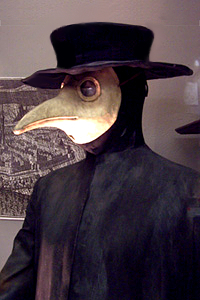
Picture from here.
Observations:
- Plagues in SFF have to serve a narrative purpose.
- The purpose can be just to create an apocalyptic landscape
- My purposes were different.
- When I started working on my “future history”, the Howard Cycle, I was faced with an immediate dilemma: The number of people on the planet was overwhelming. The effects of that population would dwarf anything I wanted to do.
- Consequently, I came to the conclusion that, narratively, I had to reduce the population size. This had to be done in a way that served the narrative.
- Of course, the aftereffects of the apocalypse would resonate for generations in the narrative and that had to be dealt with.
- It’s terribly easy to create a cozy catastrophe with plagues.
- Such a thing happens when the right people survive or die depending on what the author wants to achieve, without regard to the larger horror. Like a catastrophe where only the poor die and the more successful luxuriate in the result. (Which actually happens since the wealthy have better access to health care. Suddenly, leveling the playing field with a zombie apocalypse becomes attractive.)
- The problem, I think, is with apocalypse fiction in general. The post-apocalyptic landscape is preferentially friendly to the target group of the author. Ultra-violent evil—got that covered, Road Warrior. Catholic monks—see Canticle for Leibowitz.
- In past events, many of the elite had the capability to leave when the plague years hit. They didn’t always escape the consequences but they had a better time of it than the poor souls left behind. Thus, an account of the plague years in a beautiful villa in Italy is going to differ wildly from the same time in a Roman slum.
- It’s true now. Those that could escape the consequences of COVID did so.
- Most terrible plague events have two phases
- Phase 1: the plague (or other apocalypse) hits. Lots of people die. Terrible things happen in the ruins. Think Dresden in WW II or the Black Plague in Europe.
- Phase 2: Recovery when the plagues run their course. Did this make things better for the survivors? Fewer people/less competition for resources. Worse? Fewer people/less ability to exploit resources. See European recovery after the Black Death.
- I think an apocalypse—where humans are in real danger of losing civilization—has to go in these phases:
- Phase 1: see above
- Phase 2: Possible recovery, if there are enough people left and enough remaining infrastructure and knowledge. Again, see European recovery after the black death.
- Phase 3: Reconstruction based on restoring lost infrastructure as long as generational knowledge is retained. Rebuilding factories to smelt steel. Build tools. Transportation architecture. Etc. The knowledge of how to do things is preserved but the mechanisms have been lost. Dropping back to basic iron technology because the industrial infrastructure is lost but with the knowledge that industrial infrastructure existed and how it worked.
- Phase 4: Rediscovery based on recovering lost technology where generational knowledge has been lost. E.g., drop back to basic iron technology with only rumors and myths on how skyscrapers were built. The knowledge has to be rediscovered.
- The problem then with any apocalypse is what is left. Plagues are nice in that they are like neutron bombs: people die but structures are left standing.
Plagues in SF and Fantasy, Dan Koboldt
- Plagues don’t have to be viruses to be deadly. See Black Death in Europe and syphilis in Europe.
- Plagues don’t kill a certain population. I.e., plagues aren’t just going to kill a target group like Arabs or Jews or adults.
- This is sort of true. Often, the binding site for a given organism’s cells is conserved across the species population. Thus, a given virus suitable for humans can infect most or all humans. It might also infect other species—rabies is a good example of this. It infects any mammal.
- That said, just because an organism can potentially infect an individual doesn’t mean it will or that it will be successful in inducing disease or being lethal. Smallpox comes in two varieties, Variola major and variola minor. Variola minor has a death rate of 1% or less. The variola major death rate is closer to 30%.
- An individual may have immunity to the organism—that’s how vaccinations work—or the individual binding site might be different enough to discourage infection or prevent it.
- Thus, saying a plague doesn’t kill a certain population depends on the words “kill” and “population.”
- Most diseases don’t kill high percentages of the target population. Some do—the Black Death, for example, which killed between 30% and 60% of the population of Europe, or any of the plagues that struck the indigenous people of the New World. As for population, that depends on the resistance of the target population. Thus, killing a particular population depends on the nature of the population’s susceptibility to the disease.
- Historically diseases that were relatively benign in the Old World were deadly in the New World.
- There is also “combination” hypothesis for syphilis being brought from the New World to the Old World in that the original parent organism was brought to the New World over the Bering land bridge and did not die out in the Old World. But new varieties originated after that time were brought back to the Old World in the Colonial Period. This new strain responded to new selective pressures and evolved into syphilis. (See Alfred Crosby)
- Unnatural plagues—designer plagues—could be configured to target a particular group:
- Provided that group had a specific biochemical profile that was 1) presented such that the agent could recognize and act on it and 2) the agent would only react to that profile.
- However, this is unlikely to be so specific as to target a human invented trait such as race or ethnicity. A plague wouldn’t recognize just Arabs—that’s a human designation that has little basis in biology.
- Conceivably, a plague could be two-fold: one component that recognized a group that then activated a second component that activated the disease state. However, once the disease state was activated, it would be unlikely to remain in the target group.
- Scientists are not always creating new viruses, OAN’s opinion notwithstanding.
- Diseases need vectors and transmission mechanisms.
- High speed infection and death isn’t
advantageous to a toxic organism. If the target dies too fast the vector
doesn’t get a chance to spread.
- Captain Trips from The Stand. My comments:
- Kills too fast to be useful.
- And kills too universally—which is to be expected from a divine virus, I suppose
- Vampiric/Zombie plague from I Am Legend. My comments:
- Interesting in that it doesn’t kill everyone.
- b. Instead, it modifies the surviving subset into a new species of human
- Infertility Pandemic from A Handmaid’s Tale. My comments:
- This is an example of a narrative plague. I.e., a plague that creates a certain outcome useful to the author.
- Note: infertility plagues have been used many times. Note Children of Men and Graybeard for example.
- Blindness from See. My comments:
- See Day of the Triffids
- Wild Card virus from Wild Cards: kills most leaves the remainder with superpowers
- Me: Meh.
- Legacy Virus from X-Men: kills mutants when they use their powers. My comments
- Interesting that if one exercises one’s defining characteristics, one dies. E.g., Tiger Woods succumbs when he plays golf.
- Protomolecule from The Expanse. My comments:
- This is one of the most interesting plagues in SF. It does not kill anyone. Instead, it repurposes living mechanisms.
- While I really like it, that is an enormous amount of intelligence to pack into a molecule.
- The Cruciform Parasite from The Hyperion Cantos: confers recurring reanimation after death.
- Zombie viruses. Any zombie virus. My comments:
- Anything that acts in minute->hour timeframe is not an organism. It’s a toxin that generates a specific reaction.
- The best zombie plagues are those based on behavioral modification of humans based on the zombie fungus Cordyceps and like organisms. (See The Last of Us.) There was an interesting story I read years ago (whose title and author I forget) about an organism that lives in humans that possesses them to reproduce to get the next generation of parasite.
- One of the interesting things about fungi is the enormous amount of genetic information available to be used—far more than a bacteria or virus. In some groups, the cells have multiple nuclei, increasing by orders of magnitude the data over even “higher” organisms. If I were designing a really complex plague behavior, I’d look at working with fungi.
- Xenomorph from Alien. My comments:
- This is a lovely idea of humans becoming entwined in a parasitic wasp style life cycle. It has major problems:
- It is too universal: any organism can be infected by the aliens. Dogs, cats, predators, human creators—it’s all just grist for the mill. There is, in Prometheus, an idea that humans, being created organism, are susceptible to the same parasites as their creators. But then, apparently, any mammal, as well. Even rabies has limits to infection.
- It’s too successful. Eventually, all susceptible organisms become xenomorphs. Parasitic success relies on not being so successful that the target prey species dies from being overly parasitized. Xenomorph parasitism is so successful it will eventually kill all the hosts. Then, the aliens need a second mechanism that does not parasitize to survive—hence, the required invention of the queens.
- Of course, these biological problems go away if the organism is designed.
Plagues in Fiction, LA Public Library
This site lists some interesting works including The Plague, Albert Camus, and Journal of the Plague Year, by Daniel Defoe. It’s interesting to note that plagues in SFF are a subset of the larger plagues in general fiction.
10 Fictional Pandemics that will make you sweat
Another list. Two interesting ones: The Fireman, Joe Hill, where a spore is causing people to burst into flame. Mary Shelley’s The Last Man, showing how politics will really doom us all. And Station Eleven, where the plague aftermath is considered.


 Posts

