Showing posts sorted by relevance for query consideration of works past. Sort by date Show all posts

Monday, June 15, 2026

Consideration of Works "Past": Nausicaä of the Valley of the Wind

Usually I talk about works I read when I was younger now rediscovered. But in this case, I'm going to talk about something that I've read relatively recently—not the film version of Nausicaä. The manga. It’s a works past, of a sort. I mean, it’s new to me but it’s been out for forty years.


So sue me.

(Picture from here.)


Hayao Miyazaki is primarily a film director and animator and it's by his film work that he is best known. If you haven't seen a Miyazaki film, stop reading this blog right now and go rent one. Kiki's Delivery Service is a good one. Or Castle in the Sky. I have a weak spot for Porco Russo, since it's about seaplane pilots. Or you could go straight to the big guns and get Princess Mononoke or Spirited Away. Or, of course, you could also watch Nausicaä of the Valley of the Wind.

Oh, hell. They're all terrific. Go watch them.

The manga is in seven volumes. If you've seen Nausicaä the film, you'd be forgiven for thinking that the first couple of volumes are pretty much a recap of the film. There is more than one story about why Miyazaki did the manga. Miyazaki couldn't initially get funding for the film and so put out the mangas. Miyazaki couldn't get funding for a film that didn't have an associated manga. Etc. The mangas were written from 1982 to 1994. The film was made in 1984.

A thousand years before the story starts there was a terrible war fought, in part, by God Warriors: giant mechanisms with horrific weapons. Vast areas of the world are now filled with poisonous forests inhabited by giant insects. The forests appear to be fungal in nature and spread by spores, often carried by insects or unwary travelers. However, the poison is everywhere and people eventually die of it.

Nausicaä is a princess of the Valley of the Wind—the royalty component of the story seems to not have a direct connection to rule. Her father did rule the valley but there are hints toward the end that there may be other paths to being a sovereign than heredity. Regardless, she is looked up to and admired by the folk of the valley.

War breaks out and there are treaty obligations that the Valley send troops. Nausicaä goes with them. The war was between the Torumekeans and the Doroks. As she proceeds through the different convolutions of the war, encountering spiritual struggle, biological warfare, and enormous cruelty, she becomes more and more important. She is a force for good in an amoral conflict. Eventually, her influence, the power of the insects and the suffocating horror of the war all come together and she prevails.

I'm not going to get more detailed than that. The plot is intricate and clever but I think it is actually a side note to the issues Miyazaki is handling.

Miyazaki has always had environmental concerns. Pretty much every movie has some sort of component that can be construed to be environmental. Even Porco Russo, a story about a seaplane pilot who's become a pig, has a continuing discussion of the balance between selfishness and selflessness—which, I think, reflects Miyazaki's concerns with the environment.

In Nausicaä these issues are front and center. Humans have to live on a poisoned planet—poison that is of their own making. The poison is killing them. Yet they still war. Religion is a political means to an end. The personal and selfish pursuit of power is the source of the world's evil.

But it's not a screed. It's a story where these bits come out as important plot details. There’s no preaching here. Nausicaä never says "If only humans would somehow cease the immorality of their ways and learn to help one another. Ah, Atlantis." She does lament human behavior more than once but it's more in the vein of "Come on, guys. Stop hitting yourselves."

The film handles some of this but much of the rich and detailed tapestry of Myazaki's world is given only token treatment. The God Warrior is just a prop. The sword master Yupa a part of the chorus. This is the cost of compressing Miyazaki’s vision into a two hour film. The manga is much more detailed.

One of the interesting things in Nausicaä's character is her continuing avoidance of killing—not because she's a pacifist. But because she discovers early on the killing rage in her own heart and how easily it can be released. She decides that this is something she must control and from then on she keeps trying to find different ways to make things better. Ways that do not require homicide. Not easy in the middle of a war.

This continuing attempt to not kill anybody and to stop people from killing one another, coupled with her own forceful personality, begins to have knock on effects. People start to take her seriously and, in doing so, take her point of view seriously.

Nausicaä is, no doubt, some sort of Christ figure in this. But it's a Christ figure that we're not used to. Nausicaä is not passive. She's not going to volunteer for the cross. If she goes down she's going down trying to save everyone around her whether they want it or not.

I've read this series twice now and this aspect of Nausicaä's character is what stays with me. She's like the members of Doctors without Borders, going out there and working until they drop to save people's lives.

The work has its limitations. There is little introspection regarding motive—people just do, knowing what they must do instinctively. In my experience there's just a little consideration of what must be done. The ending is a bit abrupt. It feels wrongly shaped—I think everything happens that has to happen but it seems clunky in execution. Miyazaki did all of the drawing in pencil and the artwork is wonderful, but it’s a little opaque at times. Sometimes, you want to just see the precise definition of ink in some of the action sequences and instead there’s a blur of motion.

But these are quibbles. It's a terrific read rendered by a master storyteller at the height of his powers.


Thursday, January 31, 2013

Consideration of Works Past: Yes


(Picture is from Roger Dean's fine website and is tiny and only for fair use. I hope he doesn't mind. If you want to see Roger Dean's work, go here.)

Back in the seventies I was obsessed by this band.

I don't mean in an unhealthy way like I was stalking Jon Anderson or laying in wait for Chris Squire or hiding in Steve Howe's bathroom. I mean I was obsessed with their music.

Let me set the stage.

We moved from California to Alabama in 1964. The closest approaches of the sixties to my life was the faint wisps of WLS Chicago coming through after midnight or abortive material on the Ed Sullivan Show. The radio's big claim to fame was Tom Jones.

I learned how to play orchestral bass. When one of my friends needed a bass player for a garage band I volunteered, without knowing anything about what I was getting into. I got an electric bass and he loaned me some records: Spirit. Jefferson Airplane. Guess Who. The Who. Things like that.

I'd been playing piano since I was four. Not well, mind you. But continuously. And I was deep into Baroque music and Broadway show tunes. Playing in the band was an enormous amount of fun. But at the time for me it was only fun in the band. Outside of the band I'd listen to some of the music but mostly I went back to Bach, Scarlatti and West Side Story.

The band didn't last long. I heard the music when I went visited friends but didn't much listen to it otherwise. In 1969 we moved to Seattle. There I was introduced to more material by another friend of mine who was in a band. But I was still more into Bach than Beatles. Though I began to listen to a lot of Franz Liszt. This turned out to have a bearing on things.

I started at the University of Missouri in 1970. A lot of things happened in the first year involving sex and... well, other things being done in the American colleges in 1970. I'd started playing classical guitar-- couldn't take my piano to college and the pianos in the dorm were pretty poor.

In 1971 the Yes album Fragile hit. I went nuts.

I even liked Anderson's consumptive, yet compelling, vocals. His lyrics weren't Blake or anything but who listens to rock music for the lyrics?

First off, the naked precision of the album just floored me. At this point in the Yes history Rick Wakeman (keyboard) and Steve Howe (lead guitar) had joined the band line up. Wakeman had studied music at the Royal College of Music. Howe had pursued classical guitar for some time though I can't find any indication he had any formal training. This had a strong influence on the band. Fragile is, essentially, a series of tone poems that I thought were inspired by the Liszt tone poems. (I have no idea if this is actually true though there's a good analysis of Yes music here and there's mention of Liszt in the footnotes.)

The second thing about Fragile was that this was music that was intended to be listened to. Not danced to. Not driven to. Not as a back up to a show. In the fine tradition of classical concert music, you had to pay attention. It had something to say musically. You don't have to know German to pick up on the exultation on the Ode to Joy section of Beethoven's Ninth Symphony. It's celebration is obvious. But Beethoven understood the underpinnings of what he was doing. He knew he was communicating something profound to his audience. Music of this sort requires the mind to engage not just the glands. I'm not saying anything against raw sensual music. There's not a thing wrong with Chuck Berry's Johnny B. Goode. But this was a different sort of music requiring a different sort of understanding.

I've been reading Nate Silver's book The Signal and the Noise (highly recommended!) He makes an interesting distinction between accuracy and precision. To use a shooting analogy, accuracy is hitting where you aim and precision is grouping the shots together. To stretch this idea to music, accuracy is how close you get to the artistic target of the work and precision is the craftsmanship of the work. Up to Fragile, Yes had been accurate but not precise. By bringing Howe and Wakeman to the band to shore up Anderson and Squire's artistic vision they achieved both accuracy and precision for what I think is the first time.

I followed Yes religiously for years. Close to the Edge looked like a concerto crossed with a suite to me. I anticipated them attempting a symphony-- which I'm convinced is the intention behind Tales of Topographic Oceans and a portion of Relayer. The biggest shortcoming of the music was that it was limited by only having five performers. There's power in an orchestra. I tried my hand at transcribing TOTO for orchestra but gave up. I didn't have the skill or talent. But it turns out that has been done now in the Symphonic Albums-- though I would have done it differently.

Finding Yes opened up other similarly interesting attempts at something similar. For example Deep Purple's Concerto for Group and Orchestra. The Who's Tommy-- I know it came out before but it was Yes that made me revisit it. Most of these attempt fell short of their goal either in accuracy or precision. But I found I loved the attempt even if they didn't quite succeed. It was an introduction to me regarding how much more one could learn from a failure than a success.

Something about the Tormato album bothered me. I think I had become too enamored in the classical influence on their music and when they branched out I just wasn't able to follow. This was  1978. I went to Clarion SF Workshop, got my Master's.  I entered the workforce. Disco seemed to dominate the music scene: a place I would not go willingly. Disco was followed by Reagan and Punk Rock. I crawled into my musical bunker of Bach, Beethoven and Liszt and left the pop music world behind.

Fast forward thirty years.

I've spoken here about my obsession with Hatsune Miku and J-Pop music: Hatsune Miku and the Magic Turing Test, Hacking Music 1 and Hacking Music 2. Given how this more modern music seems to connect back to Yes and other progressive rock bands of the seventies, it shouldn't come as a surprise that I'd revisit Yes.

I feel like Gandalf talking to Bilbo: You haven't aged a day.

The material before Fragile is dated somewhat. I mean it's not like the Moody Blues which, in my opinion, have become unlistenable. But the early techniques and approaches are crude. Squire and Anderson were working beyond their abilities. They needed Howe and Wakeman to give them the tools they needed.

Tormato and Going for the One now sound better than they did when I listened to them years ago. Drama has similarly improved but I still think it's strained. It sounds as if they were running out of steam. The recordings haven't changed so it must be me. Possibly I'm less rigid than I was back then. Less ideological in my apprehension of music. Less obsessed-- or obsessed with other things. I'll talk about obsessions another time.

Since I quit listening after Drama the subsequent albums, 90125, Big Generator, Union, Talk, The Ladder, Magnification and Fly From Here are new to me. I can't say I understand them yet. 90125 and Big Generator seem more like progressive pop albums rather than progressive rock albums. They still have much of the same accuracy and precision of the earlier work but the target isn't something I'm all that interested in. I mean it's good pop music. But isn't there enough good pop music in the world?

I'm still working on the remainder.

But this is a consideration of works past and that runs from Yes to Drama.

And I have to say it's better than it ever was.


Additional Links:
A history of progressive rock
A complete review of everything Yes ever did
The Complete Yes Discography

Sunday, June 16, 2013

Consideration of Works "Past": Nausicaä of the Valley of the Wind

Usually I talk about works I read when I was younger now rediscovered. But in this case, I'm going to talk about something that I've read relatively recently-- not the film version of Nausicaä.The manga.

In a way, this is a cop out. I've been working on a set of posts involving regulation based on science and physics rather than on whim and appearance. I was going to attack gun regulation but it's more work than I anticipated. So I'm taking a break from that one and talking about Hayao Miyazaki.

Miyazaki is primarily a film director and animator and it's by his film work that he is best known. If you haven't seen a Miyazaki film, stop reading this blog right now and go rent one. Kiki's Delivery Service is a good one. Or Castle in the Sky. I have a weak spot for Porco Russo, since it's about seaplane pilots. Or you could go straight to the big guns and get Princess Mononoke or Spirited Away. Or, of course, you could also watch Nausicaä of the Valley of the Wind.

Oh, hell. They're all terrific. Go watch them.

The manga is in seven volumes. If you've seen Nausicaä the film, you'd be forgiven for thinking that the first couple of volumes are pretty much a recap of the film. There are more than one story about why Miyazaki did the manga. Miyazaki couldn't initially get funding for the film and so put out the mangas. Miyazaki couldn't get funding for a film that didn't have an associated manga. Etc. The mangas were written from 1982 to 1994. The film was made in 1984.

A thousand years before the story starts there was a terrible war fought, in part, by God Warriors: giant mechanisms with horrific weapons. Vast areas of the world are now filled with poisonous forests inhabited by giant insects. The forests appear to be fungal in nature and spread by spores, often carried by insects or unwary travelers. However, the poison is everywhere and people eventually die of it.

Nausicaä is a princess of the Valley of the Wind-- the royalty component of the story seems to not have a direct connection to rule. Her father did rule the valley but there are hints toward the end that there may be other paths to being a sovereign than heredity. Regardless, she is looked up to and admired by the folk of the valley.

War breaks out and there are treaty obligations that the Valley send troops. Nausicaä goes with them. The war was between the Torumekeans and the Doroks. As she proceeds through the different convolutions of the war, encountering spiritual battle, biological warfare and enormous cruelty, she becomes more and more important, a force for good in an amoral conflict. Eventually, her influence, the power of the insects and the suffocating horror of the war all come together and she prevails.

I'm not going to get more detailed than that. The plot is intricate and clever but I think is actually a side note to the issues Miyazaki is handling.

Miyazaki has always had environmental concerns. Pretty much every movie has some sort of component that can be construed to be environmental. Even Porco Russo, a story about a seaplane pilot who's become a pig, has a continuing discussion of the balance between selfishness and selflessness-- which, I think, is a stand in for Miyazaki's issues with the environment.

In Nausicaä these issues are front and center. Humans have to live on a poisoned planet-- poison that is of their own making. The poison is killing them. Yet they still war. Religion is a political means to an end. The personal and selfish pursuit of power is the source of the world's evil.

But it's not a screed. It's a story where these bits come out as important plot details. Nausicaä never says "If only humans will somehow sees the immorality of their ways and learn to help one another. Ah, Atlantis." She does lament human behavior more than once but it's more in the vein of "Come on, guys. Stop hitting yourselves."

The film handles some of this but much of the rich and detailed tapestry of Myazaki's world is given only token treatment. The God Warrior is just a prop. The sword master Yupa a part of the chorus. This is the cost of making it into a film. The manga is much more detailed.

One of the interesting things in Nausicaä's character is her continuing avoidance of killing-- not because she's a pacifist. But because she finds out early one the killing rage she has in her own heart and how easily it can be released. She decides that this is something to struggle against and from then on she keeps trying to find different ways to make things better. Not easy in the middle of a war.

This continuing attempt to not kill anybody and to stop people from killing one another, coupled with her own forceful personality, begins to have knock on effects. People start to take her seriously and, by doing so, take her point of view seriously.

Nausicaä is, no doubt, some sort of Christ figure in this. But it's a Christ figure that we're not used to. Nausicaä is not passive. She's not going to volunteer for the cross. If she goes down she's going down trying to save everyone around her whether they want it or not.

I've read this series twice now and this aspect of Nausicaä's character is what stays with me. She's like the members of Doctors without Borders, going out there and working until they drop to save people's lives.

The work has its limitations. There is little introspection regarding motive-- people just do, knowing what they must do instinctively. In my experience there's just a little consideration of what must be done. The ending is a bit abrupt. It feels wrongly shaped-- I think everything happens that has to happen but it seems clunky in execution. Miyazaki did all of the drawing in pencil and the artwork is wonderful. But you want to just see the precise definition of ink in some of the action sequences.

But these are quibbles. It's a terrific read rendered by a master story teller at the height of his powers.

Sunday, July 21, 2013

Consideration of Works Past: A Canticle for Leibowitz


(Picture from here.)

We can't effectively criticize Shakespeare or the Bible because they have so profoundly interpenetrated our culture and our language. People who have never read a word of the Bible know the meaning of the phrase "the patience of Job." People who would barely know the Bard's name know the meaning of the phrase "the green eyed monster." Such works have become the water in which we as fish swim. We read the Bible. We watch the plays. But we're seeing our own culture write large portrayed back to us.

These are big examples of how culture and literature reflect one another. It's the reason we should always have a literary canon. Not because these are the best we have to offer but because they are what inform our cultural milieu.

The process is dynamic and recursive. Some works are magnificent and immediately forgotten. Some distill a moment and continue to evoke that moment for decades after the moment is past. To Kill a Mockingbird shows a particular moment in the mid-20th century south and has become metaphorical in is depiction of American racism. 

Racism is timeless. The mid-20th century also experienced something particularly unique: the actual possibility of universal destruction of humanity by war. The prospect of such a holocaust has been around since the Revelation of Saint John but only until the 1950s did it become technically feasible. Humans were forced to confront not only their individual mortality but the mortality of their species. They confronted this prospect best (I think) in literature.

Nuclear holocaust and post nuclear holocaust novels were born.

We know of them as a staple these days. In film. In books. But modern post apocalyptic stories now are explorations of a trope. They don't arise out of impending doom. Those of us who learned to duck and cover are a dying breed and our children and grandchildren are products of a society that (I hope) outgrew such an immediate death. Instead, we'll have a slow chronic sickness of global warming and resource scarcity. Fertile literary ground to be sure but not the same as the quick flash and obliterating thunder.

Two books are still known today close to fifty years later: On the Beach and A Canticle for Leibowitz.

They're good bookends of one another On the Beach deals exclusively with death: there are no human beings alive anywhere on the planet by the end of the book. The work's complete focus is how people deal with the true and actual end of the world.

A Canticle for Leibowitz is almost exclusively about how humans (or human belief) survives the end of the world.

The plot is thoroughly discussed elsewhere and only needs a quick synopsis. Nuclear exchange happens. Most of humanity is killed either quickly or slowly by radiation. The living remainder turn first on those who they think did this, then the scientists and then anyone who can read. Isaac Leibowitz, a Jewish engineer, converts to Catholicism and founds an order that attempts to preserve knowledge in the face of this destruction. Six hundred years later, the order is still alive and has transformed from going out and getting knowledge to preserving what knowledge it has while being unable to understand it. They don't know if the works they are copying and recopying to preserve it is a laundry list or a prescription for paradise. It is at this six hundred year mark that Canticle begins.

The book is written in three parts: Fiat Homo ("Let there be man), Fiat Lux ("Let there be light"), Fiat Voluntus Tua ("Let thy will be done".) Part one begins with the discovery of an ancient (and important) cache of documents and ends with the canonization of Leibowitz into sainthood. It takes place during a dark ages where there are no states of any consequence. Part two involves the rediscovery of the importance and knowledge held within the documents and shows the rise of political states and conflicts. In part three the order is again gathering and preserving knowledge, this time in full understanding of the knowledge they have. The world is crumbling again between two mighty power blocs and on the verge of self destruction. The vast majority of the story takes place in the order's abbey.

Canticle asks some really big questions. What is the role of faith and religion over time? Miller suggests that the Church (and perhaps religion itself) is a means of stabilization over time. It serves as a repository for valuable things that are not currently treasured until that time they are once again revalued. The object in the story is the knowledge of the previous time. But Miller also points out the implications of faith are also held within the church and may never be properly valued in the secular world. This conflict between spiritual morality and secular practice occurs over and over again in the book both in the larger political macrocosm and the microcosm of the human interactions of the abbey. 

The characters in the novel grapple with these issues over and over again. At one point in the novel, when there is a nuclear strike near the abbey in part three, the government sets up medical triage tents where euthanasia drugs are handed out to those who have had a fatal radiation dose. The abbot fights this and protests it, not allowing the tent to be set up in the abbey.

The book continually shows intellect at war with itself, at war with morality, at war with passion. It is comprised with adults wrestling with some very big demons. This not the children's coming of age story that most post apocalyptic stories have become. These are adults who have made sacrifices for their beliefs. Who are trying to live to an impossible ideal (Christ) and failing and trying again while knowing all the while that such an ideal is, in fact, impossible.

I do not subscribe to much in the way of faith but Miller shows its nobility. Its intellectual and emotional rigor. The sorts of questions that a person of faith must ask and the integrity that person of faith must have to answer those questions honestly.

Usually, when SF deals with faith the religion is a construction to a purpose. (There's a good article on the subject here in wikipedia.) Often, the purpose is political. Sometimes it is a criticism of the concept of religion itself. Sometimes the religion is an allegory or a sacred mystery. Sometimes the issue is how to reconcile dogma with the physical world. I think, however, the consequences of faith are rarely dealt with head on. The Christian faith contains some hard nuts to crack: caring for your fellow man, the role of the secular leader, the issue of accountability and responsibility. These are not usually the stuff of SF.

There's a point in the book where the abbot of the monastery goes out to visit an old friend, a Jewish hermit named Ben. The implication is that Ben believes that he is Lazarus though it is not explicitly stated. In talking with Ben the abbot realizes that in Ben's madness he believes he is the last Jew and so bears the responsibility and accountability for the acts of every Jew that has ever been. The abbot thinks about this and considers his own role as abbot. What would it feel like to be accountable for the evil acts for every other abbot? This, by extension, is the role of Jesus: to be responsible and accountable before God for every evil act that has ever been committed by man, thereby accepting the punishment for those evil acts and absolving human beings from that crushing burden.

Heady stuff and not for the squeamish.

Canticle has not been out of print since its publication in 1959. It has a kinship with To Kill a Mockingbird. Harper Lee never published another work and has said it's because the popularity of her first novel was so great that any later work would inevitably be compared with it and found wanting. Walter M. Miller didn't publish anything else in his life time. He did work on a sort of sequel and got it a good way along but committed suicide after the death of his wife. I've read some conjecture that the difficulties of the book contributed to his death. Terry Bisson was in the process of completing the work when he died. (Here is Bisson's story of how that came to happen.) Saint Leibowitz and the Wild Horse Woman was published in 1997. I have not read it.

The book stands its ground now pretty much as well as it did when it was first published. We of the duck-and-cover generation still remember the deep, tidal fear of those times and it comes across in the book. But I think later readers will still appreciate it. Anyone born in the last hundred years will understand the apocalypse is always at hand, waiting for the moment when we might embrace it.

Sunday, February 23, 2014

Consideration of Works Past: Immortality, Inc


(Picture from here.)

I just spent the weekend at Boskone. Great fun. But after one of the panels I was asked who were my significant influences.

I quickly rattled of my personal mantra: Robert Heinlein, Clifford Simak, Cordwainer Smith, Mark Twain, John Dos Passos, Phillip K Dick, Alfred Bester. Anybody who's discussed writing with me more than five minutes will get that particular list.

Then, later, I was down in the dealer's room and looking over NESFA's table.

I've been looking for a particular work from my childhood. A book that I barely remembered that, somehow, involved life after death of a yacht designer. It had suicide booths in it. And there, on the NESFA table, I found in the short novels of Robert Sheckly, Immortality, Inc.

It looks like I have to add Robert Sheckley to the list.

BTW: If any of you are interested in classic works by Roger Zelazny or Hal Clement or Zenna Henderson or, really, almost anybody that has fallen out of print or cries out to be collected, check out the fine people of NESFA Press. This is a small press publisher that is bringing together reprints of works in hardcover. They have, for example, three very good books by my special hero, Cordwainer Smith: Norstrilia, The Complete Short Fiction of Cordwainer Smith and the Concordance to Cordwainer Smith. I keep them in my office and hold them close, whispering "my precious." Go look at their catalog here.

Sheckley had a truly skewed view of the world. In terms of sensibility he was more over in the Phillip K Dick side of SF. SF was a mechanism to open up the clockworks of life and examine them. Immortality, Inc is, in part, an examination of our fascination with death.

The plot is straightforward. Tom Blaine is a Junior Yacht Designer in a New York Firm. On the way home from his vacation cabin he has a car accident and dies. He awakes to find himself in a new body in the year 150 years in the future. In this world, life after death is well known and scientifically verified. Anyone who can afford it can get a treatment guaranteed to let them live after death. Most don't survive the "death trauma"-- a lovely wink towards Freud's "birth trauma."

But the plot is just a means by which Sheckley can use this new world as a means to skewer the one where he lives. I'm reluctant to start listing all of the lovely things in the book for fear I'll spoil it for people who have not read it. But here's a couple.

There's "transplanting": the means by which you can share or operate someone else's body. Initially, as normal science fiction uses the idea, it's mostly sold as titillation. But later it is presented as a force for revolution. As the freedom to be anyone you want to be-- held down by those that would oppress us. And there are suicide booths-- I have no doubt the suicide booths in Futurama are a direct homage to Sheckley.

The book is more absurdist than funny. More thought than laugh provoking. It is a satire-- a subgroup of SF that is sadly underrepresented. All good satires are intended to twist your head a bit. Sheckley managed that in all of his work. Immortality, Inc is no exception.

Most of the writers I consider seminal I read everything they wrote. For whatever reason, though he had a strong effect on me, I didn't do that with Sheckley. It might be that there were just too few opportunities to read him. The period I ripped through most of the books is started when I was eleven and went on through college. I was in Alabama for much of that time. No SF bookstores. No conventions I knew of. The SF book club was available-- indeed, that's where I got Sheckley's Mindswap-- but I had to husband my money. Most of my reading came from the library. Unlike Heinlein prior to 1960 or Asimov or other, like, writers, Sheckley was always a bit subversive. Possibly beyond the tastes of those southern librarians.

Imagine my delight when I looked at the NESFA Sheckley collection and found not one. Not two. But three books by Sheckley I'd never managed to read.

Sheckley novels to read:


Other good SF satires


Thursday, April 16, 2009

Consideration of Works Past: Clifford D. Simak


Clifford D. Simak is an odd duck. His work absolutely science fiction. There's no frippery in it. It's not hard SF in that we don't learn the nuts and bolts of things. It's more humanistic than that. He postulates things and then plays with human reactions. He's in the vein of Edgar Pangborn or (sometimes) Ray Bradbury.

But what makes Simak interesting, to me, is the gentleness of his fiction. I'm going to talk about three books: The Werewolf Principle, Time is the Simplest Thing and The Goblin Reservation. (Curiously, full text of The Werewolf Principle is here as well as others.)

Let's set the stage.

The TWP and TGR were written in 1967 and 1968. TITSP was written in 1961. I moved to Huntsville, Alabama, in 1964 and left in 1969. During that period I devoured every science fiction, fantasy and mystery book that existed in the Huntsville Public Library-- which contained more than you might think. Many of which I can barely remember. There was one piece of drivel called Hyperspace, which involved voracious creatures of the fourth dimension that liked to eat buildings.

It must have been during this period I read these three (and also some other works) by Simak.

Simak wasn't afraid to talk about love or fear. Many more "modern" works seem to have to paint over love with sentimentality and fear with horror. Simak wasn't like that. He was, I think, a throwback to earlier kinds of fiction like William Saroyan's The Human Comedy or Ross Lockridge's Raintree County. These were works more about how people lived their lives and any insight gained about their inner psychology derived from thoughts and actions deriving from those acts of life. Simak seemed to understand that people treat themselves gently most of the time.

That said, much of Simak's work followed a common plot where a man (almost alway) had achieved a status quo, an event drives him from that and the rest of the novel follows him finding a new equilibrium. The Werewolf Principle starts with a man having no memory of who he was but he's been declared normal and given a place in the world. But he starts transforming into different creatures. The Goblin Reservation tells the story of a professor who returns to earth only to find he had already returned previously and died. Time is the Simplest Thing posits a world where telepaths explore other worlds and encounter aliens. One of these gets a copy of an alien's mind and then must flee.

In all three, humans are not lords of creation but neither are they low scum. Aliens are often not particularly threatening but often have their own agenda-- living their (alien) lives just like humans.

What I found in Simak's work, and these three novels in particular, was a tenderness. It's very clear Simak loved his characters. I expect he enjoyed people-- at least, that's what I've gotten from his work. Both are rare qualities in SF. Tenderness is an emotion felt towards those who are vulnerable and most SF writers just don't view humans in this way. Heck, most writers don't view humans in this way.

I have to say I've consciously tried in several stories to emulate this qualilty. I've had some success. It's easy to get maudlin-- which, of course, destroys the effect.
=======================
Links of Interest
Best Stop Action Film Ever
Climbing the Giants
13 Things that Do Not Make Sense
What's Really Heart Healthy
Obama's Portie
Three Arm Monty
Should I stand or should I run... from Mountain Lions
V: Secrets of Rock Climbing
Coming West African Megadroughts
Life in Antarctica that could be on Mars

Monday, December 14, 2009

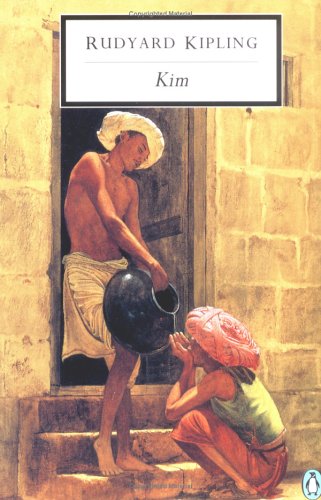
Consideration of Works Past: Kim, Rudyard Kipling

(Picture from here.)

This isn't quite in the same vein as the other posts. For one reason, it's not SF or fantasy. For another, I've been re-reading Kim every couple of years since the seventies.

But I was looking over a paperback version I gave Ben and read, for the first time, the introduction. In it the "professor" said that it was ironic that Kim was termed "Little Friend of All the World" when there was no evidence he had any friends at all. One wonders what book the "professor" was writing since it bears little resemblance to Kipling's book. I am forced to presume there exists a book, Kim, by an author, Rudyard Kipling, that, by a wild coincidence bears the same name of book and author as the work with which I am familiar.

Thus, this entry was born.

Kim is the story of Kimball O'Hara, a poor white boy in India. It bears a similarity to Huckleberry Finn in that both are poor white boys that make their way in the world. They are vastly different in that HF deals with a set of very similar cultures and Kim deals with the vast and diverse of 19th century India. I will not deal here with criticism of Kim as essentially oppressor work about an oppressed country. Similar criticism can be aimed at HF.

Both works deal with an individual coming to a moral sensibility through a path frowned upon by the culture they belong to. However, Huck is born into a world where right and wrong are clearly (if incorrectly) defined. He knows what is right because that's what he's been taught. Huck chooses a different moral path from the one he has been taught, valuing his friendship with the slave, Jim, over any possible damnation from the "moral" world.

Kim has a journey through a different section of the same country. The book starts with Kim having almost no morality whatsoever. Any higher purpose he might serve is washed away in the excitement of his life, poor and destitute though it might be. It is by way of the friendships he makes and keeps that he brings himself to any sort of moral understanding.

In Kim's case, the overbearing morality of the white sahib culture is insufferable. He seeks over and over again to escape it to the freedom of his poverty-- which to him is not any sort of poverty at all. He befriends and is befriended by a lama from Tibet. One of the struggles through the book is Kim's love for the old man and the old man's resistance to that love, since emotional attachments is against his sect of buddhism. Finally, almost in desperation, the old man finds a parable that seems to give him leave to love this boy to whom his heart is drawn.

Oh, there's a bunch of adventure, spying, etc., in the book, too. It's a lot of fun.

So I got to thinking. I've read a fair amount of 18th and 19th century literature. I've worked my way through Dickens, Austen, Eliot, etc. But I find them pretty tame stuff. Not terribly interesting. Clearly, they are works of quality but they are not works to which I'm drawn.

After reading the introduction to Kim and revisiting it, I realized that from what I can tell, the other novels (Dickens, Austen, Eliot, etc.) are safe novels. It's absolutely clear where the moral high ground is in Dickens. The stories are marvelously complex and interesting in the way they navigate the moral high ground but the moral high ground itself is undisputed.

Similarly, the Austen and Eliot are shades of gray morality. The nature of these books, as I see it, are how to negotiate between the heart's desire and the needs/demands of society. Again, the moral high ground is undisputed. These are novels of negotiation. For marriage. For wealth. For love.

(I know there are Austen fundamentalists that would burn me at the stake right now. So it goes.)

Both Kim and Huck both toss out this moral high ground in the first chapter. Morality, high or otherwise, is itself suspect. The path Kim and Huck have to decide is not how to negotiate the path through morality but what is the nature of a morality to which they can subscribe. In Huck's case, it is freeing his friend Jim. Not because slavery is wrong or right (Huck thinks and has been taught it's proper for Jim to be a slave) but because his love for Jim requires him to act as a friend to this slave even if it means he'll go to Hell.

The moral decisions for Kim are not so clear. India, for that matter, is not so clear in this book. All manner of evil and heresy lie about. Kim could pick any one of them and be fine. This doesn't come up because to Kim they are not important. He has an inkling of higher things-- how could he not as a companion to a lama? But what drives him is not a moral decision (as drove Huck) but a denial of the morality itself. He is with Teshoo Lama. He is Teshoo's chela (disciple). That is enough.

In painting Kim's story this way, Kipling strikes out from the safe, moral path to an area of risk. The moral ground of a thinking man is that which the thinking man decides it should be. What is right is what Kim decides it should be. In this way, Kim picks up burdens he chooses, not submitting to the will of others in his life. Morality becomes a matter of personal choice and cannot be dictated.

Now, that said, these are all interpretations of the actions of the character, Kim. Kim doesn't wade through this moral quagmire; he acts. But the acts he chooses change over the course of the novel from a lost but joyful boy to a sober but still joyful young man.

Huck made a moral decision that would make him an outcast in the culture from which he sprang but it is a decision that would gain him acceptance somewhere.

Kim made a different decision. Instead of choosing a particular point of view he denied the necessity of that choice. Kim is presented with having to pick a particular life: sahib, native, etc. He decides to be who he is (sahib, native and etc.) and embrace it. For Huck, the moral decision was to embrace an act. For Kim it is to embrace a life.

Neither choice, and neither book, is safe.

=====================================================
Wall of Idiots
Beck, Limbaugh and Hannity. Surprise!
Senator David Vitter R-LA
Rep. Aaron Schock R-IL
The American Army

Links of Interest
World's scariest swimming hole
Cano's Castle
CO2 + sunlight = Diesel
Obama's toast to Alfred Nobel
V: Obama's Nobel Prize acceptance speech
Fun with giant orangutans
Fun with Fractals
V: National Geographic's Blue Moon
V: National Geographic's Alien Worlds
V: National Geographic's Crocs eating dinos
Looking for Life in the Multiverse
The role of healthy bugs inside us
What's melting the Himalayan glaciers?
Quantum propulsion
Trolley canal boats

DIY
Soft-setting adhesive putty
Home Solar: Here. Here. Here. Here.
Pottery kickwheel
Tarp tents
Ski bike
Butterflake rolls
Air muscles
Millefiori beads
Honey
Laundry detergent

Sunday, April 26, 2020

Consideration of Works Past: The Revolving Boy


(Picture from here.)

By now it cannot be a secret that I like small stories.

These are stories where there might be a major cataclysm, catastrophe, war or other great event but that is backdrop. It might impact the story and the characters. It might not.

But the story of the characters is what interests me.

I read The Revolving Boy when I was a boy. It had resonance with me then. It has resonance with me now.

The author of TRB is Gertrude Friedberg. That's about as much as I can say. The wiki article says she wrote two plays that were well received-- one, Three Cornered Moon, had Ruth Gordon in it and was almost immediately made into a film. She wrote three SF stories and one novel. She was admired but, as far as I can tell, doesn't have much impression on the internet as a person.

This is a shame. I would love to know more about her.

I do know a lot about The Revolving Boy in that I've read it more than once recently.

First, like any SF book of that era, it has a lot of SF tropes like flying cars, fancy home machines and the like. I think the problem with a lot of those works is people didn't expect to actually reach the future. One of the interesting things about current near future fiction is its conservatism: people have read those dated works and don't want to have their own works suffer the same fate.

But Friedberg wrote TRB in 1966 and she was fifty-two. She'd already seen how works dated. Much of the future stuff is a bit over the top. I suspect Friedberg was having fun.

That said, it's a minor criticism and can be easily overlooked.

The book is the story of Derv Nagy from his early childhood until his late middle age. As I said, this is a small book. The big things happen around in his life and don't necessarily affect him all that much. The book is tightly focused on Derv.

Derv is born (and expresses at an early age) a marvelous sense of absolute direction.  He can tell north without thinking about it. He feels twisted over the course of daily life relative to his sense of direction-- to the point of unwinding over the day.

Later in his life (early in the book so I'm not giving much away) he determines that his sense of direction is relative to something absolute. He doesn't know what it is. He only knows where it is and he must bend his life around that direction.

Friedberg has done something remarkable here. She takes something as simple as a sense of direction and pins it down as a pivot around which someone orients his life in a very real, physical way. By doing this, she shows us how people are bent by simple things. It's easy to extrapolate from this to higher moral conundrums but she does not. She stays with this simple, fundamental thing Derv must accommodate. Derv revolves.

Derv is a true character. He has a sense of humor. Like anyone, he tries to find his place (and a place for his uniqueness) in the world. He does not become a hero or a captain of industry. He finds love. He finds a life. He finds a job. There is nothing dramatic in what he does except where those things are dramatic to him.

There were a couple of things I pulled from this book-- reinforced by other books I was reading at the same time. Derv reminds me of Huckleberry Finn. Huck also makes his way through his life. He does not accomplish great things. The world is not greatly changed by his passing through it any more (or any less) than Derv's world is changed. Raintree County is another book I read at the same time.

What these books have in common is the placement character in the context of the larger world. The world is unchanged by their movement through it-- and that is just fine. Most of us don't change the world much. We change our little piece of it in our friends, our family, our children.

I have no illusion that my writing will change the world-- it won't. The wheel of the world will go on pretty much unswerved by anything I do. But I do like to thing I have made some things, some people, some situations, a little better for me having passed through by. No doubt those changes will be swallowed up by time. I don't have a problem with that.

I never knew Gertrude Friedberg. I wish I had so I could tell her that her book made a difference to me. And I hope that difference will shine through my own work and further its effect, as little as any effect I have might be.

While the differences she made will likely outlive my own, they won't last a thousand years.

So what? What does?

Monday, September 21, 2009

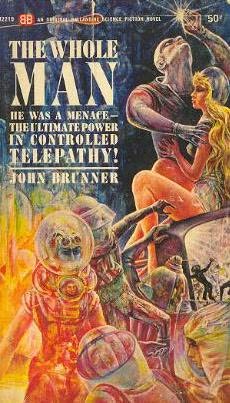
Consideration of Works Past: The Whole Man


(Picture from here.)

I read a lot of John Brunner in the sixties and seventies. I found him lest interesting as time went on. The last book I read by him was The Children of the Thunder, which I didn't like at all. He's most famous for Stand on Zanzibar, a novel about overpopulation. I like SOZ fine but I think Harry Harrison's novel, Make Room! Make Room!, has a better take on the issue.

The Whole Man isn't a lot like Brunner's other works to my mind. Most of his other works, like a lot of science fiction in general, are about big issues: overpopulation (SOZ), the failure of humanity to encompass information (The Shockwave Rider), the failure of alien civilizations (Total Eclipse), etc.

TWM, by contrast, is completely driven by the characters. There is a backdrop of the world but the narrow focus of the novel on the individuals makes it a better work.

The synopsis: Gerald Howson is born during a period of civil unrest in, ostensibly, England. The unrest was quelled by the invasion of UN troops-- signifying a strong planetary role for UN pacification. He's born deformed, one shoulder higher than the other, one log longer than the other, etc. His mother doesn't really want him but doesn't want to risk getting rid of him, either. He grows up in this environment.

When he's about 20, his telepathic gift shows up and he uses it to tell stories to a deaf-and-dumb girl. Both of them are in danger of succumbing to what is called a catapethic grouping, when the power of the telepathist's projected images overcome the natural senses such as hunger, thirst. Such groupings can be fatal.

Howson is discovered and captured prior to this happening. He has been discovered by the raw power of his gift. His gift is a consequence of his deformity.

The story is in three parts: early life and discovery, some time later when he has learned how to use his power and the seminal case that shows how his life is essentially empty, the journey he makes to find out who he is and what he wants-- to become "The Whole Man" of the title. A good synopsis, but a poor review, can be seen here.

By and large it is not as well regarded as his other works. I find this astonishing.

TWM has its issues. Its biology is suspect even by the standards of the time. It is a bit mired in the psychological approaches of the time. It is, perhaps, a bit too episodic.

But it showed me a road in fiction that I found exciting.

My thinking is forcibly wedded to reality-- not necessarily a technological reality but a human reality. That means when I look around the world and see humans doing things and look in fiction I expect to see similar things. If I pick up a heroic fantasy where the hero beats all odds to bring down the king and rule in his stead, I expect all of the knock on effects of a coup as we have seen when kings in our world have been knocked down-- power vacuum effects, revenge by the family, changes of alliances, etc. If the king is knocked down and the hero lives happily ever after, my brain says fairy tale and goes on disappointed.

That is what makes TWM so interesting to me. Given the world of the novel, nothing happens to Howson that is not character driven. He is discovered by virtue of something he does. What he does derives from the austerity of his life. His resistance to learning to use his gift derives from his personality and needs. His failure to find fulfillment in that gift also comes from his personality-- he's satisfied one part of his life and not another. His final success, and the resulting gift from his friends, completes him in a satisfying manner. No world is save. No heroes. Nothing like that.

It is a journey to self, analogous to Jung's individuation. It is further made interesting because the telepathy itself modifies the individual, much like the ability to do higher mathematics or have great personal understanding or athletic ability modifies the personality of the individual.

I knew early on I wanted to write speculative fiction. I knew I wanted to write about moral decisions-- though I didn't really articulate the concept until much, much later. But TWM was the first novel that seemed to encapsulate what I wanted to do with my fiction.

It gave me a perspective on fiction I have used to this day.
=================================================
Wall of Idiots
Lies from the RNC
Lies from the DNC
Lies from progressives
Conservative lies about health care and breast cancer
Conservative response to Obama's school speech
CPR lies about health care
Eric Cantor's gender lies
Lies about stamps
Lies about China
Plastinated cadaver sex
Conservative sex ad
Catholic conspiracies
Ian Pilmer

Links of Interest
Happy Birthday, H. G. Wells!
Haumea and here
NASA Launch Systems
Light a gril in 30 seconds and here
Gene therapy for monkeys to get color vissiiooon
Salt and pepper battery
Levitating mice
Microwave cold spot artifact
The thankless job of the FDA
Steampunk Motorcycle
Weird things fall from the air
Give geoengineering a chance

DIY
Paper monster automata
Altoids Tin Bread Baker
Dress from a button down shirt
Beneficial bug houses
Bandaid in the woods
Downloadable papercraft
Low melt casting alloys
V: low cost rice thresher
Baskets from gas bottles
Sailboat in a closet
Small, precise holes
Gray water system
Pesto
Secret image sculpture
Carbonated beverages
Overboard rescue
Battling tops
Bamboo bike frame
Clean a knife
Filleting a fish

Sunday, November 27, 2011

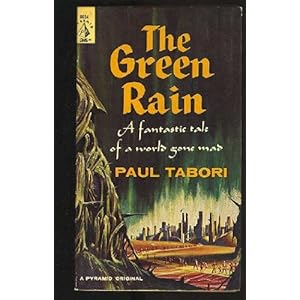
Consideration of Works Past: The Green Rain


Usually, I talk about science every two weeks. But the turkey tryptophan is still coursing through my veins and I can't face it. So I'll wax literary for a bit.

Over the past few years I've been re-reading works that I found interesting and provocative back when I was a mere babe. (You can read previous ruminations here, here, here and here.)

The Green Rain was published by Paul Tabori back in 1961. It's a short book-- barely 70,000 words, if that. It's premise is simple: there's a mistake with a chemical missile and something goes wrong. The chemical seeds the clouds. It rains and the result is that everyone caught in the rain turns green. General hilarity ensues.

Well, only if you count political destruction, death and riot as hilarity. Perhaps I have a skewed sense of humor.

There were a lot of odd books written in the sixties and seventies, many of them better known. The Muller-Fokker Effect by John Sladek, for example. Adam M-1 by William C Anderson. Rally Round the Flag, Boys! by Max Shulman. Most of these works were fairly light even though they might be handling fairly dark material.

The Green Rain reads like a bitter, eloquent Ron Goulart at the height of his powers. It opens with a quote from one of the characters, a bitter old professor named Pelargus, who says "Something goes wrong. It always does." Then, it wanders over to a satyric biochemist who has created "chlorophylogen", a chemical precursor to chlorophyll. It has the property of generating plant like behavior upon contact with light. NASA (the ISS in the book) decides to send a rocket to the moon to make it earth like. It fails in launch and returns to earth, seeding the rain with chlorophylogen. Something happens to the chemical in the return. It's no longer simple chlorophylogen, it turns human beings green.
You can't change the color of people's skin without dealing with race. Tabori does. You can't change skin color without political repercussions. Tabori gleefully traces the downfall of the cold war. You can't change skin color without religious overtones and you can't have a religion without con artists-- at least not in southern California. Tabori wanders over there, too.

It's a romp. Or, at least it is in the beginning.

Things go dark about half way through. It's not like Shulman or Anderson. There's no easy, happy ending. The bitter Pelargus may have the last laugh after all.

This is what fascinated me when I first read it long ago and it fascinates me still. Though the science is dated and the political world is different, there's a lot that still rings true in this book. There's a scene where a young actress discovers herself pure green and comes out screaming and then faints. When she wakes up her first words are "I'm going to sue for a million bucks!"

And we're off and running.

What's curious about this book, and some of the others mentioned, is how thoroughly vanished they are in popular culture. Certainly you can find them. All of the above books are mentioned in wikipedia and you can get used copies at Amazon. The internet never forgets anything.

The impact at the time of Sulman and Anderson was considerable. Tabori, less so, but he was well known. Almost none of these names are mentioned now.

It's what I call the Bret Harte phenomenon. If you've taken an American lit course, you've ran across the name. He was a contemporary of Mark Twain. However, now we remember Mark Twain and Harte is barely remembered. Now, I'm not saying Harte was as good a writer as Twain-- he was not. But he was worth reading and popular for a time. You can make a similar statement about William Saroyan or my own favorite author, John Dos Passos. Both brilliant writers and rarely read these days out of literature courses.

The Green Rain is a lovely little science fiction book that will make you think. Don't take my word for it. Go over to Amazon here and buy it. Read it.

We'll bring these guys back eventually.

Monday, August 19, 2024

Consideration of Works Past: The Year of the Angry Rabbit


I looked for this book forever.


(Picture from here.)


All of the past printings were way too expensive—in excess of a hundred dollars. I’m guessing for the longest time it was a collector’s item. Then, at some point, the cost of the book fell to a point where I merely screamed and I got a copy.


The Year of the Angry Rabbit was written by Russell Braddon in 1964. Braddon is Australian and this is a satirical novel so it comes as no surprise the armature around which the book is written is Australian politics. Braddon said he wrote it as a joke and it only took four weeks. It’s a pretty good joke both for and on the reader.


The premise is that a kingmaker constituent, Sir Alfred, responsible for the ascent of the Australian Prime Minister, Sir Kevin Fitzgerald brings Fitzgerald to task. Rabbits have been controlled by the introduction of myxomatosis. However, on Sir Alfred’s station, a resistant group of rabbits have taken over. Alfred demands Fitzgerald correct the situation. Fitzgerald tasks Professor Welch and his team to come up with an improved disease, “supermyx.” 


Welch does so with a bit of a caveat. The rabbits are immune to supermyx as well but it turns them into vicious rabid animals with an infective bite. Any animal the rabbits bite does of supermyx instantaneously—demonstrated on Sir Alfred early on.


This gives Fitzgerald an idea. After he nukes Sir Alfred’s station to make sure the supermyx rabbits don’t escape, he then commissions the military to secrete clandestine installations of supermyx bombs in every major city in the world with the control system in his study. Then, he blackmails the world into giving up nuclear arms and embracing peace. It doesn’t go all that smoothly. He has to wipe out a couple of countries that insist on continuing their war. But once that’s all over with, it’s smooth sailing. 


War is still economically necessary, however. So, Fitzgerald leases the outback in the middle of the country for scheduled wars promoted like the Olympics. Things go swimmingly. 


However, no good satire ends well. It turns out the rabbits have survived nuclear holocaust deep underground and have turned into dog-sized, intelligent, feral carnivores—all with a supermyx bite. They escape and start overrunning the country. Australia is abandoned and that would be all right except the keyboard used by Fitzgerald to trigger the supermyx bombs ends up in the path of the nightly running rabbits. Bombs go off all over the world and everybody dies.


It's a fun novel. It reminds me a lot of Paul Tabori’s The Green Rain in 1961. Both involve a technological event that changes the world and ends up ending humanity. There were other novels around the same time that felt similar: Brian Aldiss’ Earthworks (1965) and FROOMB! (1964) by John Lymington. They share a sense of inevitable doom mixed with an odd sense of humor. Tabori was Hungarian. Aldiss and Lymington were both English. Braddon was Australian. Maybe I was attracted to the unAmerican sensibility.


And I was attracted to this work and these other works. There’s a certain go-to-hell­ quality to them. A sense that they were saying I see what’s coming. Now you’ve got to see it, too.


I have read The Green Rain many times sense and it still holds up. FROOMB! has become a difficult read. I haven’t tried Earthworks again yet, though I will. 


I had high hopes for The Year of the Angry Rabbit. It didn’t exactly disappoint but it has aged and not in a good way. I think Braddon was initially going for the Leonard Wibberley tone such as in The Mouse That Roared. But the book got dark on him. Wibberley managed to keep that light tone throughout the book but it took effort and you can see different plot decisions he made that lightened the book at the cost of Mouse’s substance. Braddon didn’t do that and by the end, the “light” tone is forced. 


Tabori had the same problem in The Green Rain. When the book turned dark, he abandoned the light tone and switched to just saying what happened. There’s a short coda at the end of The Green Rain that really brings it home. I won’t mention it here in case you might read it.


Still, though it has not aged as well as I would have liked, it is still a fine book. It manages to go dark without going vicious—always a feat.