- Friday 7pm: The Future of Bioetichs as Portrayed in Film, Alcott
- Sunday 10am: Trash to Treasure! — Fast Track 1
- Sunday 4pm: A "Self" or "No Self?" Neuroscience in SF, Independence (3E)
Thursday, January 12, 2012
Arisia Schedule
I'm doing Arisia this year. Here's my schedule:


Monday, January 9, 2012
Sunday, January 1, 2012
Anatural Selection

I've been talking about "natural selection" a lot. Natural selection is defined to be the differential success of reproduction between related organisms based on the context of that organism's reproduction.
I use the word "context" precisely here. We like to think about natural selection by way of success in foraging or in evading predators or being predators. But differential reproduction covers a lot of ground. The context of the peacock is how pretty that male's tail looks to Lady Peacock.
Biologists like to talk about how such secondary sex characteristics show fitness but it ain't necessarily so. "Fitness" is a long term view of things-- it's a biological form of "Mister Right." But Lady Peacock isn't so much interested in Mister Right enough as much as she's interested in Mister Right Enough.
For example, let's consider bettas, or Siamese Fighting Fish. Male bettas display to one another to show dominance and to get the attention of females. A common biology demonstration is to create a model that stimulates bettas to display. It's not hard by alteration of color and shape to get a model that triggers a stronger display in a female or a male than an actual male betta. Betta display is costly in that it takes energy to display and fight and bright displays attract predators. So bettas are in a continuous mini-max race to woo their mates and not cost their own life while doing so.
Consequently, as long as the display does not impair their ability to reproduce it helps it. You could argue a "fitness" representation to this but I think it's reaching.
However, selection happens everywhere: politics, palate, fashion. The survivability of the apple is based on how well it tastes to humans. The success of dogs and cats depends on how much they engender caring emotion from us. The prolific triumph of raccoons, rats and cockroaches in the urban environment rests solely on their amazing success in exploiting what we choose to cast aside.
But this is not limited to organisms. Objects, too, can be selected for or against. Religion, car styles, hairdos, family size, presidential politics, all respond and change over time. They survive or don't based on the our ability to adapt them to changing cultural shifts of context.
These cultural artifacts are called memes and selection and modification of memes have been demonstrated. They "evolve."
I think memes are analogous to viruses in that they are packaged bits of information that have an affect to a target system.
(You can extrapolate from that idea that I don't think viruses are alive and you would be right. I think of viruses as biochemical systems that can undergo selection but are not, in and of themselves, alive. I think of it more as complex biochemical poisoning where the poison catalyzes the production of more poison.)
Virus reproduction is extremely interesting. For example, some viruses bring along their own polymerase to enhance the environment where they are produced. Some don't. Replication of living systems have mechanisms to prevent error. Viruses depend on error to introduce variation-- they are indiscriminate in the assembly of the virus product allowing selection to weed out those virus fragments that are not infective.
As I talked about in the Signs of Life entry, living systems have a certain constancy level required for viability. Viruses also dance to this constancy/variation tune. Some are quite constant, one generation to another, some are quite variable, some have parts that are variable and constant in the same virus. You can have two related viruses attack a single cell at the same time and the resulting virus has DNA from both.
Ideas and institutions have similar behaviors.
Even small ideas can have significant staying power if they can be abstracted beyond the context of their birth. There are scores passed on emails that talk about the excesses of congress or the president or Wall Street. They sound just plausible enough to be passed on. I have read emails talking about Obama that were originally credited to the Carter administration. I've read emails dissing congress I'm convinced were originally popularized by Mark Twain. These memes have thoroughly transcended the original context of their birth.
As viruses require living organisms to propagate, memes recombine. I have seen religious rituals in Mexico that clearly derive from both the original Mayan religion and the Catholic tradition. The Christmas tree does not originate from Christianity though it has been associated with the Christian holiday.
There are natural boundaries to memes that consist of such things as culture and language. Memes that have shed enough of the original context down to the bare essentials have managed to cross these barriers. Hatsune miku, for example, is a Japanese phenomenon I spoke of a while back. It has not crossed the walls of culture terribly efficiently. Pokemon, however, did.
One of the interesting things about memes is how we modify them intentionally. Pokemon is a good example of that. But nothing compared to Bill Bright 's Four Spiritual Laws. Bright boiled down Christian theology into four principles: 1) God loves you 2) Man is sinful and separated from God 3) Christ is the bridge between holy God and sinful Man 4) You need a personal revelatory experience with Christ to bridge the gap.
By abstracting the evangelical problem to its most simple term, Bright created an elegant evangelical solution: present the dilemma, propose a solution and explain the solution's implementation. This meme was simple enough and divorced enough from its original context it could easily jump cultural and language barriers-- though not without its detractors.
Like viruses, memes require active human participation to be reproduced and transmitted. An idea unpropagated is no different from a crystallized virus: inactive and unchanging.
The evolution of memes can proceed quickly or take generations. "All your base belong to us" came, went, came back and is now pretty much gone. Lolcat has a surprising longevity. Zoroastrianism had a good run of close to 2,000 years. Christianity and Hinduism are with us yet, though I think neither of them reflect their original founders all that much.
A question I hear about biology a lot is why is it so complex? Physics and chemistry are complex but nothing like biology.
One of the reasons I think is that in physics and chemistry fundamental laws and principles have been established and verified. Atomic theory covers most of chemistry and physics rounds out the rest. In physics, there are a collection of basic principles that govern such things electrical and mechanical phenomena. While there is much we do not know, we would be inordinately surprised to find fundamental conflicts. E.g., the OPERA neutrino experiments.
We do not have the fundamental laws and principles of biology. We know some things. We understand the principles of selection. We know that heritage shapes the subsequent modifications of organisms. But we have no mathematical model that can predict these things. Without the underlying model we fall back into studying individual examples and hope from them to discover the fundamentals.
Given the apparent resemblance of principles between, say, selection of inherited traits and selection of inherited religious principles, I think we might find out more than we expect.
Wednesday, December 14, 2011
Depression Wednesday
Found this quote from Bruce Bartlett, a former Reagan advisor and a Treasury official under Bush. Here's where I found it.
Here's the quote.
Basically we’re still stuck in the situation we were three years ago and we haven’t made any progress at all except that our problems are much worse because of political reasons, because we now have a crazy party in charge of one of the Houses of our Congress and they won’t allow anything to happen because it’s in their vested interest to make things worse,” Bartlett explained in his typically exasperated way. “Plus they have a theory that is completely nuts…. I’m very depressed. I’d love to see some program like this [paper] enacted. I see zero chance of it happening. The most we can hope for is that a complete crazy person like Newt Gingrich gets the Republican nomination, the Republicans lose so badly that they lose control of the House and don’t get control of the Senate and then maybe in a year we can finally talk about doing something rational such as what is discussed in this paper.
Sunday, December 11, 2011
What might be over there
(Picture from here.)
The news last week, among other things, is Kepler-22b, a planet about 2.4 times the radius of Earth orbiting a G-type star, Kepler-22.
Kepler-22 is about 600 light years from her. Kepler-22b appears to be orbiting in the habitable zone: the orbit around the start that gets enough sunshine to neither turn water to steam nor to freeze it utterly. It is/may/possibly be/we wish it were liquid water.
Why? Because liquid water is one of the prerequisites for our kind of life. Not that life that isn't ours isn't possible on some of the other planets found by Kepler. Just that with only a sample number of 1 we don't have much to compare it to.
We don't know the mass of the planet simply because of the way Kepler finds things. It looks for a blink in the star it's looking at to determine that something passed in front of it. Hence, we have an idea of Kepler-22b's size but not what fills it.
There's a good article over at Life Unbounded that discusses what it might be. It might be pure rock, pure ice, pure iron or a mix-- like our lovely home. If it is like our planet, things are going to be much heaver. Volume, and hence mass, is a cube function not a linear one. An increase of radius of 2.4 doesn't make the mass 2.4 times earth. If Kepler-22b were only made of rock and ice, it's gravitational pull would be about 5 times earth. A mix of ice and rock gets you 10 times earth. If it were like earth the pull would be better than 40G! But for arithmetic convenience, let's postulate it is of the composition that there are only 10Gs on the surface. Your average couch potato American Super Bowl watching male will weigh 2000 pounds, not 200-- more than a Holstein or a small rhinoceros.
Let's wax speculative for a moment. Let's say mammalian life evolved on Kepler-22b. That would mean a relatively modest size animal, such as a human, would have to have skeletal and musculature systems beefed up to be comparable to cattle. It's certainly possible-- cattle do quite well. But what would that mean?
Think about land vertebrates. They would have to either evolve these load bearing structures early or they'd never get on land. Let's start with salamanders, an early land vertebrate. If you look at a salamander the arms come into the body structure at nearly right angles. Earth's really huge salamanders would have required significant musculature around the shoulders to lift themselves off the ground. Or they could have just dragged themselves around.
Now, take that ancient 200 pound salamander and make it 2000 pounds. It's not moving, dragging or otherwise. I have a strong suspicion that land based animals would have significant difficulty. Flight might well be evolutionary impossible. I suspect verticality would be problematic-- humans would be on all fours and not have much chance to develop hands.
But that line of speculation only suggests that the evolution de novo of such structures on land would be difficult. Not impossible-- living systems manage many things. Just our kind of mammalian life being so suited to the conditions that birthed would have difficulty evolving the same sort of adaptations under such heavier gravity.
But let's go to the ocean.
Two things immediately leap to mind for ocean based life on Kepler-22b. For one thing, the gravity problem drops away. Archimedes pointed out that buoyancy is a function of how much water something displaces. If you displace 1 gallon of earth water you get a buoyancy of 8 pounds. If you displace 1 gallon of Kepler-22b water you get a buoyancy of 40 pounds. Of course, there's 5 times more pressure on that empty gallon jug so it would need to be stronger. But water is incompressible. That's why fish can go up and down the water column easily.
We can presume that we have aquatic life if there is any life at all.
Pressure changes would be much more rapid. On earth, we get about 33 feet/atmosphere. That means if you go down 99 feet you are under 4 atmospheres of pressure: 1 from the surface + 3 for the depth. On Kepler-22b that would be much more rapid: 1 atmosphere every 3.3 feet. However, that's an earth atmosphere. About 14.7 psi/atmosphere. I would expect surface atmospheric pressure on Kepler-22b would be significantly greater. I don't know how much.
Regardless, the pressure gradient in the ocean would be significant. This would completely change the ecology and physiology of marine life. We know there are some pretty strange animals living down about 5000 feet. On earth, that's about 152 atmospheres. Light does not penetrate down that far so animals have two big issues to face: no photosynthesis and pressure issues.
On Kepler-22b we get the same pressure at 500 feet. Much, much closer to the surface. Many animals on earth manage quite nicely migrating from the surface down to that depth and return, though whether they'd be able to withstand the pressure gradient on Kepler-22b is open to question.
Kelp can grow as deep as 200 m-- around 180 feet. This relationship between depth and growth is purely defined by how much light is received by the organism and is independent of pressure. We can imagine that our Kepler-22b kelp beds are surviving under 56 earth atmospheres of pressure rather than a little over 5.5.
So, Kepler-22b's attempt at vertebrate life would give us some surprises. Ocean life, maybe not so much.
We can forget marine mammals, icthyosaurs, plesiosaurs, seals and sea otters. All of those animals started on land and made the return. If a land animal actually evolved and returned to the sea, it would carry with it the characteristics that made it successful on the land. Kepler-22b's dolphins aren't going to look like ours if they happened at all. There would be too much differing heritage.
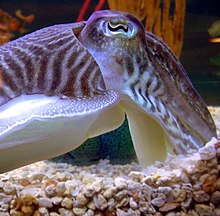
But advanced organisms can evolve in the sea. We have cuttlefish, tuna and octopuses, all of which are very bright. If/when we get to Kepler-22b we might find cultures based around them.
My money's on the cuttlefish.
Friday, December 9, 2011

Subscribe to:
Posts (Atom)

 Posts
Posts


