Sunday, June 28, 2015

Consideration of Works Past: Lord of LIght


(Picture from here.)
 
Long before Roger Zelazny was famous for the Amber series, he won the Hugo for 1967 novel, Lord of Light

Lord of Light is an odd story that blends Hindu mythology, Buddha philosophy, technical progress and science fiction. It’s structurally odd as well. It begins in the now time for the story, has an extended flashback, and then returns to the “now” for the rest of the story. The transition between parts is subtle and if you don’t catch it (which I didn’t initially) you can misinterpret the book considerably.

First, a little world building.

The colony ship Star of India lands on a lovely world. The local inhabitants are incorporeal and have no actual form but are not higher beings. They took along with their transition all of the ego, anger and greed of their former lives. They resented the incursion onto their world and the colonists and crew had to fight for their place in it. During this process the crew discovers that the world or their journey or the time aboard ship—something—has released some latent powers within them. These powers allow them to tame their world. In so doing, they become like unto the gods of Hindu mythology. They retain this power and retard the growth of the rest of the world, keeping their authority to themselves.

All this happens long before the book opens.

And it opens with one of the stellar openings of science fiction: “His followers called him Mahasamatman and said he was a god. He preferred to drop the Maha- and the -atman, however, and called himself Sam. He never claimed to be a god, but then he never claimed not to be a god. Circumstances being what they were, neither admission could be of any benefit. Silence, though, could.”

Bang! You’re not in Kansas anymore.

Everything I love about Roger Zelazny is in this novel. Big action. Lovely prose. Self-involved characters. Bifurcated lines where the thread goes one way and ends up another: "Because the world has need of your humility, your piety, your great teaching and your Machiavellian scheming."

The story is a familiar one in science fiction. The authority is suppressing technological innovation for the populace’s own good. A reformer arises (or revolutionary. It works both ways in SF) to put things right. Hilarity ensues.

Except in this case the authority are those who can make a good philosophical case for being gods: they have taken on symbolic qualities of mythological beings with physical attributes as well. Who is to say their feet are clay?

Well, Sam thinks he is and there lies the tale.

Sam himself has such attributes but rejects godhood. Instead, he brings up Buddhism as a reform and makes it stick. There are a lot of such things: the philosophy of being, the nature of death, the aspect of divinity. All while making a pretty rousing tale. 

This isn’t Zelazny’s only foray into mythology and science fiction. There was This Immortal (1966), Jack of Shadows (1971), a science and fantasy morality tale. The Francis Sandow tales: To Die in Italbar (1973)  and Isle of the Dead (1969), and Creatures of Light and Darkness (1969). Except for This Immortal, they were later than Lord of Light but LOL was such a ground breaker that I don't think the others  measure up. 

The difference here is in the mythology. This Immortal is Zelazny's take on Hercules and merely hints at the underlying story. It's pretty much straight science fiction. While in the Sandow stories Zelazny creates his own mythology and in COLAD he uses Egyptian mythology. In LOL he seems to take the philosophical underpinnings seriously. Perhaps this is because Hinduism and Buddhism are living religions. I have no idea if the book is true to the spirit of Hinduism or Buddhism. I’m guessing probably not. 

However, the characters take their roles seriously. There is no real magic in the novel but there is advanced technology that people view as magic and as extensions of their divine personas. The "gods" consider what it means to be the incarnation of a mythological character and they (and Zelazny) manage the duality of underpinnings of a real world SF and the overlay of the imagined fantastic. 

This is a delicate balance that few have managed successfully.

The book has stood up well over time in part because Zelazny didn’t bother to trap himself with gadgets. The technology is cloaked in mystery so we never get a chance to check the wheels of the carriage too closely.

And it has a come from behind ending that I never, ever expected. 

It has a lesson for writers in it as well. Once a writer decides a set of guiding principles, those principles have to be present in all levels in the work. There is a fractal nature to writing in that the same principles that govern the overall structure of the novel must also guide the minor interactions. 

A good example of this is the “magic” element in LOL. At no point in the novel is it ever magic at all. Zelazny always keeps one foot on the ground. One of the main characters, Yama, the God of Death, talks about the original inhabitants of the planet that most call demons in this vein:


“If by 'demon' you mean a malefic, supernatural creature, possessed of great powers, life span, and the ability to temporarily assume virtually any shape - then no. This is the generally accepted definition, but it is untrue in one respect. ... It is not a supernatural creature.” 

“It makes a great deal of difference, you see. It is the difference between the unknown and the unknowable, between science and fantasy—it is a matter of essence. The four points of the compass be logic, knowledge, wisdom and the unknown. Some do bow in that final direction. Others advance upon it. To bow before the one is to lose sight of the three. I may submit to the unknown, but never to the unknowable. The man who bows in that final direction is either a saint or a fool. I have no use for either.”

Neither, I suspect, did Zelazny.

Sunday, May 3, 2015

Consideration of Works Present: Station Eleven


(Picture from here.)

This is the first of a new set of Considerations: contemporary works. Why I'm doing this is discussed here. On with it:

It’s a curious thing to feel alone in the wilderness for so long and then find a companion.

Let me explain.

We all have favorite authors. People we can always turn to and read for enjoyment or understanding or technique. I have those: Mark Twain, Alfred Bester, Clifford Simak, William Faulkner, Earnest Hemingway.

Still, years ago, when I was first forming an idea of how stories worked and how I wanted to make them, I ran into John Dos Passos’ Manhatten Transfer. It made a huge impact on me though it was some time before I could articulate it.

I’m one of those people that rip through an author when I find them and Dos Passos was no exception. This culminated in reading ChosenCountry, which I’ve talked about in great length here.

Chosen Country was the book I read that finally formed the core of what I wanted to do with longer works.
John Dos Passos used a technique that is not terribly in fashion these days. He used multiple points of view to explore something larger than any combination of characters could explore on his own. This meant that the reader was an accomplice in the act of the novel. Kurt Vonnegut said it succinctly, if somewhat disparagingly, on the first page of God Bless You Mister Rosewater: "A sum of money is a leading character in this tale about people, just as a sum of honey might properly be a leading character in a tale about bees."

John Brunner tried this technique in Stand on Zanzibar but I don’t think he fully captured it.

I’ve written several books but only two have seen print: Caliban Landing and Slow Lightning. Both take little swats at the technique in that the larger story is intended to be in the mind of the reader but only partially grasped by the characters in the work. Nearly every novel I’ve written since has been an attempt to grasp this nettle. This might have something to do with why they aren’t published.

So I picked up StationEleven by Emily St. John Mandel.

This is a novel about a disease driven apocalypse. It plots the course of its characters from just before the apocalyptic event, through its aftermath to a relatively calm point later in time. It's a little cozy, I admit. It gets through the rough part and stops just before the left over relics of the past civilization begin to decay. It's an interesting apocalyptic arc-- not the one I'm most interested in, myself. I like somewhat later, after all the crash and fury when the relics themselves are becoming useless and people must come up with new solutions. But that's not the point and not the reason this novel is interesting. She has brought the Dos Passos technique into the 21st century.

Somewhere about half way through the novel I realized what she was attempting. My first thought at the end was: My God. She did it.

The problem in adapting the Dos Passos technique to a more modern audience is character. Dos Passos did a good job painting the environment his people worked in, what they did, the social environment they worked in and their motivations. But the style of the times did not delve deeply into psychological presentation the same way modern fiction does. Dos Passos largely wrote before Norman Mailer, Philip K Dick or Margaret Atwood.

Not to say he didn’t do good characterization. He did. But the nature of characterization has changed since then.
There has been an attempt over the years to attempt something called a braided novel. This looks similar to the Dos Passos technique but is not quite the same thing. The difference lies in the larger story. In a braided novel, a common story is told across common points of view. In a Dos Passos novel, there is no common story. There is a telling, to be sure. But it’s about something other than a story. Manhatten Transfer is about New York City. U.S.A. is about America. Chosen Country is about the nature of love. But there is no common story linking the characters in any of the novels.

For example, one might tell the story of the American revolution through the eyes of multiple characters. The revolution itself has a story: it has a beginning, a middle and an end. The characters are different perspectives on the story of the revolution. That’s a braided novel.

But stories are not the only kind of organizing principle around which people collect. Cities, countries, theoretical physics, also collect people. Refusing to push the organizing principle into story form and letting the characters follow their own path and then letting those paths speak to some larger issue is a different kettle of fish.

As I said before, Station Eleven is a post-apocalyptic novel where the population of the world is devastated. It begins with a death on stage a couple of weeks prior to the disaster and ends thirty years later. It follows about a dozen or so characters through the process. Some characters interact. Some have common history. Some do not. Some disappear mysteriously like so many other dying people in the book. Some never realize their connections. They do not know the story. Only the reader knows the story.

Mandel is talking about loss and recovery, disaster and adaptation, but none of the characters knows more than their own slice of the tale. After all, most of it happens after the loss of any possible distance communication between them. Consequently, their connections must remain mysterious to one another.

But not to the reader.

This was the Dos Passos genius that Mandel seems to be channeling. To tell individual stories that, through the braiding speaks to the larger idea. The threads are disconnected from one another and broken in time. Some directly tend to reflect what Mandel’s interested in. Some reflections are harder to see.

Go read it.

Friday, May 1, 2015

The Minority Politics of Puppies

I haven't had a blog show up for a bit. I've written more than one post but discarded it. Either it didn't say what I wanted to say or it said it with too much vitriol or it didn't make the situation better. Finally, I decided to just flounder on-- which is sort of a pattern of my life.

What I'm speaking of is the gaming of the Hugos by Sad Puppies and Rabid Puppies. To describe it briefly, a group of people who feel recent Hugos either overrepresent people who aren't white and male or are too literary bought a bunch of WorldCon pre-memberships and dominated the nomination process with books they feel need to be nominated. If you want to read more about it, see here, here, here and here. I find it dispiriting to read about.

For my own part, as a writer I want to be invisible. The facts of my race, gender, sexual orientation and political point of view should have no bearing on the reader's appreciation of my work. That my heritage and point of view informs my work is unarguable. That it be used to judge my work is unconscionable. If a person of color writes a bad book, it's a bad book. If a white person writes a bad book, it's a bad book. If a literary person writes a bad book, it's a bad book. If a hard SF engineer writes a bad book, it's a bad book. Ideology does not drive my nominations or my vote. If my inclination results in a literary nomination, then it should be the nomination of a work I admire.

So the Hugo nominations were gamed. It's sad but not surprising. It's no different from what the followers of Bhagwan Shree Rajneesh (locally and fondly known as the Bagworm) tried to do to Antelope, Oregon. It's not a lot different from the way people of an ideological persuasion try to game political primaries.

This process is not new. Part of it goes back to Bidwell Wheeler and the Prohibition Movement. Wheeler realized that elections were usually very close: 49-51 sorts of things. That meant if you controlled enough votes to swing elections you possessed far more power than your numbers would suggest. Once Wheeler showed how this worked, it was taken up by many groups. In recent times, as the number of participating voters declined this mechanism has become far more effective.

Enter the internet.

One of the things instant and vast communication triggers is the ability to electronically mobilize quickly. This has a corollary that marginal groups (such as the puppies) can get their act together and pool resources. No one needs to have an in-person meeting in order to mobilize money and effect.

One does need not to attend a worldcon for the Hugo nomination to go forward. Consequently, those who have an axe to grind can do so with just the spending of a small sum and an investment of a paltry bit of time online. Since the goal is nomination and not winning, and the nominating mechanism is based on the numbers of submitted nominations, it's fairly easy to game the system and nominate what a marginal group desires. Investment is low and return is high.

And it completely defeats the purpose of the Hugos-- or any such nominating procedure. It gets worse as barriers are placed into the process. Most primary nominations are done in a polling place. American primaries don't get nearly the press that full elections do in the same way off year  elections don't get the same press that presidential elections do. So if one compares voter participation for presidential elections to off year elections to primaries, then it starts with the max and whittles down to the primaries. Since the primaries determine who is standing for the actual election (as the Hugo nominations stand for the election of the award) the candidates are often in the position of representing the more radical base that vote in primaries than the electorate as a hole. As we see happening now in the Hugos.

The voting statistics for Hugo nominations look suspiciously like American voting statistics (See here.) in that significantly fewer people nominate than vote. Consequently, it is ripe for the sort of marginal politics I've been describing.

Any democratic system can be rigged this way. You can argue political parties are just means by which like minded people can game the system-- which is often a comment made by small political parties. And they are right. We see some of it with niche politics but more on the right than the left. One wonders what the world would look like if some of the parties I like (such as the Greens and others) took the Wheeler lesson and started running with it.

To paraphrase Edmund Burke, the only thing necessary for the triumph of evil is for the good to do nothing.

The problem then becomes what is the right thing to do about this.

I'm not going to Spokane so I won't see the outcome in real time. Many have said they'll vote no award. The perpetrator of Sad Puppies says that a no award process will result in repercussions from his group. To me this lays bare his motivations. He set up a situation within a democratic framework and is unwilling to abide by a possible result. I only wish elections had the same possibility.

Regardless, a no award solution might work this year but it won't work in the future. If this continues we'll see different groups trying similar techniques and then we have War of the Splinter Groups-- which pretty much is the national sate of America right now. I suppose it's not surprising that an American worldcon reflect America but it's still sad.

As I understand it, it takes two successive worldcons to implement a voting change. So I expect significant political machinations and rhetoric over the next two years. A couple of solutions have suggested themselves to me:
  1. Nominations be only by memberships that imply actual attendance.
  2. Nominations be determined to be valid only if the nominators actually end up registering at the convention. (This would have the effect of delaying the ballot until the actual worldcon, but so what?)
  3. Decreasing the barrier entry so that anyone can nominate easily. But then confirm the nominations by attendees. (Again, delaying final ballot but so what?)
I'm not a regular con attendee so I need to find another way to not do nothing. My plan is to start talking about more recent books. Books I think deserve an award nomination. Some have gotten them already-- Mandel's Station Eleven has been nominated for the Clarke Award.

The idea is if I put out what I think are legitimate award nominees, perhaps I can in some small way combat the evil I'm seeing.

I dearly hope the Hugos are salvaged lest they become as devalued as American political elections.

Friday, March 27, 2015

Through a Species, Darkly


(Picture from here.)

We continually overestimate and underestimate ourselves. Our lack of ability to objectively evaluate ourselves is a source of serious problems for us as we try to navigate a future for which our evolutionary history has ill prepared us.

We are fully capable of considering ourselves the pinnacle of creation and lord of the world at the same time regarding ourselves as lower than any other animal. I've heard this in conversation. You probably have, too.

We are magnificent animals, emphasis on both words.

One of the terrific things about scientific thought is we can take its aperture and apply it against anything. We are only limited by-- well, our own limitations as stated above. The granular representation of ourselves to ourselves.

There was a terrific cartoon I saw in the seventies that I've not been able to trace down. The image is of a bunch of animals-- human, dog, giraffe, hedgehog, chimp, cow-- and they are all thinking, "And God made in his own image." That sums it up for me.

So, when we point the aperture of science at human beings we have to leave our own self-involvement at home.

We think of the future all the time and we build things. We are our own best metaphor for the rest of the universe. So when we think of evolution and apply ourselves to it, it's hard not to have a designer around. After all, a watch isn't much different then a flower, right? If you see a watch on the ground, somebody must have built it. Therefore, if you see a flower on the ground...

Of course, it doesn't work that way. Not even for watches.

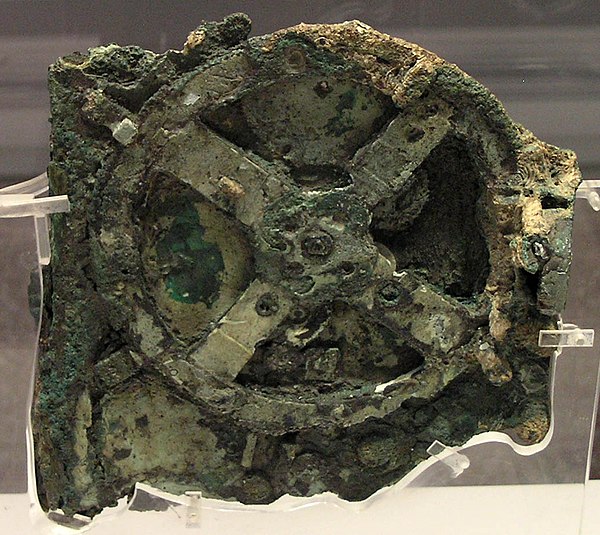
If one had no knowledge of watches, it's not even clear we'd recognize it as a watch-- after all, the antikythera mechanism was built by humans but we didn't know what it did for years. But let's presume we can recognize it as built by something.


(Picture from here.)

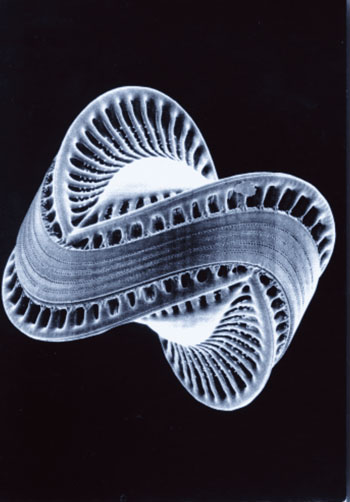
Could it be like a diatom? Few things are more beautiful and complex than the cell walls built by these one celled algae.

Okay, let's say I spot you the watch was made by a thinking being and we might even know what it was. But even then it would be a creature that has the concept of time and number, used some sort of grasping appendage of particular dimensions and possessed perception of such a resolution that would make such a watch useful.

Pretty soon you either end up with a really odd watchmaker or evolution.

The history of science, along with everything else, is littered with the shards of people's hypotheses that were grounded not in good thinking but people's self-conceptions. Evolution is no different.

One idea that people have is the concept of progressive evolution. Yes, if the life of the universe were metaphorically represented as a calendar year, we would have come to light in the last five minutes. But that only means that it took that long to develop an entity as enormous of faculty as ourselves. Right?

Well, not quite.

Now there is progressive evolution but not in the way most people mean. Evolution is always about local adaptation to local conditions, whether those conditions are external to the species or are expressed within the species. But each species exposes its heritage to the selective pressure of the moment.

If we look at the evolution of the horse, for example, we start with eohippus, a tiny dog sized forest dwelling herbivore, and end up with Seabiscuit. However, that starting point was from the very beginning a herbivore, a hind gut fermenter with tiny hooves instead of claws on the edge of its pads. It had starting material. Evolutionary descendants of modern horses would encapsulate all of the evolutionary changes that happened since eohippus. They wouldn't be starting with eohippus.

Similarly, humans forebears started walking upright. The selection here was on the feet long bones of the legs and the hips. Look at that foot: big toe, toes in the same plane. Turns out the developmental mechanism that makes feet is closely associated with the developmental mechanism that makes hands. Big toes drove human thumbs. (See here.)

Wait, you say. Monkeys have hands that they use... as hands. Humans and monkeys derived from the same stock. That suggests that hands predate human beings walking upright. So there!

Yes! Absolutely. Brain studies of how the hand is controlled the brain suggests that all of the primates use similar mechanisms and, in fact, there is generally more CPU power dedicated to the hand than the foot.

So, our ancient ancestor got hands and feet as part of the primate package. He got brain organization to use them to make tools-- we know our cousins use tools as a matter of course. We have to presume that our ancient ancestors did, too. Then, as we moved toward upright posture, that modified our feet, giving a little push on how hands were made. That exposed thumbs to selection. Which allowed tool using to become a greater selection trait. Which started to drive hand selection.

Meanwhile, this brain behind the hands-- already pre-disposed to make tools-- also gets selected for.

And we're off to the races where we can send men to the moon but can't (or more honestly, won't) keep everybody fed.

Magnificent. Animals.

I admit I'm pretty much a materialist. By that I mean that I don't have any emotional attachment to any non-physical world. Whatever makes us human lives in our brain and our bodies.

That said, if we are the sum of all of the evolutionary decisions made before us, somebody-- in fact, a lot of somebodies-- made decisions that culminated in altruism, beauty, music, commerce, husbandry and a whole slew of other things that we do either uniquely or incredibly better than everything else. To the point where we take the very guts of living things, their reproductive and physiological components, and repurpose them to to our will.

No one can take that away from us and no one should even try. To paraphrase Olivander from HarryPotter, we have done great things. Terrible things but great.

The same species that wages war, creates hospitals. That practices genocide, feeds the poor. Yes, we are red in tooth and claw but we are gentle and kind as well.

It's time for us to accept who we are and what we can do. Not as the pinnacle of creation but as the most powerful vertebrate on the planet.

The first step, I think, is to see ourselves clearly.

Sunday, March 22, 2015

State of the Farm


(Picture from here.)

It has been a long winter.

As I sit in this diner writing this I'm looking out at more snow falling. Enough already! We've broken the all time winter snow record. When will you Gods of Winter be satisfied with our misery? Must we sacrifice our children to appease you?

Hm. Ben's been seventeen a lot lately...


Okay. Winter on the farm. Gotcha.

Starting around Thanksgiving and up to about now we do winter activities around the homestead. This means cleaning out the greenhouse some. Making sure the turtles and tortoises have a nice place to sleep, perchance to dream of Terry Pratchett. (It's Terrys all the way down-- at least that's how I wish to imagine the afterlife.) Keeping the chickens warm.

Ah, the chickens. We lost Abigail and Beaker this winter. Abigail had been our oldest chicken. She survived a coyote attack, a racoon attack and a bobcat attack. Survived her peers when they were slaughtered like, well, animals. We now have Stalag 17 and I think they're safe.

She was a good chicken. Speckled black and white, she had a sort of Grande Dame grandeur. She didn't turn mean when she got old. Her last egg looked like it would have hatched into Quasimodo if it could have hatched at all. I think she kept the other chickens in line even more than the three roosters she outlived.

Beaker was a different sort. She was born with a deformed beak that twisted as it grew. Every year we had to trim it back so she could eat. Beaker was lively and quick. She was never mean, either, but she was smart. She figured out places where food had been brushed, which foods were better than other. It was Beaker that figured out how to get to the grass on the west side. Beaker was the first one on the railing in the spring and the last one to end up in the coop in the throes of winter.

Now we're left with Stumpy (whose leg doesn't work from said bobcat attack), Fish, the rooster, and the Brown One Whose Name We Cannot Remember. (BOWNWCR?) We'll need new layers in the spring and the debate now is to hatch them ourselves, buy some hens or get some hatchlings from one of the hatcheries.

The other thing we do in the winter-- appropriately in this time of Chicken Mourning-- is make wine.

I skipped wine making for a couple of years. Then, last winter, I got back into it. Over the last year I've made a plum wine, peach wine, Concord grape wine (don't laugh), Reisling, Alvorinho and an accidental Current champagne.

Over the years we've come up with a pattern that works for us. We do primary fermentation upstairs where we can control the temperature more easily. When fermentation is pretty much done, we move it into glass carboys and put it downstairs in our cold, cold basement. Right now we have a rhubarb cooking upstairs and I'm trying a lager which ferments at a much lower temperature. It's downstairs. We have a strawberry and another Concord in the glass carboys.

Wendy has cleaned out the freezer and set up a schedule of upcoming fermentation: Cornelian cherries are next. Followed by peaches. Then, a mango concentrate I got on sale a while back. Then, the grapes in the fall followed by cider. If I can get her to agree I might try something interesting like a Chardonnay from California juice.

By the end of the year we'll have about 40 to 50 gallons of wine in the basement. 

Hey. It was a cold winter. I want to be prepared for the next one.

Sunday, March 8, 2015

Consideration of Works Past: The Adventures of Huckleberry Finn


(Picture from here.)

I have hesitated to visit Huckleberry Finn in this venue for a couple of reasons. For one, I've read the book regularly since I was a child so there's no real sense of "revisiting" it. Second, so much has been written about it what could I possibly add?

But I suppose that's never stopped me before.

I'm not going to discuss the plot directly here for a couple of reasons. If you haven't read Huckleberry Finn, you should. The modern novel pretty much starts there. Shakespeare and Huckleberry Finn are alike in that both inform fiction since. Reading novels and stories without having some familiarity with both is like having muscles without bone. Whether a writer has read them or not, his work is informed by them. They are in the language we use and the structure of the material we enjoy.

Besides, the wikipedia article referenced above has a good Cliff's notes outline.

Now, it's true, I have a special relationship with this book. My father was born in Florida, Missouri, about seven miles from where Mark Twain was born. There's a small museum in the Mark Twain National Forest where his birth house has been preserved. When Dad took me there he pointed out how the house he grew up in and the Mark Twain house differed. Dad's was a little bigger and they had a coal stove instead of a wood one. Not much else.

Most of Huckleberry Finn is written in dialect. These were dialects that Dad either knew, as he'd grown up with them, or could figure out. So when he read it to me as a child, he could read all of the parts. Some of it I can do but never as well as he did.

The book is fun and very funny. It opens like this:
You don’t know about me, without you have read a book by the name of The Adventures of Tom Sawyer; but that ain’t no matter. That book was made by Mr. Mark Twain, and he told the truth, mainly. There was things which he stretched, but mainly he told the truth.
One of the best openings in the English language.

Huckleberry Finn is about a young boy named, appropriately, Huckleberry Finn. Huck is about fourteen living in a small Missouri town called Saint Petersburg around 1835-1845. At the time, Missouri was a slave state so Huck's life and slavery are intertwined.

There's an interesting way we talk about slavery in the modern day, as if it were something grafted on to life in the slave states. One of the things Huckleberry Finn makes completely clear is that the cloth of life in those times was completely composed of slavery's threads. It is in the roots, branches and leaves of everyday living. It was not grafted onto life; it was their life.

Huck and slavery, and by extension moral choice and understanding, dance through the entire novel. Sometimes Huck dances with it face on. Sometimes he's across the room looking the other way. But the dance is continuous.

Huck's relationship between himself, society and morality (Twain makes it clear these three are  distinct) is somewhat tenuous at the beginning. He's an outcast of sorts that's been taken in to be "sivilized." Civilization takes. Sort of. Ultimately, he is brought out of civilization and ends up on a raft in the Mississippi River with a runaway slave named Jim. From then on, Huck has to continuously wrestle with a moral point of view. But he's never actually conscious of it.

This is where Twain shows his genius. Many works would have the character agonizing over what to do-- and Huck does this. But never in a higher moral sense. Huck is attempting to determine the right course of action personally. What to do with his friend Jim who is also a runaway slave.  Jim is his closest and dearest friend. Both have risked their lives for the other. Jim is also a runaway slave. Another man's property:
Here was this nigger, which I had as good as helped to run away, coming right out flat-footed and saying he would steal his children—children that belonged to a man I didn’t even know; a man that hadn’t ever done me no harm.
Huck is trying to be a good kid-- he's not yet a man in his own eyes. Jim is someone else's property. He should tell the authorities so Jim can be returned to his rightful master. Everything in his upbringing has told him this is the right thing to do. The moral thing to do. He can't do it and the fact that he can't trips him up regularly.

Many would call Huckleberry Finn a coming of age story. I can understand the point but I wouldn't for a few reasons. For one, Huck never admits to becoming an adult. Of course, he never admits to being a kid, either. He is changed by the end of the book and made decisions that will live with him and direct him throughout his life afterwards. But he doesn't dwell on it. Life isn't a lot better for him at the end of the book as it was in the beginning but he's completed his journey without regrets.

More importantly, coming of age stories bring a lot of baggage with them these days. Modern coming of age stories seem to have blended with political revolution stories. I'm not such a huge fan of this trend. Two me, moral revelation and political ideology are separate things. Though they affect one another they are not identical. Someone who votes against me is not automatically a monster.

And political revolution is not necessarily the best model for a coming of age story. Revolutions are complex things that people attempt for complicated reasons. In The Moon is a Harsh Mistress, the conspirators embark on a revolution not because of any moral code-- they're adults and have figured that out already. They're doing it because in less than a decade they're going to be starving to death.

If you look at revolutions that have happened there have been children and young adults involved. Les Misérables has a lot about the tragedy of losing young life in the pursuit of an ideal. We have young people sacrificing themselves for such things every day. But they are on the front lines. They are fodder for the revolution. The people that make a revolution stick-- John Adams, George Washington, Ayatollah Khomeini, Fidel Castro-- are not kids. They are tough men. For good or evil they've determined their moral course and created their political ideology. They've made their choices and are now acting on them.

That's a huge burden to place on a kid just figuring out what's right and what's wrong.

It's also impersonal.

One of the important threads in Huckleberry Finn is that morality is personal. Jim is not a slave in the abstract-- Huck's met lots of slaves in his life. None of them moved him like Jim. But they are bound by a deep love for one another. (And by that word I do not mean sexual romance.) It is a deeply personal decision Huck has to make and because it is personal we feel it, see it and live it with him every step of the way.

By the end of the book Huck has made no great decision regarding slavery in general. He has not become an abolitionist in the political sense of the word. He's not going to go north and fight slavery or start helping on the underground railroad. He might some day though he never says so. As I said, his course has been changed and where he will end up is anyone's guess.

I suppose I could have said the same when it was first read to me.

Sunday, February 8, 2015

Thermoregulation 103


(Picture from here.)

Last time we talked about small endotherms-- specifically small mammals. 

I have nothing against small endotherms. But there are significant limitations to the adaptations small animals can achieve in the realm of thermoregulation. They are small so they're dominated by the surface area. If it's too cold they have manage maintaining body heat. There are only a few ways they can manage this: burn more food which means eat more food. (Think shrews.) Drop their body temperature as in hibernation. Or grow some sort of insulation. Since they're small, there are distinct limitations on this. A two ounce mouse is not going to benefit from an additional three inches of blubber.

On the other end, if it's too warm they have different responses. They can sweat. They can find a cool spot. They can estivate (the high temperature approach to hibernation.) They can lose their hair or other insulation.

But with small animals the major thermoregulatory adaptation is behavioral. They go underground. They go in the water. They hide from the sun. They migrate.

Not to say that large animals don't have behavioral adaptations. But it's unlikely to see an elephant burrowing to escape the heat. They'll seek the shade of trees and vegetation but digging out tunnels is beyond them.

It's also true that since large animals are no longer dominated by surface area we start to see issues of heat loss come into play.

So it's in big animals that we start seeing some very interesting physiological adaptations.

Let's start with large animals in a cold world.

Endotherms in the cold have to generate heat. There are a few things that can happen here.

One is the regular old metabolic mechanisms I mentioned last time. Another, in mammals, is brown fat. Both of these are fully expressed in large animals. In addition, because in large animals we have reduced surface to get rid of heat-- this can actually help in the cold. Then, we have the nature of many of the animals themselves.

Most really large terrestrial animals are herbivores: from cattle to elephants, we're talking animals that eat plants. By eating plants I mean eating cellulose. Which means they have a fermentation vat in their bodies because only select bacteria can digest the stuff. Herbivores don't convert plants to nutrition. They consume plants for microbes which digest the plants. The herbivore then digests the microbes and their off products. Most herbivores are hindgut fermenters which use a cecum off the entry point of the large intestine. Horses, marine iguanas, Galapagos tortoises and gorillas are hind gut fermenters A select few are foregut fermenters which use an adaptation in the stomach. Cattle are foregut fermenters.

The point here is that endothermic herbivores not only have the ability to heat via metabolism and brown fat, they have heater buried deep in their core tissue. It's not a coincidence that the largest terrestrial animals are herbivores and many of them, such as mammoths, live-- or lived-- in cooler climes.

The increasing size of the animal reduces the cost of carrying insulation. Heavy hair and a good layer of fat become cost effective. As long as the herbivore can feed the furnace it will do all right. Neglecting predation, the biggest problem cold weather herbivores face is getting enough food.

The cycle of big animals in the north is often large animals live of the land and smaller animals prey on the large animals. This is the wolf/elk relationship. The predators are usually quite a bit smaller herbivores-- they have additional constraints. Predators and prey are always in an arms race. Your fat and hairy-- but warm-- wolf is going to have a hard time catching up to that graceful elk laughing at him.

Predators, and other smaller mammals, have a different approach. They have no internal heater other than metabolism and brown fat and can't afford. There are considerable innovations in insulation. Consider the wolf skin and the elk skin. The wolf skin tends to be a bit thinner with a very think covering of fur. The fur is complex, consisting of a light, soft layer overlaid by a course layer. The wolf has bet on light insulation and an increased food consumption as its strategy for the cold. (Good discussion here.)

Now, if you look at the elk skin it is quite a bit thicker. Some fur but not as much as the wolf. The deer outweighs the wolf and, in addition, has that hindgut heater. It's bet on a larger body with decreasing surface area and increased dependence on its internal heater.

Beyond insulation animals in a cold world adapt by selectively altering their circulation. It resembles prioritization. What's important? Brain. Lungs. Liver. Intestines. Who needs the finger tips? The palms of the feet? The circulatory system shunts the blood back to the interior before it ever reaches the extremities. The extremities, feet, hands, paws, tail, become more tolerant of lack of oxygen and CO2 buildup. Not completely, of course. The shunts open periodically to circulate that cold, stale blood back to the nice warm interior-- which presents other problems. More on that later.

That's when everything works well. Anyone who's had frostbite has a good knowledge of what happens when things go wrong.

But animals often have to endure both cold and hot environments. Some large animals (elephants, for example) live almost exclusively in tropical areas. Now we have the problem of getting rid of heat. How do we do that?

Humans sweat. Evaporative cooling is extremely efficient. It has a few problems. It uses up water where water might be quite precious. It's not always effective. Those of you out in Arizona or Southern California might not realize this but sweat doesn't always work. Anyone who's ever spent a summer in Mississippi can attest to this. And not many animals have it available to them. Human sweat is mostly water. Most sweat has a much larger percentage of oil-- think of the "lather" on a hot horse, for example. Some animals, like dogs, barely sweat at all. Since it has such limited applicability, we'll largely neglect-- though human thermoregulation, and the experiments on it, are so interesting it deserves its own post.

Remember the surface area/volume problem. One common solution is to increase the surface area of one part of the body. This is the reason for the elephant's ears.

Elephant ears are vast things, of many square feet of area and not much in thickness. There is evidence they play a role in elephant perception of infrasound-- sounds at very low frequencies. But they are filled with capillaries and act as huge radiators. And here we discover a truly elegant design. I'm referring to the countercurrent exchange mechanism.This is a simple concept that is used over and over again in the vertebrate body.

The idea is take a fluid flowing in a tube in one direction with something that needs to be given up to a tube with the fluid following in the opposite direction.  Remember I was talking about the problem of bring the cold blood back to the body? This is how the effects of that are mitigated. As the blood returns from the cold extremities, it passes close by warm blood flowing to the extremities. Consequently, there's not this huge flow of cold blood back to the interior. Instead, it is prewarmed before it ever reaches the interior.

Of course it's not perfect. I have a friend of a friend who was making hamburger patties by squeezing very cold raw hamburger meat with his bare hands. His circulation was not the best and the cold blood pooled in his hands and forearms. Eventually, that cold blood made its way to the heart without being warmed much and it was enough to trigger cardiac arrest.

Counter current exchange is used over and over again. In the lungs for gas transport. In the kidneys for excretion. And it is one of the primary mechanisms by which mammals (and birds) handle extremes of temperatures. I am speaking, of course, of your friend and mine, the ocean endotherm.

The ocean endotherms we're talking about are the penguins, cetaceans (whales and dolphins) and pinnipeds (seals and sea lions.) We're not going to talk about otters and beavers this time though they['re quite interesting.

Here is where physiological adaptation tends to trump behavioral adaptation. Water transmits heat 25 times more efficiently than air-- to the point that many cases of insulation such as fur and feathers depend on the trapping of air within the insulation mechanisms. 

Both pinnipeds and cetaceans derive from land animals that presumably had fur. However, neither has hair in any sort of insulative capacity so the cost of maintaining fur must have been too costly and not much benefit. I can hazard a few guesses on this.

We know that feathers on penguins and fur on otters serve as insulation. Both of these animals spend a significant amount of time on land. We know that fur and feathers require grooming. The adaptive direction seals and whales have taken preclude that. It's hard to groom with flippers.

Both furn and feathers depend on trapped air for insulation. Air compresses at depth so one would presume loss of insulation as the volume of the air is reduced. Otters forage down to about 100 meters. The emperor penguin dives down to 565 meters. And the sperm whale goes down nearly 1200 meters. (See here and here.) 100 meters is about 11 atmospheres so the volume of the air, as insulation, would be 1/11 of the same air at the surface. One would expect its insulative capacity to be close to nil. Deeper would be worse.

Fat, however, is not terribly compressible and so has similar insulative ability in water at depth than in air.

Marine mammals and birds exist in a three dimensional world rather than the boring terrestrial mammal two dimensions and those three dimensions range from quite warm at the surface to bloody cold at depth.
To manage this problem the marine mammal has a number of mechanisms available to it. Interestingly enough, penguins, toothed whales like dolphins, baleen whales like humpbacks and pennipeds like sea lions have evolved very similar mechanism when dealing with heat  and gain. These fall into three general approaches:
  1. Mass. Marine mammals tend towards the large end of mammals. They start bigger at the small end and get way bigger at the big end. Emperor penguins are quite large though not all penguins are that big.
  2. Fat insulation. This is blubber in whales and its equivalent in seal, sea lions and penguins
  3. Controlled radiators to get rid of excess heat or to retain heat depending on circumstances.
The radiators are the flippers in the seals and sea lions, wings in the penguins and the fins and flukes of the cetaceans. There are valves in the arteries leading to these radiators which shut down when heat is to be retained and are opened when it needs to be released. A gray seal, for example, might dive a thousand feet to feed. When it does, it shuts down these valves to the exterior and essentially becomes an animal of only torso and brain. Then, when the animal resurfaces, these valves can be opened and the interior of the animal can be cooled, if necessary.

Whales have such a significant problem that mother whales that swim south to birth and nurse stop eating. One reason is that the additional heat generated by feeding can't be removed easily in tropical waters.

Seals and sea lions have a different problem. The gray seal, for example, is tiny next to any whale. It does generate heat but nowhere near as much. Another reason for the seal to shutdown blood flow to the periphery is to reduce oxygen requirement during the dive. So the seal dives to the deep Arctic water, feeds, and returns to the surface. The cells in the flippers and periphery are still there during the dive, making CO2 and requiring oxygen, even though now they are cold.

So when the seal comes to the surface, it has to give some blood to its flippers. But, in so doing, it gets some mighty cold blood on the return. Another example of the challenges these animals face.

(Side note: when I was in college, Sam Ridgeway, who worked on the Navy Marine Mammal Program, came to speak. As I recall, he mentioned a gray seal that they had trained to take a breath from an monitored opening and then go to the other side of the sealed tank and hold down a switch. Then, it would return, exhale into the opening and get a reward. They were measuring CO2 and oxygen respiration. They were not even close to stressing the seal in their little five minute tasks. So they decided to try something. While the seal was holding down the switch, they closed the door on the opening. The seal returned and found there was no oxygen to be had. Instantly, the seals heartbeat dropped from about twenty or so per minute to three. It then exhaled against the surface of the sealed tank making a large bubble. After a moment, it snarfed that air back up. CO2 is more soluble in water than oxygen so the seal was, effectively, getting rid of the CO2. After a moment, they opened up the tank again and the seal began inhaling air and exhaling it against the back of the tank.)
This is all fine and good for endotherms. But many fish and reptiles are quite large. Is there anything interesting there?

Animals do all sorts of interesting things. Really large fish such as the Great White Shark, bluefin tuna, marlin and swordfish, are so large and active the volume/surface area ratio begins to work for them.

Bluefin tuna travel up and down the water column regularly from fairly warm surface water to the cold of 3,000 feet. This is a huge change in temperature for an animal as intimately involved with its medium as a fish. Surface temperature might be as high as 50F depending on where the tuna was and at depth be as low as 36F.

The tuna has-- wait for it-- countercurrent exchange flow in its gills that conserves heat in its deep swimming muscles-- called red muscles for the amount of blood in them. Heat from the motion of swimming is conserved in these muscles along with the core such as brain and organs. It's not an endotherm but one could call it a limited homeotherm. (See here.)

The Great White Shark goes one step further. It actually has a strip of red muscle near the center of the body that actually releases metabolic heat. It also has similar mechanisms to the tuna. (See here.)

Blue marlin and swordfish have less ability to maintain body temperature but conserve waste heat of movement to help.

Okay, you ask. What about really big animals? You know what I'm saying. What about dinosaurs?

Oooooooooooooookay. This has been a long and heated debate in the scientific community.

We know a few things. The sauropods were huge. Big enough that they might well be able to conserve body heat by sheer thermal mass alone. Certainly tuna do it. There's no reason the laws of thermodynamics would make an exception of apatosaurus.They might not have been endotherms but they certainly could have been homeotherms.

Birds are definitely endothermic and they evolved from dinosaurs. Many of the late dinosaurs that were branching into birds have similar internal construction and had feathers. Feathers came long before flight and probably evolved to retain heat. It's a reasonable assumption that the heat retained originated within the body rather than coming in from outside.

Robert Bakker devoted an entire book gathering the evidence for endothermy neatly summarized here. The evidence is good but not, to my mind, completely conclusive.

For one thing, the bigger therapods such as T. Rex or even allosaurus were large enough that there might not be a real need for endothermy as we know it. Homeothermy and conservation of heat by behavioral means might have been sufficient to keep a quite high body temperature.

We have a tendency to think of the ancient world such as the Jurassic as just like ours but with differently shaped animals. That's not surprising. Behaviors don't fossilize easily and we don't have a lot of dissectible  lying around. Like none.

But we do know that animals were different before dinosaurs. At some point endothermy and homeothermy evolved. There were amphibians, then reptiles, then dinosaurs, then birds and mammals. Thermoregulation evolved just like anything else. There's absolutely no reason the mechanisms we see in the modern world were merely replicated a hundred million years ago.

And the scale of dinosaurs is something we have absolutely no experience with. The largest land mammals we've shared the earth with have been no more than a few tons. How does that compare to a forty ton sauropod? The largest terrestrial predators we've seen are less than a ton. How does that compare to a six ton T. rex?

I do think they thermoregulated for one good reason. Antarctica had no ice cap when there were dinosaurs but  it had six months of dark cold and six months of sunlight. It had a thriving dinosaur population. Some of those animals look to me to be too small to migrate. Did they hibernate and warm up in the spring? Maybe-- though we have no land reptiles that big now that do that though there are large salamanders that do. Maybe they warmed up over the polar summer and then cooled down in the winter purely by external means. Or, maybe, they were like the Great White Shark and had a little strip of muscle that warmed them up to the point they could conserve the heat of movement. Or maybe they were like bears and were true endotherms when it suited them.

They did something. But it may not have been anything like what animals do now.

----

For further reading, I strong and enthusiastically recommend Knut Schmidt-Nielsen's How Animals Work. You can get a sample of it here or buy it used.