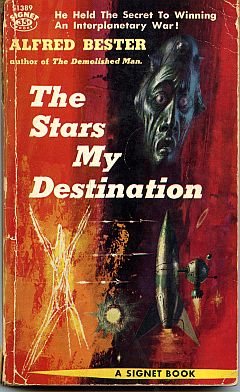
(Picture from
here. For a better cover, see
here.)
This book got me kicked out of a reading club.
There was this girl I was interested in way, way back when. Kind of an artist, touchy feely sort. The kind of person that beautifies their environment. I admired that. Anyway, she was in this book club and I was interested in her so I joined as well. We went through several books-- some good, some not. One I liked was
A Yellow Raft in Blue Water by
Michael Dorris.
They suggested I pick an SF book.
Most of the books we'd been doing were a little tame and I thought to shake things up a bit. So I suggested
The Stars My Destination. It's a rough book but I figured they were up for it.
I was wrong, of course. And was thoroughly excoriated. The girl I was interested in terminated whatever minuscule interested she had in me and I left the club.
The moral of the story: TSMD has some rough bits and isn't for the squeamish.
TMSD is about redemption and forgiveness. Books about such things usually talk about tame things: I was a neglectful father. I did something not so bad and feel wretched about it. The problem is that these days we don't really do much that really qualifies for redemption and forgiveness and so our scale of what to feel guilty about is skewed. When somebody comes around who has really done something nasty, we like to think of them as unforgiveable.
Forgiveness and redemption is, in my opinion, a peculiarly Christian notion. If you read the Greek plays, there is payback and revenge but it's all tied up in fate. The Greeks would have had no trouble understanding Karma.
But Christ comes along and says you can be forgiven for your sins if you so desire. This brings to the front the concept of redemption and creates a new class of stories.
Of course, once you've introduced the idea of short circuiting guilt and payback, you've created a means by which people can evade guilt and payback. People like that for themselves but not so much for others. Hence, some things become "unforgiveable". I don't read the gospels that way. From what I can see, anything is forgivable if the heart is sincere. That's the way people emulate Christ. Of course, if one can emulate Christ effectively, one can be Christ. Every man can be his own Messiah. Which makes things all Gnostic-- can't have that. And so we're back to what is forgivable and what isn't forgivable.
That long little digression brings us to the interesting piece of TSMD: the character of Gully Foyle.
TSMD is the story of Gully Foyle, an intelligent but uneducated and incredibly lazy man, who is sparked to greatness for the sake of revenge. He is abandoned in space and subsequently bends his efforts to finding who did this, why and exact payback on them. However, when he gets there, he finds he has transformed himself into a thinking animal and discovers he actually has a sense of right and wrong.
Hence the problem the book club had with this book. Foyle becomes a murderer, rapist, thief and traitor to get what he wants. He leaves a trail of broken people. When he gets there, the implication is he will be forgiven. (The book never actually reaches the point of redemption. It reaches a point where redemption is possible and stops. Something I like.) The book club didn't think he'd done enough, or refused the possibility that he would be able to do enough, to be forgiven.
Anybody who can be a Messiah must be crucified, I suppose.
What I learned from the book was that a dark character could be interesting. Modern SF has few characters like Foyle. Even the vampires, parasites that they are, have been prettified. Foyle's character has muscle. He is not pleasant. He makes no apology for what he does and only comes to see himself as loathesome when he has changed himself.
Alfred Bester wrote a slew of wonderful short stories and a handful books. Two of them,
The Stars My Destination and
The Demolished Man (DM review
here) shook the foundation of science fiction. It was a new way to write SF stories. DM is more psychological and not as good as TSMD, in my opinion. DM was written in 1953 and TSMD in 1955. While he continued to write short stories, he didn't do any novels until 1975 when his health began to fail. Unfortunately, they were not so impressive as his first two novels. I discussed TSMD (
here) compared to a similar novel,
The Transfinite Man, by Colin Kapp.
TSMD was never made into a film. I've played with writing a screenplay of it several times but never did any actual work. Other reviews of it are here.
Here.
Here.
Here.
Hey! Anybody out there in Hollywoodland! This one would be great.
=======================================
Wall of IdiotsLies about Obama and the PiratesLies about Obama and ReligionLies about Obama and Health CareLies about Ollie North and Al GoreReligion and TortureClimate Change NihilismPolitical Links100 Days of ObamaSpinLinks of InterestPenis Evolution:
Here.
Here.
Here.
Key Role of Genes on AutismEccentric Exo EarthThe 1918 Flu PandemicEtsuko FukayaGoogle vs. WolframPaleontology IllustrationGeorge GuidestonesHelping Hands to Wash HandsGoogle Book SettlementViolent Spider SexDIYCigar Box GuitarLED Lighting in West AfricaDrawdioSourdough BreadBicycle DynamoGlass Blowing SwivelEar Bug OwlHydrogen BaloonGluing GuidelinesVoltage AnnotationsToriton


 Posts


