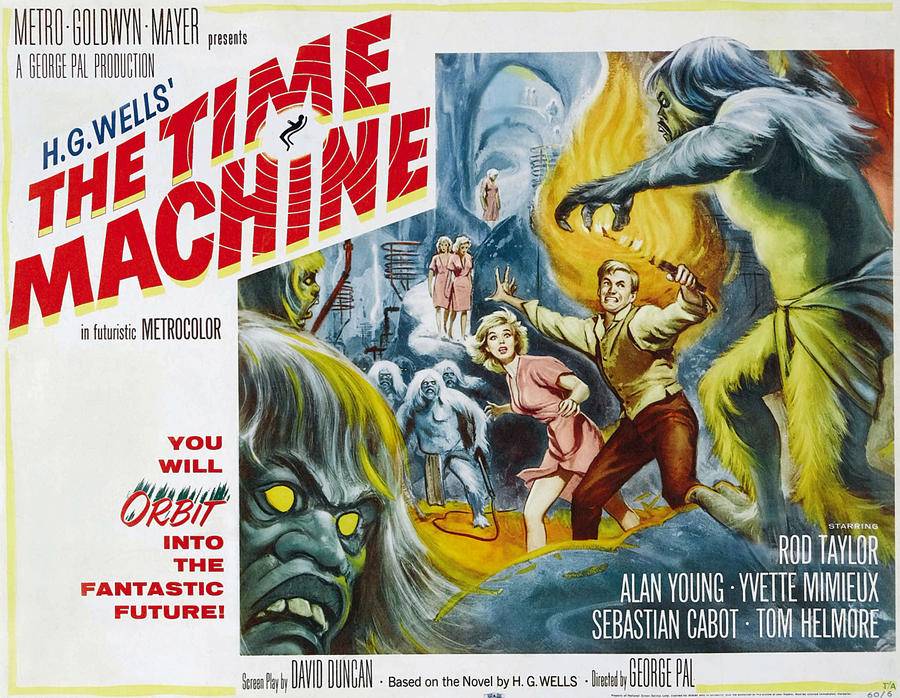
(Picture from here.)
Not that I knew who they were. I was, shall we say, less than sensitive to who a given producer or animator was. But I did know Destination Moon, The War of the Worlds, Tom Thumb, and The Time Machine. I knew them by their look and feel. I could tell from a given trailer that this was a film I wanted to see.
I only saw Tom Thumb and The Time Machine in the theater. The others came across my TV screen.
I was living in Southern California at the time and the TV stations didn’t have five million made for television movies and recycled sitcoms available. Give them time. They would.
Instead, they used old SF and fantasy movies in their place.
There were a lot of Creature Features and I saw my share of giant ants, slugs, frogs, and blobs. But it was the SF shows that caught my attention. And I was savvy enough to realize that there were some that were a cut above the rest. I didn’t know George Pal by name but I knew his work.
Thus, when I saw a poster for The Time Machine, I got my Dad to take me.
It wasn’t a family affair. My sister was three and, the times being what they were, it was me and my Dad or nothing at all. Mom was staying home with the toddler. I had no control over this. Though, when I had my own toddler, I did take him to see Revenge of the Sith when he was eight. But he didn’t like Obi Wan and Anakin fighting and I took him out. Just as well. That way he didn’t get to see Anakin with his arms and legs burnt off.
Ben always preferred “big scary beast.” (The Beast from 20,000 Fathoms, Ray Harryhausen.) We still have the VHS tape but I think it’s worn out.
So, I’m *mumble* years old in the theater and I am taken for a ride that I never forgot.
A quick synopsis for those who lived under a rock for the last century. No judgement. Some of my best friends are tortoises.
The Time Machine was an 1895 novel written by H. G Wells. In it, the nameless protagonist, named only the Time Traveller, invents a device that is able to traverse time similar to traversing any of the other three dimensions. If you can specify movement to a location to a point defined by x, y, and z, the device allows similar traversal across axis t. It does not traverse any of the other dimensions but remains in the same x, y, and z, place as it moves across t. This is somewhat important to the plot in the novel but is crucial in the film.
The Traveller goes to the future, sees how wars continually happen and ends up in what looks like a utopian society where the earth bears fruit without toil and everyone looks healthy and young. These are called the Eloi. After exploring, he returns to the machine and finds it gone.
This “utopian” society proves to be supported by underground Morlocks. These live underground and feed and care for the Eloi so they may, in turn, feed on them. The Traveller speculates that the Morlocks were the underclass servants, forced to dwell underground until they became intelligent but animal-like dwellers in darkness. With no challenge to keep them intelligent, the Eloi lost that same intelligence until they were the pretty, child like beings the were the Morlocks’ main course at dinner time.
Early on, the Traveller rescues one Eloi, Weena, from drowning and thereafter she clings to him. In the forest at night, they are attacked by the Morlocks and in an accidental forest fire, many of the Morlocks and Weena are killed.
The Morlocks try to lure the Traveller into an ambush but he takes the time machine and uses it to escape.
From there, he keeps going to the future, seeing the eventual loss of humanity and the final death of the earth. He returns back to his own period in time to be late to his own dinner party. The frame of the novel is him showing up at said dinner party and telling the story. Subsequently, he departs once more never to be seen again.
There’s a lot to like in Wells’ novel but, like many of his works, the characters are sketches and what is important is the ideas.
Fast forward to 1960.
George Pal had wanted to make this film for years. Pal was originally from Hungary and eastern Europe has been interested in science fiction pretty much from its creation. They always took it seriously while over here in the States, we didn’t think much of it.
I had seen the film again back in the seventies but then didn’t have much opportunity until it showed up on one of the streaming services.
A few things struck me as an adult that didn’t even register when I as a *mumble* year old.
For one thing, the Traveller had a name: George. For another, the bookend nature of the dinner party was more clearly defined. Now, there were two dinner parties: the first, where George shows a model that disappears and then another a week later where George is late to his dinner party, showing up as dirty and bruised. This is in the novel but Pal took time to show a bit of the relationships between him and his friends. In the Wells novel, they’re pretty much scenery that talks—sort of like Socrates’ students, though they didn’t say such things as, “no man of sense could dispute that,” and like epithets. Still, their purpose in the novel is to allow the Traveller to expound on the idea.
Pal’s dinner party is between long time friends. The casting here is great, including the wonderful Alan Young, as Filby, and Sebastian Cabot, as Hillyer. When I was a boy, I didn’t much care who the actors were, just the story. But Alan Young was important to me. Androcles and the Lion was perennially showed on television and I never missed it. One of these days I’ll get a chance to watch it as an adult.
George goes forward through time. Wells guessed at coming wars but Pal had the advantage, in 1960, of knowing about two of them and being frightened of the prospect of a catastrophic third. George stops during World War I, and meets Jaime, Filby’s son, where he finds out his friend had died. He stops during the World War II Blitz, yet another war. He catches the eve of World War III, meeting Jaime a last time, as people are going to the air raid shelter prior to atomic holocaust. He escapes forward in time bit is entombed. He continues to go forward until, over eight hundred thousand years in the future, the rock wears away and he is free.
This is where he enters the idyllic future Wells discussed. There are structures that look maintained and several that are ruins.
And it is here in the film I began to get just a little irritated. Not with the film. With the soundtrack.
George is plunging through the jungle of fruits and berries, desperately looking for other human beings. The music is huge, melodramatic, and bombastic—pretty much the prescription for most SF films. (I’m looking at you, Star Trek: The Original Series.) About this point, I figure George must be thinking, I could maybe hear other human beings if someone would turn that damned music off!
The music fades, and, sure enough, he hears laughter. This is the scene where he first meets people, Weena falls into the river and almost drowns but George saves her. No one else does anything.
From this moment on, George is important to Weena and Weena becomes important to George. In the novel, Weena is almost an encumbrance. Here, there is emotional connection and the beginning of love.
Which, evil person that I am, I immediately began thinking: Food and shelter is provided. These are humans. What other thing will they spend their time on? And, being smart, how will the perfect it? I figure George is about to have the time of his life.
But they don’t get the chance. The Time Machine has been stolen by Morlocks. The Eloi are entranced by the Morlocks siren (with an allusion that this resembles the air raid siren of WW III) and Weena is captured. George goes to save her. The Morlocks are burned alive and (mostly) destroyed. George gets his time machine back and goes forward too far. Not as far as Wells took him, but enough that he wants to go back to his own time.
And he shows up at his dinner party. Recounts the whole tale and is roundly disbelieved.
In the book, the only real character in the dinner party is Filby. Like in the book, Filby in the film is the only character that realizes what the Traveller is doing. But, in the film, it is the relationship with Filby that brings George back. And it is the failure of the dinner party that proves to George that this is not, in fact, his time. His time is with Weena. And so he leaves.
The film has not degraded since 1960. I think it’s because Pal raised up the character of Weena and the dinner party guests to be more rounded and interesting than they were in Wells’ book. A film recounting just what happened in Wells’ novel would vibrate between boring exposition and themes that we’ve now seen hundreds of times.
Now, it turns out, Pal wanted to show that final scene where George goes to the end of the Earth but the studio wouldn’t fund it. I’m not sure it would have added anything. The uniting of George and Weena, however it turned out, was, I think, the right choice.
I’ve been thinking I’ve been a victim of time travel lately. Only to the worst of times.
After all, Orange Voldemort wants to take over the midterms, while he’s bombing Iran and Oracle is running Medicare. How could this be good?


 Posts
Posts


No comments:
Post a Comment