Sunday, September 28, 2014
The Bones of the Matter
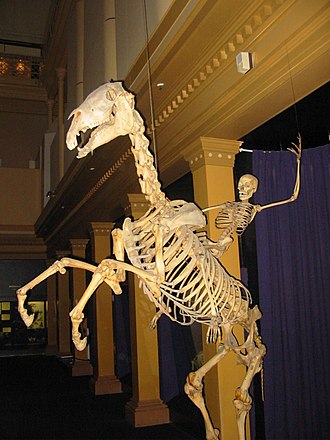
(Picture from here.)
I've been getting over an injury I got doing judo about a month ago. So, of course, I started thinking about bones.
The skeleton is one of our most obvious anatomical features. I know we can see and feel skin and eyes and hair. But the skeleton is one of our clearest examples of an anatomical system. The bones articulate. They move together. Muscles attach to them.
Where did they come from?
Well, we're vertebrates. That meas we have a dorsal notochord. There's an erroneous concept that vertebrates are animals with backbones. But that's a little tough since chondrichthyes (cartilaginous fish) don't have a "bone" in their skeleton, excepting teeth. The structural members are all cartilage, not bone. A more precise definition is that vertebrates are animals that have a vertebral column, which may or may not be composed of bone. The column is composed of different elements, called vertebrae, and house the spinal cord. And that sharks have, too.
The two great branches of fish in the vertebrates are the chondrichthyes and the osteichthyes. And that's where mammalian heritage of bone begins. We are descended from the osteichthyes and the hard, calcium rich substance has been with us since.
Fish evolved cartilage before they evolved bone. The cartilaginous fish evolved into two groups: Agnathostomata (fish without jaws) and the Gnathostomata (fish with jaws.) Agnathostomata include such pleasant fish as lampreys and hagfish.
The Gnathostomata are no stranger to bone. Placoderms showed up over four hundred million years. Some species have bone; some do not. The bones serve as armor, teeth or other purposes. They do not server as structural members. That came later.
The critical feature of bone is the mineralization of the softer tissue. At some point, we developed the ability to impregnate that nice soft tissue with rock. More importantly, we impregnated particular tissue with rock. Structural tissue. Cartilage, though, is crucial. The processing of cartilage is a necessary precursor to bone growth-- mice grown without crucial genes involving cartilage development lack bone. (See here.)
So, how did mineralization get going.
Well, about 1.5 billion years ago a tremendous amount of Calcium Carbonate (CaCO3) were washed into the oceans from volcanic and other sorts of tectonic activity. So many organisms took advantage of this new found chemical trove. A lot of weird animals in the Cambrian showed up a bit more than .5 billion years ago. Animals that wore their skeletons on the outside.
A skeleton, inside or outside, soft or hard, gives muscles something to pull against. The structural skeleton can be made out of enclosed water, cartilage, other muscle or bone. The important thing is to give a rigidity to the structure so that organized movement can occur-- at least more than squishy oozing along.
We had, back then, no shortage of skeletons on the outside. This should not come as any sort of surprise. Lots of animals had hard outer bits. Clams, for example, Growing hard bits on the outside was relatively common. So it doesn't seem all that hard to put hinges between the hard bits and get crustaceans and trilobites.
Vertebrates belong to the phylum Chordata, animals with notochords. We have notochords, too. Inside our vertebral column. We like to call it a spinal cord. What's different about chordates is they put their notochord on the dorsal (back) side instead of the belly side. Very early on, we wrapped that notochord with vertebrae and we were off. The skeleton evolved from the vertebrae. Consequently, our skeleton evolved from the inside out while the other animals with hard parts evolved their skeleton from the skin inward.
All of the animals at that time with moving hard parts refined them. We end up with shrimp, crabs and the afore mentioned trilobites. Back in vertebrate company, we evolved fishes, fishes with jaws and jawed fish with bony armor. But no mineralization of the structural members.
One big shift in the vertebrate world was to shift from our friend calcium carbonate, so beloved by our exoskeletal brothers, to calcium phosphate. (CaPO4). This was in the form of calcium hydroxyapatite. (Ca5(PO4)3(OH))
Why change strategies when calcium carbonate had been around for a long, long time?
One idea was that the original use of calcium phosphate wasn't as bone at all. Instead, it was a storage mechanism of phosphorus-- often a biochemical limiting factor. Anyone who has used phosphate based fertilizer knows its utility. ATP/ADP (adenosine tri-phosphate and adenosine di-phosphate) are the way the cell stores and release energy. That P in the abbreviation is for phosphorous. But as nice as this is, why did vertebrates evolve it and not invertebrates? After all, it would have been good for both. It could be that the change to phosphorous was for a wholly different reason and the storage advantage was a happy accident.
Another idea derives from vertebrate activity. From the fossil record and from observation of vertebrate animals in the wild, it looks like we're active creatures. We don't sit around. We run. We hunt. We don't sit and wait for our food to come for us. We go and get it. One of the side effects of this activity is a change in pH-- the acid or base values of the tissue. Calcium carbonate is much more soluble material than calcium phosphate. Consequently, fish that tried to swim hard could find their hard bits not so hard.
The first structures resembling bone we find in the fossil record are teeth or teeth like structures. They are with us to this day. Sharks have teeth. Lampreys have teeth. Teeth are a bit different from normal bone. Both bone and teeth are calcium phosphorous structures but teeth are much harder than bone. But bones can heal. Teeth can't. However, the biochemical structures are close enough that one wonders if the biochemical pathway that brought forth teeth was torqued a bit to bring forth bone.
There are also teeth like structures in the skin to form shields. Remember placoderms? One of the arguments in paleontology is which came first? Teeth or shields? Genetically, they appear to derive from the same source.
Early skeletons were cartilaginous but were not based on collagen, the primary structural protein in connective tissue. Later, when collagen evolved, it was used in the skeleton such as those involving sharks and such. It fell to the ancestors of the bony fishes to invent ossification.
There are two mechanism of ossification: intramembranous ossification, where the bone is laid down directly into connective tissue, and endochondral ossification, where cartilage serves as a template for the bone. Intramembranous ossification happens in bone repair and in the early construction of certain head structures. Endochondral ossification is how the skeleton gets formed.
It didn't happen all at once. Apparently, endochondral ossification started with surrounding connective tissue-- biochemically similar mechanisms for embedding bone in the skin. Eventually, the process of cartilage replacement occurred. How this occurred. There is fossil evidence that early sharks had the ability to deposit bone in tissue though it was not used structurally.
There is also current evidence (see here.) that some sharks can mineralize cartilage in a similar way to how bony fish do it. That said, is this development that occurred since sharks diverged from the rest of the fish? After all, the biochemical means by which mineralization occurs is very old in the vertebrate family tree-- recall our constant friend, the placoderm. And the mechanism for laying down a supportive skeleton is represented in both the boney and cartilaginous fish. We often look at what we call primitive animals and forget that they've been around just as long as we have with just as nasty and powerful selective pressures on them. Sharks diverged from our line 400 million years ago. But they haven't been sitting around since then. They've been evolving, too.
Once structural mineralization occurred, though, the advantage it gave was tremendous. It enables fish to swim fast. In fact, the cartilaginous fish have to derive structures analogous to bone in order to get that upper speed.
Marlins, for example, have a bony skeleton stiffened not only by having just a few vertebrae but also by strapping those vertebrae together with bony strips and ropes of connective tissue. Mako sharks are similarly fast but don't have any such things. How do mako sharks swim fast? They increase their internal pressure against a skin which does not stretch. In this way they mimic what the marlin does. Essentially, they create a fluid skeleton to make up for any deficiencies in their skeleton.
Not to mention that a mineralized skeleton set the stage for invading the land. There are a lot of reasons even an average sized vertebrate dwarfs the largest land invertebrates that ever lived. Skeletal scaling is one of them.
Which brings me back to my ankle. I wish its intramembranous ossification process would get its act in gear.
Sunday, September 21, 2014
Consideration of Works Past: Farnham's Freehold
(Picture from here.)
I've been avoiding writing this post for a bit now. Heck, I've been avoiding reading Farnham's Freehold for a while now. There is a whole lot of controversy on that book. While race showed up regularly in his work, FF was the only book where he attempted to actually confront it.
There was a controversy about Podkayne of Mars. It is nothing compared to the controversy around Farnham's Freehold.
Spoiler alert: it's a bad book and not worth re-reading.
But not for the reasons one might think. Or, at least, not solely for those reasons.
Here's the plot, FF's main protagonist is Hugh Farnham, a self-made millionaire. He's one of Heinlein's Perfect Men: He's older, handsome, able to shoot a gun and appreciate a Picasso, incredibly wise-- so wise that everyone defers to his wisdom even when they completely disagree with him. So intelligent that other people appear stupid around him-- wait a minute. Other people are stupid around him. Farnham has a reasonable IQ and everyone else is a Delta Moron. Did I pick up Idiocracy by mistake? Nope. Heinlein's name is on the front page and it's a book, not a movie. Hm.
Anyway, Farnham has built the worlds greatest fallout shelter in his basement and, because Farnham is always right, a nuclear holocaust occurs. They all go to the shelter: Hugh, his worthless son, Duke, his whiny useless wife, Grace, his somewhat useful daughter, Karen, Karen's hot friend, Barbara, and Hugh's black servant, Joe. All of them act out all sorts of Generation of Vipers shtick to show how smart Hugh is and how callow everyone (but Barbara and Joe) is. Everyone goes to sleep except Hugh and Barbara. And they have sex. After all, what should a twenty-something beauty do during the apocalypse than have sex with her grandfather?
The big one hits and blows them forward in time a thousand years. They don't know this originally. They just know that they're in exactly the same spot as they were but everything is beautiful and rustic.
They eke out the pioneer life with Hugh as boss. Karen is also pregnant-- predating nuclear holocaust because, well, reasons. Hugh will not consort with Barbara because he is an Honorable Man and still married to whiny, bitchy Grace. So it looks like it's going to be a Karen/Joe and Barbara/Duke future Eden. (Except that Karen tells Barbara that if Hugh would have her, she'd pick him. Incest be damned.) But Karen dies in childbirth.
Then, they are discovered by the true rulers of earth: Black People.
Turns out that Africa wasn't harmed by the nuclear exchange and ended up colonizing the USA and Europe. All white people are slaves. Our merry band of misfit toys would be slaughtered for just being there (it's a park, sort of) but for Joe. Since Joe is black, they must be his slaves and therefore they won't be hurt but Joe is held responsible.
Long story short: Hugh makes himself indispensable to the Lord Owner. (Surprise!) Grace ends up Lord Owner's consort-- which she likes. She finagles her son (Duke) to be with her but that requires Duke to be castrated. She's comfortable with that. Since he's getting good drugs, Duke is, too. It is discovered that not only have the Black Lords enslaved white people, they are eating them. White people are the main meat staple of the culture. For thousands of years. I'm guessing cows, pigs, chickens, kangaroos, armadillos, dogs, cats, possums and rats were in short supply.
Got to say this about human beings. We're as hard to kill (and as uplifting) as a cockroach.
Lord Owner sends Hugh back to his own time with a device to make it accurate so he can commercialize it. Hugh, of course, dumps the device. They find a mine shaft and stock it in the time they have left and then sweat out the apocalypse with the idea they will be able to change the future. Or it's a parallel world. Something. Afterwards, they make themselves into good frontiersman libertarians. The end.
Okay. That took longer than it should have.
Here's what I think Heinlein was trying to do. And I'm being charitable here. So don't shoot me. I think Heinlein was less malicious than he was inept.
First, I think deep in the abscesses of Heinlein's mind he was thinking that he really wanted to treat any black characters as he would treat any other character. He probably thought the sameness was a virtue. I'm sure he thought he was combating racism. Hugh had to be white-- he was espousing all of Heinlein's pet ideas. He was, in effect, Heinlein himself: he had to be white.
He wanted to put his white characters in a position of oppression-- a role reversal. That's obvious enough. Black/White role reversal to combat racism has a long history from Watermelon Man (Godfry Cambridge) to White Man's Burden (Travolta/Belafonte) to John Howard Griffin's Black Like Me. (The book, not the movie made from the book.) One cannot fault Heinlein for attempting something difficult in a noble cause. One can fault him for doing it badly.
But he had a problem: Hugh has to be right. This is the salient point of the entire novel. Hugh is always right. But he's white so if the oppressors are black, Hugh is not going to get much traction. Hence, Joe was born. Joe could have been a partner. A colleague. A friend-- but the structure of the novel prohibits that. Hugh can have no peer. Joe could have been family but Heinlein wasn't that progressive. So Joe is a servant.
Later in the novel Joe ends up throwing in with the black aristocracy. There's a rather good scene where Hugh upbraids him for doing so. Joe responds that until Hugh has tried to hitchhike in Mississippi, he has no understanding of the situation. It is likely the sole place in the book where somebody stands up to Hugh and isn't immediately forced to admit the error of his ways.
And that example is one of a few things where I think the book was on point. Joe owed Hugh (or Heinlein) nothing. Shoes on the other foot: fine. We can't all be saints and it's clear in the context of the book that Joe is trying to get them as good a deal as he can get within the limits of the culture he's in and without sacrificing his own neck.
You can make the argument that the blacks were merely white men with black skins. I can see that. The book takes place thousands of years in the future so I would not expect future blacks to resemble current African American culture. You could make the argument that Joe, being a representative of current African American culture should actually resemble said culture. But Joe is on camera so seldom compared to the white folks he scarcely gets the chance. You could make the argument that Joe, being second only to Hugh in importance of the frontier family's survival and probably the second most important character in the book should have a lot more camera time.
Yeah, you could.
Which brings me to the real problem with the book. Yes to a lot of the criticism of it. Yes it handled race badly. But the core issue of the book is that it is inept. It's clumsy. It stumbles. It's broken. It should have been pulled by the editors as a bad book. Not a controversial book.
Like the whole cannibalism thing. Okay, Heinlein was probably thinking that slavery consumes people's soul. So it's a metaphor for what slavery does to the human spirit.
Come on, Bob. This book was published in 1964. I surmise it was written in 1963. King's I Have A Dream speech, Bob. The Medger Evers murder, Bob. The Birmingham Campaign, Bob. The Birmingham Church Bombing, Bob. Hell, I was an eleven year old kid in Thousand Oaks, California, and I heard about these things. Do you think that maybe, just maybe, a book where a black aristocracy is literally eating white human flesh could be, oh, misinterpreted?
Like Barbara, and every other woman that shows up in the book (with the exception of his wife) wanting to sleep with Hugh. Including his own daughter. I mean, Heinlein's view of women in this book is little more than sex kitten/breeders but even in that context that's a bit much.
(It would be an interesting thought experiment to rewrite the book from Grace's point of view. Hugh is every bit the despicable villain Grace thinks he is. He connives what he does and makes good sounding excuses afterwards. He built the fallout shelter because of a sick, paranoid fantasy. The fact the nuclear annihilation actually occurs is a coincidence. She is sick and distraught at what she has to do to save herself and her son, viewing the role Lord Owner's consort as consent to rape. Pretty much what every slave woman submitting to master probably thought. That it would have been better to die in the nuclear fire than to have to live here under these circumstances, under these rules. To have Karen think about having sex with Hugh to appease him. Barbara having to view her coming child as a brutal compromise for survival. But I digress.)
Like vast numbers of pages taken up describing interminable hands of bridge. Pages. People agonizing over decisions they made. In bridge.
The book was published in 1964 sandwiched between Podkayne of Mars and The Moon is a Harsh Mistress. I commented on Podkayne here. Podkayne has its problems. Harsh Mistress is, in my opinion, Heinlein's best adult book. It's flawed but he manages to pull everything he's ever tried to do together in one book. I think it works though it is a product of its time. One of these days I'll put up a post justifying my opinion.
Harsh Mistress is followed by I Will Fear No Evil, which I had considered the worst Heinlein book I had ever read until I reread Farnham's Freehold. Clearly, it was the beginning of the end.
What I was hoping to find was a book where a writer whose work I respect had come out swinging at a subject few in SF were considering in 1964. A swing and a miss is still a swing. What I found was a boring slog through the mud. The game was rained out long before it ever had a chance to start.
Sunday, August 31, 2014
Falling into Harvest
(Picture from here.)
It's harvest season on our little microfarm. Nanofarm? Postage Stamp Farm? That might be a good name for the place.
We have two gardens. The main one south of the house and the east garden where the turtles live. Yes, we have livestock. We grow turtles. And chickens, but the chickens give us less trouble. There's a long and sordid history on how we got into raising turtles but it boils down to not wanting the pet trade to decimate animals we like. Turns out from capture to pet store takes a toll on wild animals. So we got into breeding them to compete with the captors. But that's a long story for another post.
Besides, they love to eat slugs. The turtle garden is always slug free.
South of the turtle garden are a grape arbor and two fruit tree espaliers. Moving west we hit the plum espalier and the persimmon tree to reach the main garden. South of the main garden is a small grove of fruit trees planted this year. Moving further west to the south forty is another couple of grape arbors and the leek, scallion, garlic and green onion beds. Moving north from there, next to the house is the west espalier-- a Belgian fence style. Continuing north, behind the house, is the greenhouse.
Everything was hammered this year by caterpillars. We got one-- count 'em, one-- apple on the Granny Smith. We didn't even get many blossoms. Ditto the plums. We did well on peaches and pears-- though we had to harvest the pears early. A local nest of carpenter ants learned a new trick. The found a pear, ate a hole and proceeded to mine the pear through the hole leaving a husk. I have to find the nest. I have blood in my eye and no carpenter ant will be left unscathed.
We had a number of blossoms on the apricot and nectarines but no fruit set on the apricots and we got little on the nectarines-- four, to be exact. I think the same caterpillar problem.
We have grape vines that are good producers: the marechal fochs and the concord. This spring I cut back both fairly hard and they seemed to thrive on it. Looks like we're going to get a good harvest. The marechal looks like it should be harvested in a week or so and the concord is just starting to purple.
For the last ten years or so I've had an impossible project I've been working on: creating a drinkable concord wine. It must be dry with a hint of concord but no trace of the evil solvent taste concord is known for. I've been having some success. I'm hoping this will be a good year.
The marechal looks to be a good harvest as well. In the last few years I've been in state of war with the yellow jackets. This wasn't helped by the size of the marechal vine. It had become so big that different sections matured at different times-- hence the major cut back.
We didn't have a good year for plums and apples as I said so I won't talk about the espaliers much. The persimmon looks to be a great harvest. The tree is laden with fruit. Of course, it's over a month away and anything can happen.
We moved some trees from the Belgian fence: two filberts and a mulberry. Both were just too vigorous. This is their first year in the new spots so it's a wait for next year scenario. But all the plants seemed to recover well in their new locations. We got a few mulberries but no sign of filberts.
This has been an terrible year for deer. For the first time the deer have decided the main garden, and the adjacent new fruit trees, are one long buffet table. We put up an electric fence a couple of weeks ago and this has discouraged them from the garden. The new trees are hurting. I'll have to put up a cage of some sort to protect them.
We had a good peach harvest but I got lazy and didn't thin them enough so some of the branches of the tree were just too heavy and suffered. We took the result and made peach fruit salad with melons from the garden and froze the remainder. A couple of years ago I made a nice peach wine. We'll see if I do that this year.
The greenhouse did well. We've had two large bunches of bananas that we're drying. The strawberry guavas are going to be ready in a couple of weeks. We've started trying aquaponics which has more difficulties than we perceived. Right now, the we're using goldfish for the fish part and growing vegetables. We've also attempted rice. Average rice yield in Missouri for the last five years was 6,676 pound/acre. That gives a couple of pounds a year for two crops. So we'll see.
Wendy decided that clawfoot bathtubs are the best alternative for our hydroponic attempts. This gives our greenhouse an... eclectic look.
Which leaves the gardens.
We got a good crop of cantaloupes and honeydew but not so great on actual watermelons. This year we tried putting down the black plastic and that seemed to help.
Wendy and I have been gardening at the house since 1993 and in Watertown for several years before that. Wendy's been gardening in New England since she was a child. So we have a good idea of what summer's are supposed to bring. Typically, it has been cool to the possibility of freezing up to Memorial Day. Warming to hot by the end of June. Hot through July and early August. Latter August if variable but by Labor Day things start to cool off. Normally, there's no frost in September but there is some possibility of frost by Halloween. That was the norm until about seven or eight years ago.
Then we started seeing a shift. First, there were wet, cool Junes. Then, we started seeing Hammer of God
heat waves in early May. The apricots would blossom up and then get hit by a frost.
The last couple of years we have seen the HOGs, wet stretches of June, hot Julys and, this year, a cool August. Lots of chaos. That's exactly what the global warming models say: more chaotic behavior. So Wendy and I are adapting like a microcosm of the rest of the world.
So, now we're looking at different varieties that can cope. Some of the heirlooms we've liked in the past can't cope with the variability over the summer. We're trying some new things. This year we're trying yacon, a Peruvian tuber.
We all have to learn to be adaptable.
Sunday, August 10, 2014
Consideration of Works Past: The Door into Summer/Double Star
(Pictures from here and here.)
My two favorite Heinlein novels have always been The Door into Summer (1957) and Double Star (1956).
The reasons for this have changed over the ears. TDIS was not one of his most popular novels-- one critic suggested that this was a novel where the commentary by the narrator was the best part. DS, on the other hand, has been roundly praised over the year and won Heinlein's first Hugo.
TDIS is about Dan Davis, an inventor and engineer who is bilked of his company, his livelihood and his fiance by is friend and... his fiance. The love of his life manages to swindle him out of everything. He's about had it and is planning to take the Long Sleep (suspended animation) for thirty years when he bucks up and confronts his partner and his partner's wife-- the fiance mentioned before. They drug him and manage to put him in cold sleep anyway and he wakes up thirty years later.Davis likes the future and manages to make a place for himself. But he discovers he can go back in time and rectify the situation. He does and then returns back to his new home-- the future-- via a second cold sleep.
Double Star has a completely different story. DS is about Lawrence Smythe, known professionally as The Great Lorenzo. Turns out there is a popular politician that has a resemblance to him: John Bonforte. Said politician has been kidnapped on the eve of an important ceremony for the martians. The ceremony must go on (echoing the old "show must go on" theme) so they hire Smythe to impersonate Bonforte for the ceremony. Eventually, this turns into Mother Night: beware who you pretend to be for that is who you are.
I'm not going to go into the plat synopses in detail-- that's what Wikipedia is for.
The two works had an interesting history together. TDIS has never been one of Heinlein's popular novels. I'll quote Blish as quoted by Wikipedia: "It is surely an odd novel that is at its best when the author is openly editorializing...." Since normally I don't care for the odd Heinlein authorial intrusion but in this case they were fun. But they weren't true Heinlein editorializing. Davis is about as apolitical as a human being can be. He's a good engineer who is swindled precisely because he doesn't much take notice of things that are not interesting to him. Several of the "editorializing" happens when people explain things to him. Sort of like explaining things to Huck Finn in Twain's work. The author may have set it up but it's carried by the character.
Double Star, on the other hand, had significant acclaim and won Heinlein's first Hugo. Several have suggested it might be Heinlein's finest novel. Smythe is equally far from politics as TDIS's Davis, but in a different direction. Davis is a quintessential engineer. He treats the rest of the world with indifference graded to annoyance. Smythe is a consummate actor. He views the world as a stage and himself as the main character. He is flamboyant where Davis is self-contained. Outgoing where Davis is reserved. Curiously passive in what happens to him where Davis actively changes things around him. To quote Wikipedia quoting Blish again, Blish thought Smythe was "only first-person narrator Heinlein has created who is a living, completely independent human being."
From this I take that Blish knew a lot of actors and almost no engineers.
I want to be absolutely clear when I talk about the span of Heinlein's work that I stop in 1970. I don't know happened to RAH after that but it wasn't pretty and I quit reading him.
I think there is an Evil Heinlein and Good Heinlein. Good Heinlein has all of the good characterization, clever prose, humor and good ideas. Evil Heinlein pontificates on how the world ought to be, makes the women characters too stupid to breathe and takes itself very, very seriously. A work has considerable show with Good Heinlein at the helm but if Evil Heinlein gets its fingers inside there's no hope for it. After 1970, Evil Heinlein is ascendant.
So I feel differently from Blish. I tend to like Heinlein's first person narrators better than his other characters. (Podkayne excepted. See here.) Or, rather, I think Heinlein is best when working under constraints. This is why those works considered "juvenile"-- Red Planet, Tunnel in the Sky, Have Space Suit--Will Travel, Citizen of the Galaxy, etc.-- tend to have so much less Evil Heinlein in them. Since the point of view characters are essentially children or teenagers, the characters cannot be used to found Evil Heinlein wisdom. It is interesting in Tunnel in the Sky (Heinlein's answer to Lord of the Flies), the first and last chapters have Evil Heinlein in them but it is absent in the middle and largest part of the book. The middle part of the book is exclusively from pov's of the teens. A coincidence? I think not.
Double Star and TDIS have a similar constrained nature. Both protagonists are very limited in what they can perceive and understand. Because of this Heinlein is forced to treat them as human beings instead of possible channels for Evil Heinlein. Which brings Heinlein to use his powers for Good rather than Evil.
The books have both aged fairly well. As with most SF works from over fifty years ago they have to be viewed as more Alternate History than prediction. I wish we had bases on the moon in 1970. Both books have few female characters-- a place where Evil Heinlein particularly liked to get its claws wet-- so, for good or ill, that part of RAH is not fully expressed. There's a squishy bit at the end of TDIS that echoes the ending of an earlier juvenile, Time for the Stars that will make a modern reader cringe. One has to have a filter on to read a Heinlein novel with modern sensibility. I think it's still worth doing. Other mileages may differ. Double Star has no squishy bits.
Both of these books were written in the middle fifties. Heinlein was just breaking fifty himself. He'd had a really good ten years-- Heinlein's first published novel was in 1947 though he'd certainly been popular in the magazines before this. So you could say the novels between 1955 and 1961 were where he hit his stride. It's not surprising that these two books happened right then. Both were experiments in characterization. Both were experiments in narrative.
And both are my favorite Heinlein novels.
Monday, July 21, 2014
Humanizing Technology
(Picture from here.)
I'm a big fan of technology. There are technological solutions to many of the world's issues from hunger to clean water. The problems we face are usually how to get people out of the way of solving the problem rather than the problem itself.
That said, I'm definitely not a fan of humanizing technology.
Let me be very clear. I am all in favor of making technology easy. I want getting food and clean water to be so cheap and comfortable that you'd have to spend money and effort not to get it. I want to be able to ask my computational partner, think I'd like that? And have it come back to me with a cogent answer.
But I don't want it to try to act like a human being. I'm not interested in the illusion of an experiential entity.
There's a strong pursuit of this illusion going on now. The most recent one to come across my desk is Jibo, a robotic device that is intended to integrate into a family. To act in the role of a person. (See here.)
Jibo was developed by MIT's Cynthia Breazeal with the expressed intent of becoming "part of the family." (See here.) She feels emotion is the "next wave of this humanized high-touch engagement with technology."
I'm not a fan.
I like a humanized robot voice better than a voice that sounds artificial mainly because it's more intelligible. And I really like some of the capabilities advertised for Jibo. It has strong facial recognition coupled with a good camera. So it can take pictures like nobody's business. Since it can identify users, it's a no-hands portal to the net and can be a real internet helper with reminders and such. My objection isn't what it can do but how it presents itself.
For example, in the Jibo advertisement the robot does things like read a story to a child. According to the article Jibo will "put a smile on your face and make you feel better."
It worries me that someone thinks consumer machine is necessary for that.
I have a dog. It greets me when I come home and puts a smile on my face and makes me feel better. Sometimes it makes a mess. It has to be taken out and walked. If I step on its tail by accident, it yelps in pain so I musn't do that. The dog gives me a gift and requires an obligation. This is a transaction between us. This is a relationship between two experiential entities.
But Jibo is not an experiential entity. It is a machine that is intended to counterfeit the trappings of an experiential entity. It is designed to present the attributes of a relationship without the realization of a relationship.
This bothers me.
I think it's important that we understand who we're talking to. Who we're in actual relationships with. I think, for example, we should be concerned about the welfare of our children, parents and friends. The welfare of celebrities doesn't remotely interest me. I think we should concern ourselves with factual news rather then pleasant fiction. The relationships I have are with my wife, son and dog. Not my toaster. Not my microwave oven. Not my nice talking internet portal.
Fundamentally, it's a distraction. I talked about the Turing Test a while back. Turing had the idea that a device that could imitate a human being could be as intelligent as a human being. Back then most of the literature conflated intelligence with the ability to experience things. After all, how could you be smart and not experience the world?
Now we know that it is quite possible. Intelligence and experience are very separable. We can have quite intelligent systems that have zero experiential nature and really dumb systems that fool people sufficiently to be thought intelligent. In fact, some of the truly creepy ideas in SF are systems that are very intelligent in their execution of tasks without such a nature. Think of Terminator.
Or, even better, remember the old Colossus or War Games movies. Now think of them again and realize there was nothing in those machines but elaborate rules engines. Nothing inside but LEDs and a hum.
Now, if there were a person (entity, experiential organism, alien) in Jibo, I'd be all over it.
Sunday, July 6, 2014
Getting into Space
(Picture from here.)
The fundamental problem with getting into space is conservation of momentum.
Specifically, we need propellant. A space ship throw propellant out the back. Momentum must be conserved so when a mass is cast out in one direction, the ship moves in the opposite direction. Momentum is often defined in terms of mass (m) times velocity, such that:
- m(1)v(1) = m(2)v(2)
Where m(1) and v(1) are, in this case, the mass and velocity of the propellant and m(2)v(2) is the mass and velocity of the ship.
It doesn't take heavy algebra to see that if you have a low mass, high velocity propellant you can get a higher mass to move a little bit. This is, in fact, what all propellant based systems do. It's a way of getting energy translated into velocity.
But with rockets and other space ships you have to carry your propellant with you. Consequently, that mv equation becomes much more dynamic and difficult. The mass of the space ship is really the mass of the ship plus the mass of the propellant plus the mass of the machinery to store, process and inject that propellant with energy. The ratio of propellant to payload is often as much as 10 to 1. So to impart a significant velocity to a payload of one ton requires ten tons of propellant. This is the source of step rockets like the Saturn V or almost any other launch vehicle. As soon as you've used up a portion of propellant, you discard the mechanism (and parasitic mass) that delivered that propellant.
Launch vehicles use chemical reactions to impart velocity to the propellant's mass. The Saturn V used liquid oxygen and kerosene for the first stage and liquid oxygen and hydrogen for later stages. Some in-space systems use things like a Hall thruster, where an ionized gas such as argon is accelerated out the back end with electrical fields without a chemical reaction. The experimental NERVA rocket used an atomic pile to heat a propellant and release it out the aft. In all cases, the propellant had to be brought along and expended. Once the propellant was used up the space craft was unable to control itself. There are several potentially operational satellites in orbit that aren't usable because they have no attitude control: they've used up their propellant.
It's fairly clear that a real movement of humans and materials requires we reduce this problem.
There are a lot of ways to do it.
One mechanism is to remove the propulsion problem from the space craft entirely. This is the attraction of electromagnetic catapult or rail guns, solar sails, laser ignition-- all under the rubric of ground based or ground assisted propulsion. The idea is that you transfer energy and momentum from the ground to the space craft. You don't care how heavy it is on the ground. This frees the space craft to only carry what is necessary for its travel. It's hard to do this from earth: we have a deep gravity well and a thick atmosphere. A lot of easy mechanism that would work, say, on the moon, either can't overcome the gravity or can't push through the air. Which is, by the way, why I keep saying we should make a moon base our first priority. Forget Mars. Forget humans in deep space. Once you have the moon a lot of those things come for much, much cheaper.
*sigh*
It's also the reason for the attractiveness of the space elevator. Ground based propulsion-- that is, the elevator's motors are powered from the ground-- and it gets you above the atmosphere. It's also true that the top of the elevator is high enough from the earth's surface that the gravity well is considerably reduced.
But we're still stuck with the propellant problem. Our mythical deep space vehicle needs to dump something out the back end in order to move the front end.
Why can't we be like a submarine? It doesn't take water with it. Instead, it imparts momentum to the water in which it floats and thereby gets a return on momentum for itself. Why can't we do that?
This is the basis of Harold White's work at the advanced propulsion lab at NASA.
White's gotten a lot of press recently on his work on the Alcubierre drive concept-- and I'll talk about it, too, since that might someday get us out of the solar system. But his work on the "Quantum vacuum plasma thruster" (Q thruster) is much more exciting.
Remember I mentioned the Hall thruster? It's well documented and in use. The Dawn mission uses it. It's a low thrust, high efficiency system nicely designed for long term missions that require a little thrust over a long period of time. Not suitable for human spaceflight but good for many things.
If you look deep into vacuum the space is anything but empty. Virtual particles whip into and out of existence all the time. One would expect that these virtual particles-- being virtual, after all-- would have no actual effect on the real world except for the Casimir Effect. Turns out if you take two plates and put them extremely close together-- closer than a given wavelength of light. This precludes vacuum virtual particles from coming into existence of that wavelength or less. Outside the plates those particles can come into existence. This gives a density difference that can be measured as a pressure.
White's Q thruster operates on the same essential principle of plasma handling-- similar to how a Hall thruster operates-- and adds velocity to the virtual particles to give them momentum out the aft end, giving a net thrust. It is not a reactionless (or inertialess) drive. Momentum is conserved in that there is a wake of virtual particles. (Though where that momentum goes when the virtual particles disappear is a good question. One I haven't seen answered.)
He's gotten some interesting experimental results. (See here.) He's been working with the idea of getting between .4 to 4 Newtons/kW. As a thought experiment, he suggested a space mission with a 50 metric ton payload to Jupiter in 35 days-- about the same time it took Columbus to sail from the Canary Islands to the New World. The same mission to Saturn would take 70 days.
Similarly, Earth's gravitation field is about 9.8 Newtons. Reduce the payload by two thirds but keep the same power source: you have a thrust of 12 Newtons and an effective lift off acceleration of 2 Newtons: 1 kg accelerating at 2 m/s**2. Chug your way into space.
So this is very exciting. This has some proof in the lab-- White has a test harness that shows promise. But, if it pans out, it is an engineering exercise to put it into practice. 2 MW is nothing-- the solar cells on my house can do that in a few days. A tiny nuclear power plant can do that every second for years.
That's the one I'm hoping for out of White's lab. It is not (unfortunately, to me) what is getting all the publicity. That's the warp drive.
Relativity pretty much seals the deal on most ideas of faster than light travel. The speed of light in a vacuum is the iron clad speed limit of anything travelling in space. But, as the saying goes, you don't get down off an elephant. You get down off a duck. While the speed limit of travel in space is the speed of light, that says nothing of the speed of space itself.
In fact, current theoretical models of the big bang incorporate inflation, where the early universe expanded many times the speed of light. While nothing in the expanding space, light or otherwise, could have exceeded the speed of light, the relative distance between points of space was increasing at multiples of c. This gives an effective travel speed greater than the speed of light.
Miguel Alcubierre was the first physicist see the possibility of FTL travel by altering space. In 1994, he posited that if one could warp space such that it was expanded at one end and contracted at the other, the net result would be a bubble that would transit normal space at multiples of c. This has since been dubbed the "Alcubierre Drive." However, it required exotic matter, negative mass and an energy requirement that was staggering: something like the mass of the planet Jupiter converted completely into energy.
In 2011, in an exercise for the 100 Year Star Ship Conference, White looked at Acubierre's equations. He realized that they were sensitive to the geometry of the system. (Paper here.) By altering the geometry of the warp bubble he was able to drastically reduce the energy requirements from a mass the size of Jupiter to something like the mass of a Buick. This is still not a small amount of energy. The numbers being tossed are more than the energy released in the largest nuclear weapon ever built: Tsar Bomba. And it would require actually containing and using such energy.
But by scaling down the energy requirements to something imaginable, he also created a model that could, on a small scale, be testable in the lab. Currently, he, and other labs, have been attempting to determine if they can create a very small warp bubble. To determine this they are trying to change the nature of a laser interference pattern in a predictable manner. They've had some success but nothing sufficiently definitive. White has been willing to talk about his results in symposia but so far no paper has come out yet.
So we have two extremely interesting ideas that are right now being tested in the lab. The Q thrusters-- which, if they work, will pretty much open up the solar system to us-- and the warp drive that could give us the stars.
I won't live to see the warp drive in operation though I might live to see it disproved-- that would be a sad day indeed. But the Q thrusters. That could get us anywhere. That's the important research.
Further reading:
Sunday, June 22, 2014
Rotaries v Intersections, An Exercise in Analysis
(Picture from here.)
This is the sort of thing my brain does. Which probably tells you more about me than you want to know. Indulge me. Next time I'll talk about space drives. I promise.
I live up here in Massachusetts. When I moved up here, back in the Cretaceous, I encountered something called a "rotary." It's also called a "roundabout", "circular intersection", "traffic circle" and other names. Some of which are even printable. They took a little getting used to but I managed. The problem with Mass drivers isn't rotaries; it's that they, and the state police, view traffic rules as mere suggestions or revenue sources. No one takes them seriously.
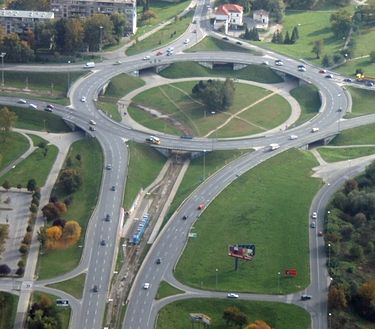
Then, in the 80s, there was a big push to get rid of rotaries. It is a certain truth in life that no intersection is so completely devoid of merit that a Massachusetts traffic engineer can't make it worse. Perfectly functional rotaries were replaced by obvious inventions of the devil. At left is a picture of what happened to the Route 2 Rotary in Cambridge. The black circle is where the rotary used to be. That mess is controlled by four barely functioning stoplights.
Get caught in this thing and kiss an hour of your life good-bye.
So, I'm driving into work today and not happy about it. To alleviate my boredom I took a back way in through Lincoln. The back way goes through a 5-points. This may be a term most people are not familiar with. It's a relic of my sordid youth in Alabama. A 5-points is a 5 way intersection. And, of course, there was little or no understanding by the drivers of who has which turn. I got through that and mused on intersections all the way in.
It came to me that intersections have an ascending complexity rule. It's an easy one to formulate. Let's consider the simplest intersection, a straight line with a stop sign. No cross streets.
Since the road is bi-directional, two drivers have to be considered. So each driver has exactly one choice. This is a complexity level of two. The next kind of intersection is three points. Each driver has to consider two choices. This gives us a rule of:
C = R * (R-1), where R is the number of roads coming into the intersection and C is the complexity level.
This number goes up fairly quickly. For R = 3, the C value is 6. For R = 4, the C value is 12 and for my favorite, the 5-points, the C value is 20. If you graphed this it would look like an ascending curve.
Rotaries have a different rule. Each entry at a rotary has, in effect, an R of 2. The choice is limited by 1) spreading out the intersections across the rotary and 2) determining that direction of travel in a rotary is one way. This turns the rotary into a series of R-2 intersections. The complexity of the entire rotary could be considered a sum of the R-2 intersections.
So, in this case, if we have a four way intersection, we have a complexity level of 8 as opposed to the R-4 straight intersection complexity level of 12.
Notice that while the curve for a linear intersection is an ascending curve, the increasing complexity of the rotary is linear. This means we can add complexity to a rotary with much less impact than adding the same complexity to a linear intersection. However, it also says that for a small intersection, the complexity of a linear intersection is less or equal to a rotary.
However, rotaries were often the victim of their own efficiency. One could get on a rotary faster than one could get off. This caused nightmarish congestion. The Brits came to our rescue and redesigned the rotary in the 1960s. The big change was the addition of a precedence rule: vehicles in the rotary have priority to those outside the rotary.
(This, by the way, was always the rule in Massachusetts but drivers often had difficulty understanding it. The problem driver precedence, I think, was one reason rotaries fell out of favor.)
But there is a hidden complexity in the rotary. The 4-way intersection is intended to be traversed one at a time. Time is not a factor except as measured by the impatience of other motorists.
In the rotary, however, vehicles are on the move. Time is a significant factor. The rotary has to be sized that a given vehicle has enough time to get on and off the rotary. Ideally, this is done without much slowing down.
If we take 30 mph as an ideal speed of traversal, that's 44 feet/second. Let's allow 3 seconds at a given intersection in the rotary just to have room. That's 132 feet between intersections. A simple two road rotary would have to be 264 feet in circumference or 84 feet in diameter.
I'm not sure how to evaluate this numerically. If 30 mph is the proper speed than as the size of the rotary increases or decreases, the complexity must increase or decrease. The number of choices remains the same but the time in which to make them is a variable.
When I was visiting my home town in Missouri I saw what must be the smallest rotary imaginable. It could not have been more than 20 feet in diameter. Two cars draped across the center would hang off both ends. This little thing had four roads coming into it. If you didn't hang hard on the steering wheel, you would drive off the road. But I digress.
This is the sort of analysis engineers do on all sorts of things. There's a reason that data going across a network is called "traffic." Many of the original network topologies use road metaphors. One of the famous problems of mathematics, solved by Euler in 1735, is how to determine the optimum path to traverse seven bridges in Konigsberg. That was the beginning of graph theory. Which was the start of that map program in your smart phone.
Which could help you navigate one of the Massachusetts rotaries.
Subscribe to:
Posts (Atom)