Showing posts sorted by relevance for query podkayne. Sort by date Show all posts

Wednesday, May 26, 2010

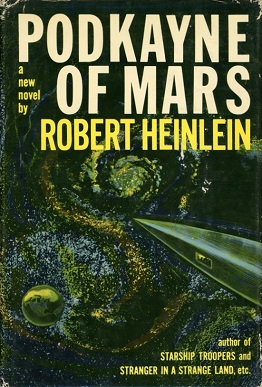
Consideration of Works Past: Podkayne of Mars


(Picture from here.)

First, let's get a few things straight. Heinlein is not God. Heinlein was a good, if pedantic writer. Like Mark Twain, he liked to pontificate in his work. Like Mark Twain, the quality of his work suffered when he indulged that predilection. Unfortunately, Twain was nine times the writer Heinlein was. Heinlein's later work degenerated into long sermons punctuated by meaningless action and pointless sex.

Podkayne is the story about a young girl about fifteen who has been raised on Mars along with her brother, Clark. Podkayne is fairly intelligent and sophisticated by Mars standards but, Mars being a frontier society, her sophistication pretty much fails outside of Mars. Her twelve year old brother Clark is considerably brighter and much less trusting. They travel towards earth in the company of her Uncle Tom ostensibly for pleasure but later it's known that Tom is on an important political trip for Mars. Things get sticky on Venus. Clark gets kidnapped. Tom gets kidnapped. Podkayne gets kidnapped. Tom is released to do their bidding. Clark develops a plan to escape. Podkayne gets trapped inside the blast perimeter of Clark's bomb.

Podkayne was written in 1962 and published, also unfortunately, in March of 1963-- eight months before the Kennedy assassination. Podkayne, as a teenager, is a late fifties early sixties girl. She wants to be a space ship captain. The pill came out in 1960. Betty Friedan's book, The Feminine Mystique, came out in 1963-- the same year Second Wave Feminism started. Consequently, any radical notions of women working in a man's world (a subtext in the book) were outdated the moment it was published and possibly before.

For example, Podkayne starts out in the beginning of the book all fired up to be a space ship's captain. Later, she admits that it's not so clear she has what it takes since her educational opportunities are limited. She considers marrying a space ship captain as a legitimate alternative to doing it herself. After all, babies are important and fun, too. She doesn't consider bettering the alternatives-- getting help from her Uncle Tom, who is an important senator, or from her possible boyfriend, who is rich beyond belief. In short, there are only two alternatives: slugging it out with a man or sleeping with him. In this, she's a fifties teenager, not the incarnation of a teen at the moment the book is written.

The ending, as published, has Podkayne in the hospital and Clark waiting for her. Clark has some hope of redemption of his sneaky and selfish ways.

Heinlein wanted the book to serve as a cautionary tale for parents that pursue their own goals at the expense of raising their children-- this is the reason for Uncle Tom's diatribe at the end of the book in the original, published ending. In his original, submitted, manuscript Podkayne died. Heinlein thought that having her die validated the rest of the book. The editors thought that killing Podkayne was a downer and had RAH change the ending. Hence, Tom's diatribe so that RAH can be sure we get the right message. RAH said that letting Podkayne live was like "revising Romeo and Juliet to let the young lovers live happily ever after." Which captures both what he thought of the required change and who he liked to compare himself at the same time.

From the tone above you can tell this isn't one of my favorite books.

First, the anti-parenting diatribe comes as a shock. There is no support for it in the book and since it's an add-on I need not respect it.

There are some interesting things going on, however. There's a racial subtext that apparently isn't obvious to a lot of people. I don't mean the obvious statements in the book. Tom is of Maori blood and is dark. Podkayne takes after the Norwegian side of the family and is blond. But there's a subtler, more interesting element. The very fact that Tom Fries is referred to as "Uncle Tom" cannot have been by accident. The scenes describing Pinhead the Venerian are reminiscent of southern white literature depicting black men as rampaging brutes. (See here.) There's also a scene where Podkayne reaches her limit and decides that she's going to plead with her Uncle Tom to do whatever it takes to save her. She's not proud but anything beats being tossed in the cage with Pinhead. RAH wasn't stupid. He knew what he was doing. It's not clear to me what he meant by this but it is clear he meant to something.

Finally, I'll weigh in on the ending controversy.

I read the 1995 version of Podkayne published in 1995. Apparently, there was an essay contest as to which ending was the best. The finalists were listed in the back of the book. Three versions of the ending were included in the book: the original, the first published version and an emended version combining the two.

Largely, the essays fell into "leave the original ending" camp. The biggest reasons seemed to be 1) because RAH wanted it that way and 2) reasons that RAH had given for wanting it that way. The pro essays were largely emotional of the "she's too nice to die" sort. The best essay was that Podkayne had to die because she was too stupid to live. RAH said

Which is close to what I would have said to RAH had he dropped Podkayne into our workshop.

Essentially, all of the essays, the editor and RAH himself were wrong though the "too stupid to live" essay was closest.

Consider the ending:
  1. Podkayne was out in the jungle with no hope of finding her way back.
  2. Clark gives her a tracker (essentially GPS) to help her find her way out. She loses it.
  3. Clark gives her a gun to take care of herself. She loses that, too.
  4. She doubles back to find a pet she'd left at the compound.
  5. She then gets lost and circles around in the blast area when Clark's bomb goes off. She dies/not dies depending on the version.
Yup. Too stupid to live.

But, like most problems in writing, the obvious solution (leave the original ending) is not the correct one.

It's not whether or not she dies that's the problem. It's the way the situation was set up. RAH set up a condition where her living or dying didn't matter. He had substituted sentimentality for pathos and by doing so made Podkayne pathetic regardless of what happened to her. It's a silly problem and both solutions are by their nature silly. The real solution is to change the problem.

Podkayne doesn't lose the tracker and doesn't lose the gun. She does turn around and goes after the pet. After all, how many pet owners have lost their lives returning to a burning building to save a cat or a dog? She gets the pet and runs outside but there wasn't time. She gets caught in the blast anyway. Perhaps she didn't figure the time well. Perhaps Clark's bomb went off early. Perhaps she bet poorly. Regardless, she was doing something she wanted to do and was caught by the blast doing it, not wandering in the wilderness like some lost and bawling calf.

Now, given that scenario her death (or life) has meaning. So, should she die?

I don't think so.

Forget all the issues of whether she's a role model or is too nice to die. That's all hogwash. What matters is artistic integrity.

For Podkayne to die is artistically sentimental. It's too easy. Podkayne doesn't get a chance to examine her life. (I submit that slogging through bog trying desperately to get away from a nuclear detonation isn't a good time for inner reflection.) She doesn't get a chance to open up her choices and decide her life. Nor does Clark. In either current version, neither gets an opportunity to look at themselves. RAH is giving us easy answers.

The last scene in the book would, of course, when Clark is there with Podkayne, her body burned and broken but with the possibility of recovery, and Podkayne wakes up.

I never liked Romeo and Juliet much, either.

Sunday, September 21, 2014

Consideration of Works Past: Farnham's Freehold


(Picture from here.)

I've been avoiding writing this post for a bit now. Heck, I've been avoiding reading Farnham's Freehold for a while now. There is a whole lot of controversy on that book. While race showed up regularly in his work, FF was the only book where he attempted to actually confront it.

There was a controversy about Podkayne of Mars. It is nothing compared to the controversy around Farnham's Freehold.

Spoiler alert: it's a bad book and not worth re-reading.

But not for the reasons one might think. Or, at least, not solely for those reasons.

Here's the plot, FF's main protagonist is Hugh Farnham, a self-made millionaire. He's one of Heinlein's Perfect Men: He's older, handsome, able to shoot a gun and appreciate a Picasso, incredibly wise-- so wise that everyone defers to his wisdom even when they completely disagree with him. So intelligent that other people appear stupid around him-- wait a minute. Other people are stupid around him. Farnham has a reasonable IQ and everyone else is a Delta Moron. Did I pick up Idiocracy by mistake? Nope. Heinlein's name is on the front page and it's a book, not a movie. Hm.

Anyway, Farnham has built the worlds greatest fallout shelter in his basement and, because Farnham is always right, a nuclear holocaust occurs. They all go to the shelter: Hugh, his worthless son, Duke, his whiny useless wife, Grace, his somewhat useful daughter, Karen, Karen's hot friend, Barbara, and Hugh's black servant, Joe. All of them act out all sorts of Generation of Vipers shtick to show how smart Hugh is and how callow everyone (but Barbara and Joe) is. Everyone goes to sleep except Hugh and Barbara. And they have sex. After all, what should a twenty-something beauty do during the apocalypse than have sex with her grandfather?

The big one hits and blows them forward in time a thousand years. They don't know this originally. They just know that they're in exactly the same spot as they were but everything is beautiful and rustic.

They eke out the pioneer life with Hugh as boss. Karen is also pregnant-- predating nuclear holocaust because, well, reasons. Hugh will not consort with Barbara because he is an Honorable Man and still married to whiny, bitchy Grace. So it looks like it's going to be a Karen/Joe and Barbara/Duke future Eden. (Except that Karen tells Barbara that if Hugh would have her, she'd pick him. Incest be damned.) But Karen dies in childbirth.

Then, they are discovered by the true rulers of earth: Black People.

Turns out that Africa wasn't harmed by the nuclear exchange and ended up colonizing the USA and Europe. All white people are slaves. Our merry band of misfit toys would be slaughtered for just being there (it's a park, sort of) but for Joe. Since Joe is black, they must be his slaves and therefore they won't be hurt but Joe is held responsible.

Long story short: Hugh makes himself indispensable to the Lord Owner. (Surprise!) Grace ends up Lord Owner's consort-- which she likes. She finagles her son (Duke) to be with her but that requires Duke to be castrated. She's comfortable with that. Since he's getting good drugs, Duke is, too. It is discovered that not only have the Black Lords enslaved white people, they are eating them. White people are the main meat staple of the culture. For thousands of years. I'm guessing cows, pigs, chickens, kangaroos, armadillos, dogs, cats, possums and rats were in short supply.

Got to say this about human beings. We're as hard to kill (and as uplifting) as a cockroach.

Lord Owner sends Hugh back to his own time with a device to make it accurate so he can commercialize it. Hugh, of course, dumps the device. They find a mine shaft and stock it in the time they have left and then sweat out the apocalypse with the idea they will be able to change the future. Or it's a parallel world. Something. Afterwards, they make themselves into good frontiersman libertarians. The end.

Okay. That took longer than it should have.

Here's what I think Heinlein was trying to do. And I'm being charitable here. So don't shoot me. I think Heinlein was less malicious than he was inept.

First, I think deep in the abscesses of Heinlein's mind he was thinking that he really wanted to treat any black characters as he would treat any other character. He probably thought the sameness was a virtue. I'm sure he thought he was combating racism. Hugh had to be white-- he was espousing all of Heinlein's pet ideas. He was, in effect, Heinlein himself: he had to be white.

He wanted to put his white characters in a position of oppression-- a role reversal. That's obvious enough. Black/White role reversal to combat racism has a long history from Watermelon Man (Godfry Cambridge) to White Man's Burden (Travolta/Belafonte) to John Howard Griffin's Black Like Me. (The book, not the movie made from the book.) One cannot fault Heinlein for attempting something difficult in a noble cause. One can fault him for doing it badly.

But he had a problem: Hugh has to be right. This is the salient point of the entire novel. Hugh is always right. But he's white so if the oppressors are black, Hugh is not going to get much traction. Hence, Joe was born. Joe could have been a partner. A colleague. A friend-- but the structure of the novel prohibits that. Hugh can have no peer. Joe could have been family but Heinlein wasn't that progressive. So Joe is a servant.

Later in the novel Joe ends up throwing in with the black aristocracy. There's a rather good scene where Hugh upbraids him for doing so. Joe responds that until Hugh has tried to hitchhike in Mississippi, he has no understanding of the situation. It is likely the sole place in the book where somebody stands up to Hugh and isn't immediately forced to admit the error of his ways.

And that example is one of a few things where I think the book was on point. Joe owed Hugh (or Heinlein) nothing. Shoes on the other foot: fine. We can't all be saints and it's clear in the context of the book that Joe is trying to get them as good a deal as he can get within the limits of the culture he's in and without sacrificing his own neck.

You can make the argument that the blacks were merely white men with black skins. I can see that. The book takes place thousands of years in the future so I would not expect future blacks to resemble current African American culture. You could make the argument that Joe, being a representative of current African American culture should actually resemble said culture. But Joe is on camera so seldom compared to the white folks he scarcely gets the chance. You could make the argument that Joe, being second only to Hugh in importance of the frontier family's survival and probably the second most important character in the book should have a lot more camera time.

Yeah, you could.

Which brings me to the real problem with the book. Yes to a lot of the criticism of it. Yes it handled race badly. But the core issue of the book is that it is inept. It's clumsy. It stumbles. It's broken. It should have been pulled by the editors as a bad book. Not a controversial book.

Like the whole cannibalism thing. Okay, Heinlein was probably thinking that slavery consumes people's soul. So it's a metaphor for what slavery does to the human spirit.

Come on, Bob. This book was published in 1964. I surmise it was written in 1963. King's I Have A Dream speech, Bob. The Medger Evers murder, Bob. The Birmingham Campaign, Bob. The Birmingham Church Bombing, Bob. Hell, I was an eleven year old kid in Thousand Oaks, California, and I heard about these things. Do you think that maybe, just maybe, a book where a black aristocracy is literally eating white human flesh could be, oh, misinterpreted? 

Like Barbara, and every other woman that shows up in the book (with the exception of his wife) wanting to sleep with Hugh. Including his own daughter. I mean, Heinlein's view of women in this book is little more than sex kitten/breeders but even in that context that's a bit much.

(It would be an interesting thought experiment to rewrite the book from Grace's point of view. Hugh is every bit the despicable villain Grace thinks he is. He connives what he does and makes good sounding excuses afterwards. He built the fallout shelter because of a sick, paranoid fantasy. The fact the nuclear annihilation actually occurs is a coincidence. She is sick and distraught at what she has to do to save herself and her son, viewing the role Lord Owner's consort as consent to rape. Pretty much what every slave woman submitting to master probably thought. That it would have been better to die in the nuclear fire than to have to live here under these circumstances, under these rules. To have Karen think about having sex with Hugh to appease him. Barbara having to view her coming child as a brutal compromise for survival. But I digress.)

Like vast numbers of pages taken up describing interminable hands of bridge. Pages. People agonizing over decisions they made. In bridge.

The book was published in 1964 sandwiched between Podkayne of Mars and The Moon is a Harsh Mistress. I commented on Podkayne here. Podkayne has its problems. Harsh Mistress is, in my opinion, Heinlein's best adult book. It's flawed but he manages to pull everything he's ever tried to do together in one book. I think it works though it is a product of its time. One of these days I'll put up a post justifying my opinion.

Harsh Mistress is followed by I Will Fear No Evil, which I had considered the worst Heinlein book I had ever read until I reread Farnham's Freehold. Clearly, it was the beginning of the end.

What I was hoping to find was a book where a writer whose work I respect had come out swinging at a subject few in SF were considering in 1964. A swing and a miss is still a swing. What I found was a boring slog through the mud. The game was rained out long before it ever had a chance to start.

Sunday, August 10, 2014

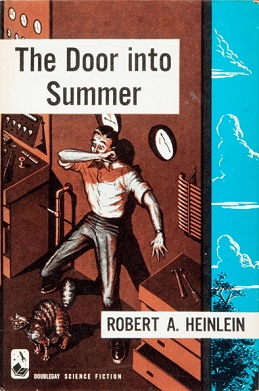
Consideration of Works Past: The Door into Summer/Double Star


(Pictures from here and here.)

My two favorite Heinlein novels have always been The Door into Summer (1957) and Double Star (1956).

The reasons for this have changed over the ears. TDIS was not one of his most popular novels-- one critic suggested that this was a novel where the commentary by the narrator was the best part. DS, on the other hand, has been roundly praised over the year and won Heinlein's first Hugo.

TDIS is about Dan Davis, an inventor and engineer who is bilked of his company, his livelihood and his fiance by is friend and... his fiance. The love of his life manages to swindle him out of everything. He's about had it and is planning to take the Long Sleep (suspended animation) for thirty years when he bucks up and confronts his partner and his partner's wife-- the fiance mentioned before. They drug him and manage to put him in cold sleep anyway and he wakes up thirty years later.

Davis likes the future and manages to make a place for himself. But he discovers he can go back in time and rectify the situation. He does and then returns back to his new home-- the future-- via a second cold sleep.

Double Star has a completely different story. DS is about Lawrence Smythe, known professionally as The Great Lorenzo. Turns out there is a popular politician that has a resemblance to him: John Bonforte. Said politician has been kidnapped on the eve of an important ceremony for the martians. The ceremony must go on (echoing the old "show must go on" theme) so they hire Smythe to impersonate Bonforte for the ceremony. Eventually, this turns into Mother Night: beware who you pretend to be for that is who you are.

I'm not going to go into the plat synopses in detail-- that's what Wikipedia is for.

The two works had an interesting history together. TDIS has never been one of Heinlein's popular novels. I'll quote Blish as quoted by Wikipedia: "It is surely an odd novel that is at its best when the author is openly editorializing...." Since normally I don't care for the odd Heinlein authorial intrusion but in this case they were fun. But they weren't true Heinlein editorializing. Davis is about as apolitical as a human being can be. He's a good engineer who is swindled precisely because he doesn't much take notice of things that are not interesting to him. Several of the "editorializing" happens when people explain things to him. Sort of like explaining things to Huck Finn in Twain's work. The author may have set it up but it's carried by the character.

Double Star, on the other hand, had significant acclaim and won Heinlein's first Hugo. Several have suggested it might be Heinlein's finest novel. Smythe is equally far from politics as TDIS's Davis, but in a different direction. Davis is a quintessential engineer. He treats the rest of the world with indifference graded to annoyance. Smythe is a consummate actor. He views the world as a stage and himself as the main character. He is flamboyant where Davis is self-contained. Outgoing where Davis is reserved. Curiously passive in what happens to him where Davis actively changes things around him. To quote Wikipedia quoting Blish again, Blish thought Smythe was "only first-person narrator Heinlein has created who is a living, completely independent human being."

From this I take that Blish knew a lot of actors and almost no engineers.

I want to be absolutely clear when I talk about the span of Heinlein's work that I stop in 1970. I don't know happened to RAH after that but it wasn't pretty and I quit reading him.

I think there is an Evil Heinlein and Good Heinlein. Good Heinlein has all of the good characterization, clever prose, humor and good ideas. Evil Heinlein pontificates on how the world ought to be, makes the women characters too stupid to breathe and takes itself very, very seriously. A work has considerable show with Good Heinlein at the helm but if Evil Heinlein gets its fingers inside there's no hope for it. After 1970, Evil Heinlein is ascendant.

So I feel differently from Blish. I tend to like Heinlein's first person narrators better than his other characters. (Podkayne excepted. See here.)  Or, rather, I think Heinlein is best when working under constraints. This is why those works considered "juvenile"-- Red Planet, Tunnel in the Sky, Have Space Suit--Will Travel, Citizen of the Galaxy, etc.-- tend to have so much less Evil Heinlein in them. Since the point of view characters are essentially children or teenagers, the characters cannot be used to found Evil Heinlein wisdom. It is interesting in Tunnel in the Sky (Heinlein's answer to Lord of the Flies), the first and last chapters have Evil Heinlein in them but it is absent in the middle and largest part of the book. The middle part of the book is exclusively from pov's of the teens. A coincidence? I think not.

Double Star and TDIS have a similar constrained nature. Both protagonists are very limited in what they can perceive and understand. Because of this Heinlein is forced to treat them as human beings instead of possible channels for Evil Heinlein. Which brings Heinlein to use his powers for Good rather than Evil.

The books have both aged fairly well. As with most SF works from over fifty years ago they have to be viewed as more Alternate History than prediction. I wish we had bases on the moon in 1970. Both books have few female characters-- a place where Evil Heinlein particularly liked to get its claws wet-- so, for good or ill, that part of RAH is not fully expressed. There's a squishy bit at the end of TDIS that echoes the ending of an earlier juvenile, Time for the Stars that will make a modern reader cringe. One has to have a filter on to read a Heinlein novel with modern sensibility. I think it's still worth doing. Other mileages may differ. Double Star has no squishy bits.

Both of these books were written in the middle fifties. Heinlein was just breaking fifty himself. He'd had a really good ten years-- Heinlein's first published novel was in 1947 though he'd certainly been popular in the magazines before this. So you could say the novels between 1955 and 1961 were where he hit his stride. It's not surprising that these two books happened right then. Both were experiments in characterization. Both were experiments in narrative.

And both are my favorite Heinlein novels.