Showing posts sorted by relevance for query hancock. Sort by date Show all posts

Monday, May 24, 2021

Consideration of Works Past: Hancock and the Superhero Trope


(Picture from here.) 


A little context. Iron Man, the first entry of the Marvel Cinematic Universe, came out in the USA in May. Hancock, Will Smith’s superhero movie, came out in July that same year. No one knew at that point what a juggernaut the MCU would become, nor that eventually the Disney behemoth would be behind it. Regardless, Iron Man was a beautifully produced, well directed, finely realized superhero film. Hancock was not really a superhero film—at least not in the Iron Man mold. It was inevitable the two would be compared. Hancock was declared the lesser film. Problematic. A mess. Iron Man was praised as a terrific achievement.


Back in 2008, I wrote this entry regarding Hancock. I would have left it there but over the last couple of years with all of the fireworks over all of the different superhero movies (I’m looking at you, Justice League.)  a couple of reviewers brought out all of the old criticisms. So, I watched it again to see how it weathered.


I think Iron Man was terrific. But I think Hancock was brilliant.


Though the years have not changed my opinion, my reasons have changed.


The majority of superhero stories follow a set number of beats:

  1. Character discovers he has powers.
  2. Character discovers the nature of his powers.
  3. Character discovers the moral dimension of having powers.
  4. Character determines the path forward regarding the powers

The decisions the character makes in step 4 determine whether the character becomes superhero or supervillain. Superheroes see duty. Supervillains see opportunity. Peter Parker in MCU’s Civil War said this: “When you can do the things I can. And you don’t. And the bad things happen. They happen because of you.”

 If you look at the original Spiderman comic: Peter Parker discovers he has powers. He explores them. He does not engage with the world regarding his powers—in fact, given the opportunity to stop a criminal he opts out. That criminal kills his Uncle Ben. His guilt and responsibility for Ben’s murder cause him to become a superhero.


Not all beats happen in that order or with equal importance. The first Thor opens with him having full knowledge of his powers and their nature. But he’s a dick—so the film largely concerns itself with steps 3 and 4. The Iron Man arc through the films has Tony Stark create and extend his powers through the first couple of films. He spends the next several films exploring the moral dimension of his powers—each film changing the rules and having him adapt. By the Endgame film, Tony knows exactly who he is with relation to his abilities. I would argue his path through Endgame is the natural process of him deciding the logical end point of where those moral decisions take him.


There are several of superhero franchises in comics and two big ones in the film industry: MCU and the DC Universe with Superman and the rest. In all of them there’s a tension between character and abilities. Marvel made a decision to lean on character. DC made a decision to lean on abilities. Every now and then, DC will point out that Clark’s important memories are of Clark Kent, not Superman. But it never lasts. With Marvel, on the other hand, few people refer to Tony as Iron Man. He’s Tony Stark.


These emphases make a difference in the tone of the above beats but not their presence. They’re always there.


The reliance on these beats, and certainly the money involved, tends to make these stories keep in continuous spin. In the comics, no one stays dead and no profitable product ever ends. The DCU has certainly stayed with that idea. But the MCU has managed to kill a couple of major characters. That could prove interesting.


Enter Hancock. (Remember Hancock? This is an entry about Hancock.)


Hancock accepts that these beats occurred. But they failed. By this, I mean at some point in his life Hancock went through all of those beats and decided to become a hero—did it at least twice, according to the film. And they weren’t enough. The moral decision—by itself—is insufficient. At the beginning of the film, he’s still doing heroics but his heart isn’t in it. He’s drunk most of the time. There is no joy in his life. He is alone.


One of the most obvious comparisons between Iron Man and Hancock is that Tony Stark is loved. Oh, he’s an incredible dick. But there are people who care for him. Support him. Sympathize with him. Later in the MCU (and the DCU) the heroes themselves care for one another. Hancock has none of this.


It’s like the MCU and DCU wander across these four beats over and over: 1234, 3421, 1114, and all other combinations.


Those beats are Hancock’s past. Hancock has already learned all the lessons, fought them, rejected them, accepted them, left them behind. He’s still going through the motions—like Peter said, if you don’t, it’s on you. But it’s empty. A meaningless moral sham.


I wonder if the difference between Hancock is the perspective of age. Growing up is a continuous process of learning oneself and proving oneself. But, at some point, that learning is accomplished. That proof is done. What’s left? A joyless existence marching towards death? That’s where Hancock starts.


At the core of Hancock is the relationship between Hancock himself and Ray Embrey. Ray is one of many Hancock saves in the worst way possible—these bad saves are so common in the film that people neglect the fact of the save only to denigrate the way Hancock did it. (In this case, Ray is stuck on a train tracks. Hancock saves him by standing in the way of the train which destroys the train, the tracks, and a lot of real estate.)


But it’s Ray who realizes he has been saved, regardless of how it was done. It is Ray that reaches out to Hancock and wants what’s best for him. It’s Ray that realizes how the world is losing a remarkable human being--- Hancock’s powers are almost an aside. It’s Ray that creates a place where Hancock can find his way home. Ray doesn’t preach to him. Ray just shows Hancock things Hancock has done badly and asks: don’t you want to better?


At the core of the story is a person of abilities that is lost and a person that helps them find themselves.


See? Not a superhero story at all.

Monday, July 7, 2008

Little Heroes: Why Hancock is a Good Movie and No One Wants to Admit It

The headline is: Hancock is a lot of fun. It's not what you expect. Go see the movie.

I'm going to talk about the released version of the movie. I'm not guaranteeing I won't be mentioning spoilers.

I admit it. Stories that break the mold are meat and drink to me. I couldn't get through Lord of the Rings until I'd read Bored of the Rings first and needed LOTR to make sense of the jokes.

I also admit, freely, I will go see almost any superhero movie and am almost always disappointed with the results.

The problem with superheroes is this: the heroes are super.

Let's look at the problem. First you have a "hero"-- someone by definition outside the norm. Few of us are heroes under any circumstance. Fewer still take on the role for a career. Those that do-- policemen, firemen, etc.-- are often extremely flawed human beings. When did you last see a drama about a heroic cop that was well adjusted?

Now we add the "super" part.

We've all seen exceptional human beings: Kobe Bryant, Michael Jordan, Eliot Spitzer, John F Kennedy. We've also seen that these human beings are flawed in their own right. Superman, Batman or anyother-name-man have powers above those of moral men. Remember the Greek Gods? And what a fine and functional bunch they were, too.

So we take what is in effect divine power and weld it to mortal man and we get hypermorality. "With great power comes great responsibility." Heck. Why should we believe in divine hypermorality when the regular garden variety morality is so hard to come by?

Why have a super hero?

The comics-- the origin of the genre-- tackle it in a couple of ways. The most obvious, and most common, method is to create villains of such a caliber and scope that it takes a superhero to handle them. It didn't take long for the Joker to show up in Batman. It didn't take long for Lex Luthor to build things to take on Superman.

But this puts the whole superhero construction into an arms race between the hero and the villain. SuperGuy is just strong enough to defeat BadDude. Then BadDude gets stronger by the eating bad plums. It's curtains for SuperGuy until he figures out by eating raisins he not only gets more regular but is able to counter BadDude's bad plum power. And so forth and so on. Until we have gods, and goddesses, universes contained by vaguely humanoid beings, guys who eat planets, living planets that eat gods and badass women who will eat both, burp politely and go on looking in a different spiral arm for their next meal.

Enter the movie Hancock.

First, and most obvious from the movie trailers, Hancock isn't about a hypermoral hero. He's sort of a hero but the morality is questionable.

Second, not obvious until you've seen the movie, there is no super villain. Hancock is super. With one exception, and she's no villain, nobody else is. So all the villains are human being.The only super that Hancock fights against is Hancock.

Third, there is redemption of a sort but it's not the "with great powers comes great responsibility". It's more, "This is the thing I do. It's better if I do it and people like me than if they don't."

You can sum all this up into this theme: Play the hand you're dealt.

If you read the reviews (with the possible exception of the New York Times review) there are two things that stand out: 1) the reviewers did not have any idea of what to expect and 2) they're pissed off about it.

Me? I'll take an honest ambitious failure over a pretentious success any day.

The reviewers wanted an adventure story. A superhero story. They wanted something they could wrap their fat arms around and indulge in a little popcorn french kiss. Superhero porn.

Hancock doesn't do that. It's funny. It's rough. It's what might happen if the guy down the street you don't like because his motorcycle's too loud suddenly got super powers. Hancock is scarey. Reviewers like things to be edgey in a way they can analyze so they don't get frightened. Hancock's not interested in taking prisoners.

There are flaws in Hancock.

All hero stories (super or otherwise) have a creation myth of the hero attached. Apparently, in the screenings of Hancock there was a lot more information presented. That's largely been cut and the movie has been improved. I would have had even more mystery attached. Why should a super really understand what or how they created them? It's a trait of a lot of this sort of fiction that we know more about what's going on in the fiction than we were ever know if that fiction were to happen in real life. Hancock leans in the direction of the characters knowing no more than we would expect if the story were real-- something I'm fond of. But in my opinion they didn't go far enough.

Some of the "physics" how things work between the Will Smith and Charlize Theron could have been made more clear. I figured it out but I write science fiction. It's easy for me to make up rubber science for such things.

There are a couple of clumsy points. Charlize Theron presents herself as a housewife of sorts but when she meets Smith later as one super to another she's wearing a Black Leather Babe outfit. Bateman's character is a PR guy who's trying to save the world and failing. Theron doesn't seem to have a job. How are they managing the mortgage on that sweet California house?

But these are nits.

Hancock is to superhero films what Frank Miller's "The Dark Knight Returns" and Alan Moore's "Watchmen" is to comics. What Alfred Bester's "The Stars My Destination" is to science fiction. It takes the trope and punches a big super hole in it so we can breathe.

----------------------------------
Links of Interest
Hallucinogenic Heresy
Phoenix may die.
More on Mercury. And here.
HydroCars? Naah.
Reseveratrol: Not just for Breakfast Anymore
U.S. Not Prepared for Asteroid Strike: Duh.
SIDS mechanism suggested
Man (of sorts) gives birth to baby girl
Punk Robots Pogo for Science
The Art of Extinction
Jesse Helms Dead at 86
Is Fundamentalism Bad for your Health?
Thomas Disch Dead at 68

Monday, January 5, 2009

Back from the Grave, Ready to Party

It was a good vacation.

One of the things we got was the DVD of Hancock. I spoke about Hancock at length before but now that I've seen it again I have two additional things to say about it.

The first is that I was wrong. It is not the best superhero movie of all time. That's because it's not a superhero move. Instead, it is a movie with a superhero. Now, it is the best movie with a superhero of all time but that's sort of problematic as it is the only (to my knowledge) movie with a superhero that's been made.

Why the distinction?

I twigged to this sort of idea listening to the Julie Schwartz Memorial Lecture, featuring Neil Gaiman, the other day. Cowboy works, science fiction works, mystery works, etc., have stations of the cross in them. This is, of course, vastly oversimplified. A cowboy book, for instance, has a clear hero and villain. The hero is usually flawed in some way and often mysterious or has a troubled past. He comes into town. That's pretty much universal. See A Fistfull of Dollars, for example. The alternative plot is something comes to town to meet the hero. See High Noon. Confrontation ensues. The hero (usually) wins.

There are also cowboy movies that play against type where each station of the cross is marked by its opposite rather than the normal fare. Unforgiven is a good example.

A book with cowboys in it is significantly different. In such a work, the stations of the cross are essentially absent or reduced in scope to coincidences. A good example is E. L. Doctorow's Welcome to Hard Times. This book happens to have cowboys in it but the book is in now way a cowboy book.

This is not to say that the genre work is worse or better than the work that uses some of the trappings of the genre. It's just to say they must be judged differently.

Hancock, then, is a movie with a superhero in it. Batman: Dark Night is a superhero movie.

The second additional thing I have to say about Hancock (remember? There were two.) is perhaps one of the reasons it is not a superhero movie. To recap: Hancock is an amnesiac man with superpowers. He tries to help out but he's drunk most of the time so he's often worse than the problem. He's drunk because 1) he's miserable, 2) he doesn't know who he is and he's alone and 3) because of 1 and 2 he's an asshole. Ray, a PR guy who's trying to use his PR powers for good rather than evil, is saved by Hancock. In return, he tries to straighten Hancock. Oh, by the way, Ray is married to the other superbeing in the story but doesn't know it. Fun ensues.

The neat bit that is so important in the story is that Ray, fully normal human being, is on equal footing with the two superbeings. At no point does he act subservient. At no point does he act as if he is less important than they are-- the movis clearly stating that importance does not derive from naked power but instead comes from within. It comes home later when Hancock and Mary have a fight and express some emotions that have been bottled up between them for hundreds of years. What she is protecting is not earth. It is not some abstract concept of evil or the predations of a concrete supervillain. It is trying to preserve a bit of happiness that she has with Ray. She prefers Ray. She chooses Ray. Ray makes her happy.

Contrast this with the overblown melodrama in Dark Night. Batman can't have a relationship with a normal person because his high flung morality prevents it: it would interfere with his life's work. He's taken on that life's work because he has a grief problem anybody with a grain of counseling could help him with. But he clings to it. The world of the Batman requires the grim world of Metropolis and the psychopathic Joker. Hancock lives in the real world. That's the difference.

Well, as real a world as can have a Hancock, anyway.

=====================================================

Rovers Still Going After 5 Years!

Political Links
Franken "wins" in Minnisota? and here

Wall of Idiots
Mike Griffin's Wife Pleads for his Job
Genetic Engineering at Home
Uncomfortable Chic

Links of Interest
Science before Newton
Solar Perihelion
Best Astronomy Pictures of 2008
Biodiorama Art
DIYBio
SF in China and here
Americans Who Don't Deserve to Travel
Burning Time
Meteor Impact Killed Mammoths?
Hot Peppermint Stick Bug Action
New! Pandemic! The Board Game
Penny Postcards

DIY Links
DIY Laser Communicator
Water Rocket
Pegboard Tool Cart

Sunday, July 8, 2018

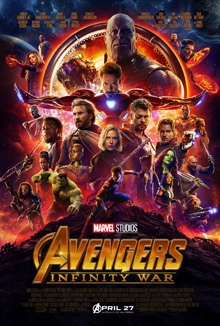
Considerations of Works Present: Avengers, Infinity War


I’m going to talk about Avengers: Infinity War root and branch. I’m going to talk about other films like it. If you don’t want to know what goes on in the film, don’t read much further.

I will say this at the outset: A:IF is a well made film and the visuals are terrific. So go see it.

SPOILERS-SPOILERS- SPOILERS-SPOILERS

There. That’s out of the way.

There’s an interesting trend in the Marvel universe that I very much like—and, in fact, see rarely in comparable films about the fantastic. That is, the stories are not about the fantastic at all. These are not films about superheroes; they are films about human beings that happen to have superpowers.
I think I first started noticing the distinction back in 2002 with Firefly. But I couldn’t have articulated it at that point. That came when I saw Hancock.

Hancock is a film where the main character, John Hancock (Will Smith) is endowed with superpowers and lives pretty much as a bum in Los Angeles. He’s an amnesiac drunk who does heroics in the worst possible way. It was poorly received. I don’t really know why—I thought it was terrific because it had no super villain. The protagonist is his own worst enemy—the story is how he figures out who he is in the absence of having any memory of who he is. Possibly the expectations were a superhero movie. What they got was a human being coping with problems who happened to have superpowers.

Now, don’t get me wrong. I hate what I call high school movies or high school television. By that I mean teenagers (or people who act like teenagers) that have angst about who they are, flip through relationships and the stories devolve into will he/won’t she fall in love? My own experience in high school was that it was a great place to escape. Adulthood was much more fun and way more complicated. Hancock had no high school and there was little romance and the protagonist doesn’t get the girl. The girl is happily married and stays that way.

So: a long path to the Infinity War.

Marvel has been building up tp A:IW for ten years. It has a main cast of maybe forty people? Fifty? If you haven’t been watching the previous films you won’t know who they are. This film is for those of us who have.

That said, how do you film a movie about forty people?

Answer: you don’t.

It reminds me of the kid’s riddle: you don’t get down off an elephant; you get down off a duck.

The film is, instead, a situational biography of the “villain” of the piece, Thanos. The forty people are the supporting cast. We learn who Thanos is. Why he’s doing what he’s doing. How he’s doing it. And how he ultimately succeeds. 

It reminded me of Spielberg’s Lincoln. Lincoln encapsulates all of the relevant biography of Abraham Lincoln in his struggle to pull together the 13th Amendment after the war is over. The action circles around that work but must reflect who Lincoln was and who the presidency and the war has made him.

Similarly, A:IF is all about the struggle of the Avengers, Guardians of the Galaxy, Dr. Strange, Spiderman and everybody else to keep Thanos from his goal: to halve the population of the universe.

(One pet peeve: I hate people talking about “the universe” frivolously. As if even someone with God Like Power could have much effect on a thing 13.7 billion years old and 91 billion light years across—and that size is only the observable universe. Make it “the galaxy” or even better “the local spiral arm.”)

Why? Because he has seen his own world and others destroyed by an ever increasing populace. He’s buying time. Not much time, either. We went from 3 billion people to 7.4 in 48 years. So, at best, he’s given the “universe” fifty years. But, hey. At least, he’s trying.

He sacrifices his daughter, his kingdom and everything he has to get there and nearly fails but ultimately succeeds and half the population disappears into smoke. He ends up resting peacefully by the side of a lake.

There’s a lot to unpack in A:IF. For example, we learn that heroes make lousy soldiers. Twice, the heroes almost win but fail due to their own inability to think strategically. The first time, they’re trying to pull the gauntlet off Thanos’ hand while he’s asleep. (Why Iron Man or Dr. Strange just cut the arm off is an interesting question.) But the emotionally overburdened Peter Quill beats on Thanos because of he murdered his love and wakes him up.

The second time is when Thor goes for the dramatic strike of his axe to Thanos’ chest. Even Thanos realizes this was a mistake: “You should have gone for the head.”

It’s Hancock all over again: there are consequences to actions and heroes don’t often consider them well. Super people are those endowed with the powers but aren't the best suited for the job.

We do learn a bit about the supporting cast—there’s a substory involving Banner and the Hulk,who is beaten to a bloody pulp by Thanos just for fun and then won’t come out regardless how much Banner pleads with him. Poor Peter Parker clearly doesn’t want to die—that’s a pretty sad scene. We might get a save from Captain Marvel but who knows how that’s going to come out?

Which brings us to the last bit about A:IF: what’s next?

I don’t mean just what’s going on in the next movie. I mean that Marvel may have done their job too well. This is good movie. It has profound implications for the rest of the Marvel Cinematic Universe. And they’ve announced three movies a year.

They’re clearly going to bring back the dead. What’s Guardians of the Galaxy without Gamora? No smoke for her: she was outright killed. Same for Loki. Same for Vision. Gamora was dumped off a thousand foot cliff. Loki was strangled. Vision had his brain plucked out.

And that’s just the onscreen killings. What about all those people smokified?

The problem is that if the Marvel brings them back cheaply it breaks the MCU. They potentially are going to use time travel but that is the cheapest of cheap solutions and I’m not sure if I’d watch any more after that.

My wife came up with a really good idea. One of the infinity stones is the “soul gem.” She thinks the smoked were pulled into the soul gem. We ran with this and came up with the idea that inside the soul gem is a whole world where the people in the gem saw the other people turn to smoke. They think their world is real. The story then when people both inside and outside of the gem begin to understand where everybody is and begin to push against the boundary. That would be fun.

That leaves the problem of the truly dead—Gamora, Loki and the Vision—as an exercise for the intelligent reader.


Wednesday, March 4, 2009

Big Head Press


As anybody who has perused my website, both of you, will know, I'm a big fan of comics and webcomics in particular. There's a new kid in town I'm quite enamored of. New to me, anyway. That's Big Head Press. I've been through two of their webcomics, one finished and one in process.

The finished one is La Muse. La Muse goes where superhero comics fear to tread. I mean, if you really were super, if you really were a god like being with incredible powers, wouldn't you do something about the world? This is where a lot of superhero comics go off the rails: the good guys in spandex need the bad guys in spandex. Otherwise, they have to really save the world. What's that going to do to the franchise? It's similar to the way Hancock worked. La Muse doesn't have any villains to fight. Just us.

The other isn't finished but has the potential to be very, very interesting: Odysseus the Rebel. Now, I have a soft spot for Odysseus. I even wrote a book (unpublished) derived from the Odyssey.

Grant and Besier have a different take on the story. Odysseus is just trying to get home. He didn't want to go to Troy. He doesn't like the gods-- if they'd leave him alone he'd be just fine.

I haven't gotten through the rest of the stories yet but I'm eager to try.
=====================================
Political Links
The Cost of Cap and Trade

Links of Interest
Cooperative Feeding Frenzy
MARS: A New Kind of Wind Turbine
The Cost of Being Baleen
Psychedelica

DIY
Greenhouse: here and here